
Arsinoe IV did not escape from Alexandria in 48 BCE. She escaped from one Alexandria into another.
Julius Caesar held only part of the city. He had fortified a section of the royal palace and the nearby harbor approaches, while Egyptian forces under Achillas controlled much of the mainland. Somewhere inside Caesar’s palace sector was Arsinoe, a daughter of the late Ptolemy XII and sister of Cleopatra VII and Ptolemy XIII. Late in 48 BCE, she got out.
Caesar’s own account says Arsinoe removed herself from the palace and joined Achillas. Cassius Dio, writing much later, gives a more specific clue: Arsinoe was not very well guarded, and her eunuch Ganymedes secretly brought her over to the Egyptians. Neither source explains the physical route.
The escape mattered immediately. Arsinoe was not merely another fugitive. She was a Ptolemaic dynast, and her arrival gave the anti-Caesar side a royal figure around whom to organize.
At a Glance
Who: Arsinoe IV, daughter of Ptolemy XII and sister of Cleopatra VII and Ptolemy XIII.
When: Probably around mid-November 48 BCE in the Roman civil calendar.
Where: Caesar’s fortified sector of the royal palace complex at Alexandria.
Custody: Guarded political containment rather than a documented prison cell.
Accomplice: Ganymedes, Arsinoe’s eunuch tutor/guardian, according to Cassius Dio.
Destination: Egyptian forces under Achillas elsewhere in Alexandria.
Immediate result: Arsinoe joined the anti-Caesar war effort; Dio says the Egyptians declared her queen.
Unknown: Exact room, gate, disguise, route, time of day, transport, and method of bypassing Caesar’s guards.
Caesar Inside the Palace
Arsinoe’s escape grew out of a dynastic crisis that Caesar had entered after arriving in Egypt in 48 BCE. Ptolemy XII had left a succession arrangement involving his children. After his death, Cleopatra VII and her younger brother Ptolemy XIII became rivals for power. By the time Caesar reached Alexandria following Pompey’s murder, Cleopatra had been driven away from the center of government, while Ptolemy XIII’s advisers controlled the young king. Caesar intervened in the dispute and attempted to impose a settlement.
The intervention did not give him control of all Alexandria. Fighting intensified around the palace and harbor. Caesar’s own Civil War describes him occupying a relatively small part of the royal palace, strengthening its defenses and using an attached theater almost like a citadel. The city was divided.
Achillas commanded the Egyptian army and gained control of most of Alexandria outside Caesar’s fortified area. Caesar held the royal sector and access to parts of the harbor, but he was effectively besieged.
That division is essential to understanding Arsinoe’s escape. Her problem was not reaching the edge of Alexandria. It was crossing from the Roman-controlled royal enclave into the Egyptian-controlled side of the same city.
What “Caesar’s Custody” Means
Ancient sources do not describe Arsinoe sitting in a Roman prison. Caesar had control of the palace sector and members of the royal family inside it. Cassius Dio later says that Arsinoe was not very well guarded, language that strongly suggests custody but also explains how departure was possible. Political containment is therefore more precise than imagining bars and chains.
Arsinoe mattered because she was a potential claimant to Ptolemaic authority. Earlier in Dio’s narrative, Caesar had included her in his dynastic settlement by assigning Cyprus to Arsinoe and her younger brother Ptolemy XIV. Once war broke out, keeping royal siblings under Roman control limited the number of legitimate Ptolemaic figures available to the opposition. Her escape broke that advantage.
Two Ancient Versions of the Escape
The closest account comes from Caesar himself. Near the end of Civil War Book 3, Caesar describes his fortified position and then says that the younger daughter of King Ptolemy, hoping for the vacant throne, removed herself from the palace to join Achillas. He immediately presents her as participating in leadership of the war. Caesar does not say how she did it.
Cassius Dio supplies the accomplice. In Book 42 of his Roman History, written more than two centuries later, he says the eunuch Ganymedes secretly brought Arsinoe to the Egyptians because she was not very well guarded. The difference in emphasis is important.
Caesar makes Arsinoe the grammatical and political actor: she leaves the palace and joins the enemy. Dio gives Ganymedes the central operational role. Neither version requires Arsinoe to be passive. A covert extraction organized by her tutor can still have been a planned political escape undertaken with her consent and ambition. What cannot be recovered is the mechanism.
There is no secure ancient account of a disguised princess passing a checkpoint, a bribed sentry, a palace tunnel, a boat crossing the harbor, or a rope lowered from a tower. Later art supplies such imagery because artists needed a scene. The ancient narratives do not.
When Did She Get Out?
The ancient authors place Arsinoe’s flight within a clear sequence but do not supply a modern calendar date. A detailed modern chronology by John T. Ramsey and Kurt A. Raaflaub places Achillas’s occupation of Alexandria on 7 November 48 BCE in the Roman civil calendar, Arsinoe’s escape around the middle of the month, Caesar’s execution of Pothinus on 17 November, and the killing of Achillas in early December. That makes mid-November a useful reconstruction, not an ancient timestamp.
The distinction matters because the Roman Republican calendar was badly out of alignment with the solar year. Converting the entry into a proleptic Julian date produces a different modern-looking month and can create more confusion than clarity. For the escape itself, the historically useful statement is simple: Arsinoe left Caesar’s custody in late 48 BCE, probably around mid-November by the Roman civil calendar.
Crossing the Political Line
The escape was complete when Arsinoe reached Achillas’s side. Cassius Dio says the Egyptians declared her queen and pursued the war with greater energy because they now had a member of the Ptolemaic family as leader. That detail explains why the escape mattered beyond Arsinoe’s personal safety.
The anti-Caesar forces already had soldiers, commanders, and control of most of the city. What Arsinoe supplied was dynastic legitimacy. A Ptolemaic princess could embody an Egyptian royal alternative to the settlement Caesar was trying to impose. This did not produce a stable partnership.
Caesar says a dispute quickly arose between Arsinoe and Achillas over leadership. The later Alexandrian War gives the conflict greater detail: Arsinoe, acting through Ganymedes, struck first and had Achillas killed. Her escape from custody had turned into a struggle for command.
From Escapee to War Leader
After Achillas’s death, Ganymedes took military command. The author of the Alexandrian War says Arsinoe herself exercised complete control without a consort or guardian while the army was entrusted to Ganymedes. Cassius Dio similarly portrays Ganymedes as assuming command after persuading Arsinoe to eliminate Achillas.
The surviving narratives are Roman and pro-Roman in different ways, and neither gives access to Arsinoe’s own voice. That limitation matters when judging motives.
Caesar says she hoped to obtain the throne. That is plausible in a dynastic civil war, but it is also the conqueror’s explanation of an enemy royal’s conduct. What can be established more securely is behavior: she left Caesar’s palace sector, joined the forces fighting him, acquired royal status among them, and participated in the removal of a rival commander. For a short period, Arsinoe’s escape made her one of the principal leaders opposing Caesar in Alexandria.
Caesar Wins
The escape did not ultimately produce an independent Arsinoid regime. The Alexandrian War continued into 47 BCE. Caesar received reinforcements, defeated the forces opposed to him, and restored Cleopatra to power alongside her younger brother Ptolemy XIV after Ptolemy XIII died during the final fighting. Arsinoe again fell under Roman control.
The Alexandrian War says Caesar decided to remove her from Egypt so that she could not become the source of renewed political dissension. This second captivity is important because it shows exactly how seriously her first escape had been taken. A Ptolemaic royal outside Caesar’s control had already become a war leader once. He did not intend to leave her in Egypt to do it again.
Arsinoe in Caesar’s Triumph
In 46 BCE, Caesar celebrated a series of triumphs at Rome.
Arsinoe appeared in the Egyptian triumph as a captive.
Cassius Dio says that the spectacle of a woman who was regarded as a queen being led in chains aroused extraordinary pity among the Roman crowd. He adds that she was subsequently released.
The scene reversed the political meaning of the Alexandrian escape. In 48 BCE Arsinoe had crossed out of Caesar’s control and emerged among the Egyptian forces as a royal leader. Two years later Caesar displayed her publicly as proof of his victory over Egypt.
Yet he did not execute her after the triumph.
Arsinoe spent the following years outside Egypt, associated in the later tradition with sanctuary at Ephesus. In 41 BCE, according to Josephus, Cleopatra persuaded Mark Antony to have her killed at the temple of Artemis there.
The later killing belongs to the long aftermath of Ptolemaic dynastic conflict rather than to the mechanics of the 48 BCE escape.
The Tintoretto Problem
Arsinoe’s escape acquired a visual life far more detailed than the ancient evidence.
Jacopo Tintoretto’s sixteenth-century The Liberation of Arsinoe imagines an elaborate rescue scene involving a tower, chains, water, a rescuer, and dramatic movement. The painting is powerful because it transforms a one-sentence ancient escape into an event viewers can see.
Historically, almost none of those mechanics are secure.
The painting was created roughly sixteen centuries after Arsinoe. It belongs to the reception of her story, not its evidentiary foundation. It cannot establish that she was chained, that she escaped from a tower, that a boat waited, or that the physical environment resembled the scene Tintoretto painted.
The contrast is useful. Art supplies what the sources withhold.
What the Sources Actually Establish
The historical core is compact.
Caesar controlled a fortified section of Alexandria’s royal palace during the developing war. Arsinoe was inside that sphere of control. In late 48 BCE she got out and joined Achillas.
Caesar says she removed herself from the palace. Dio says Ganymedes secretly brought her to the Egyptian forces because she was poorly guarded.
Those two traditions establish custody, escape, accomplice, and destination more securely than they establish mechanics.
Arsinoe remained in Alexandria. She crossed a military and political boundary within a divided city. Her arrival gave the anti-Caesar side a member of the ruling dynasty, and Dio says she was proclaimed queen. She then struggled with Achillas for control, and Ganymedes emerged as military commander after Achillas was killed.
The unknowns are equally important. We do not know the precise palace location from which she departed, the exit she used, the number of helpers involved, whether guards were deceived or avoided, how long the passage took, or what physical route brought her into Achillas’s lines.
That uncertainty does not weaken the case.
Arsinoe’s escape mattered because it converted a contained dynastic claimant into an active enemy leader. Caesar’s control of the Ptolemaic household had been a political weapon. Arsinoe and Ganymedes found a way around it.
Evidence discipline
What the record supports
Status labels distinguish secure conclusions from uncertainty and rejected claims. Color is never the only signal.
DOCUMENTED
Arsinoe IV escaped from Caesar’s control in Alexandria in 48 BCE.
Caesar’s own narrative states that she left the palace to join Achillas; Dio independently preserves the same broad event.
Sources: SRC-001, SRC-002MYTH
Arsinoe was held in a conventional locked prison cell.
The sources describe a fortified palace sector and poor guarding, not a prison cell or formal carceral facility.
Sources: SRC-001, SRC-002WELL-SUPPORTED
Ganymedes helped Arsinoe escape.
Cassius Dio explicitly says Ganymedes secretly brought her to the Egyptian side; Caesar’s earlier account does not name him at the escape point.
Sources: SRC-001, SRC-002UNKNOWN
The exact physical mechanics of the escape are known.
No secure ancient account supplies the exit, disguise, route, transport, guard encounter, or time of day.
Sources: SRC-001, SRC-002MYTH
Arsinoe escaped from the city of Alexandria.
She left Caesar’s palace sector and joined Egyptian forces elsewhere in the divided city.
Sources: SRC-001, SRC-002WELL-SUPPORTED
Arsinoe was declared queen immediately after joining the Egyptians.
Cassius Dio says the Egyptians declared her queen and fought more vigorously because they now had a Ptolemaic leader; Caesar confirms her assumption of a war leadership role without using the same formula.
Sources: SRC-001, SRC-002MYTH
Tintoretto’s rescue scene preserves the historical mechanics of Arsinoe’s escape.
The painting was created roughly sixteen centuries later and is an imaginative artistic reception, not evidence for chains, a tower, rescuer, rope or ladder, or boat.
Sources: SRC-010, SRC-011Evidence diagram
From palace custody to rebel command
Ancient sources agree that Arsinoe left Caesar-controlled custody, but differ over the agency and mechanics of her transfer to the Egyptian army.
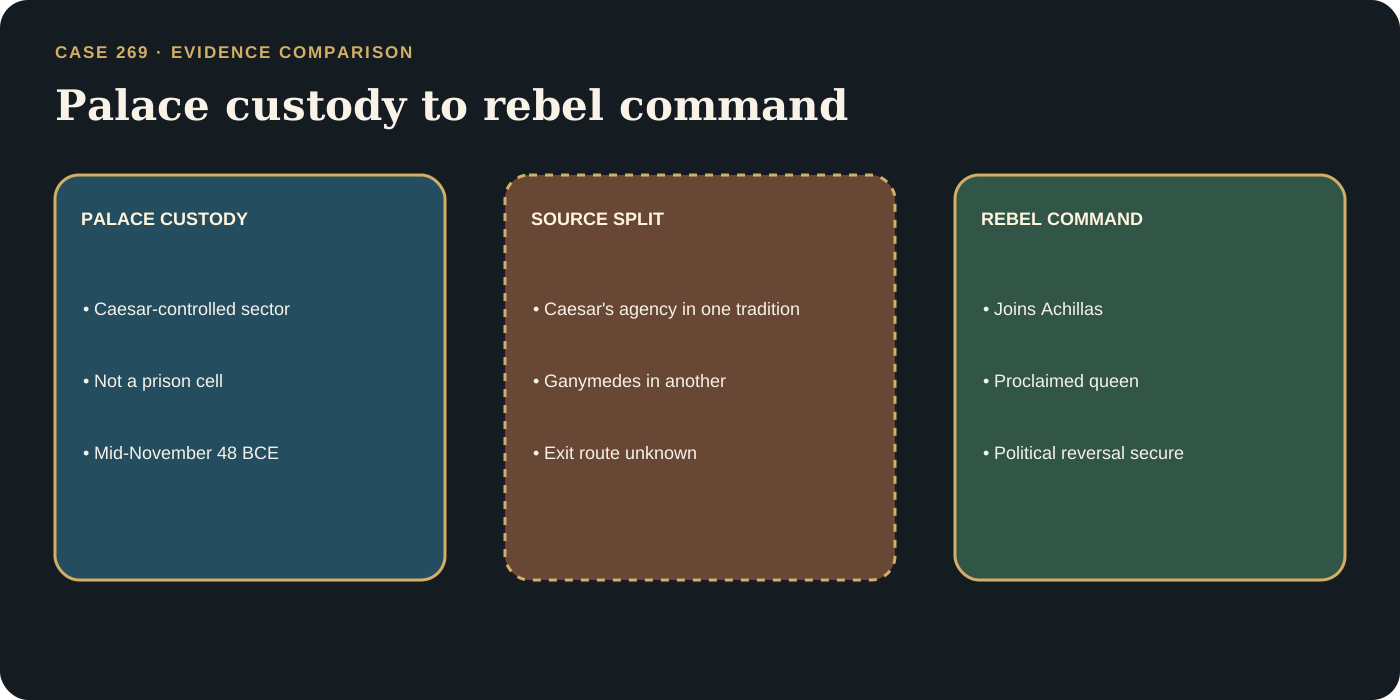
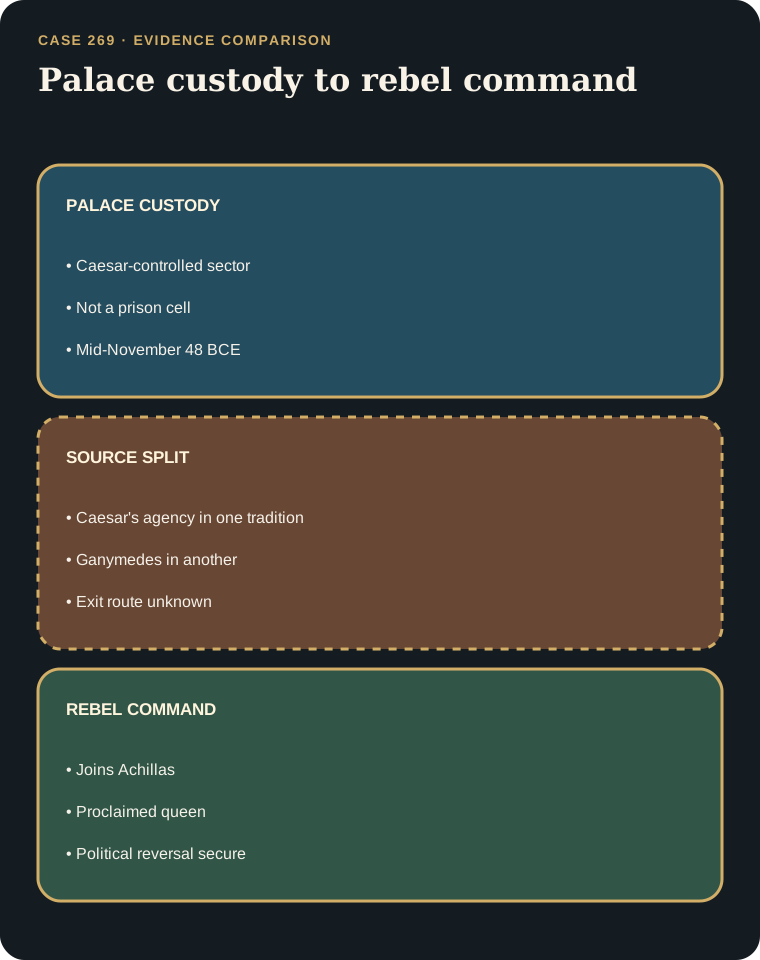
Ancient sources agree that Arsinoe left Caesar-controlled custody, but differ over the agency and mechanics of her transfer to the Egyptian army.