
The Renaissance goldsmith really did escape Rome’s papal fortress. The difficulty is separating the event from the spectacular version Cellini later wrote about himself.
From papal craftsman to papal prisoner
By 1538 Cellini was already famous in Rome as a goldsmith, medalist, sculptor, and sometime servant of powerful patrons. He also knew Castel Sant’Angelo from the other side of its walls. During the Sack of Rome in 1527, he had taken refuge there along with Pope Clement VII and part of the city’s population.
Eleven years later he entered the same fortress as a prisoner.
The charge reached back to that catastrophe. Cellini was accused of taking jewels belonging to Clement VII during the Sack. Whether he was guilty is not something the surviving evidence used here establishes, and the accusation should not be turned into a conviction by repetition.
What can be dated unusually well is the beginning of the case. A biographical study of Benedetto Conversini, the governor of Rome who handled the proceedings, places Cellini’s arrest in mid-October 1538. On October 23, Conversini ordered the seizure of Cellini’s property. On October 24, he interrogated him.
Those dates are important for more than legal chronology. They rule out one of the most repeated dates attached to the escape.
Cellini could not have escaped on Corpus Christi in 1538 because he had not yet been arrested when that feast occurred.
Material evidence
Tools of Escape
The objects used in an escape reveal how a plan worked under constraint.
- 01Core escape material
Bed-sheet linen
Cellini said he cut sheets into strips and sewed them into lengths for descent. An official Castel Sant’Angelo history independently preserves the broad sheet-rope tradition.
- 02Door preparation
Pincers
Cellini claimed that he obtained pincers from a guard, concealed them in his mattress, and used them to work on the door fastenings.
- 03Concealment
Wax and rust
According to Cellini, wax shaped and colored to resemble nail heads concealed the progressive removal of hinge fasteners.
- 04Intermediate crossing
Long pole
Cellini said a pole helped him negotiate an intermediate barrier after his first descent left him inside the fortress complex.
A privileged cell was still a cell
The official Castel Sant’Angelo account says Cellini was confined in a cell reserved for people of rank. That did not make escape simple, but it helps explain why his prison experience was not necessarily identical to that of prisoners kept in the fortress’s harshest spaces.
Cellini’s own narrative describes a period in which he could receive visitors and materials and had enough freedom inside the prison regime to observe doors, guards, and routines. A separate Treccani biography of his young associate Ascanio de Mari says that De Mari visited him twice a day during his imprisonment in 1538 and 1539, bringing him things to work on.
This is the background to Cellini’s claim that he did not improvise the escape in a single desperate night. According to the Vita, he prepared the prison itself.
He wrote that he obtained a pair of pincers from a guard from Savoy and hid them in his straw mattress. He then began drawing nails from the hinges of his door. To conceal what he had done, he said he shaped false nail heads from wax, colored them with rust, and pressed them into place so that casual inspection would not reveal the missing iron.
It is an ingenious story. It is also, at present, a later claim, not a documented engineering record.
The same caution applies to his linen. Cellini says he cut sheets into strips and sewed the strips together. That is more specific than the familiar image of a few intact bed-sheets simply knotted end to end. The Ministry of Culture independently preserves the broad tradition that his escape rope was made from sheets, so the use of bed linen is well supported. The exact cutting, stitching, length, and arrangement come from Cellini.
Escape sequence
A supported descent surrounded by memoir detail
The broad escape and linen-rope descent are well supported; much of the vivid cell preparation comes from Cellini’s later account.
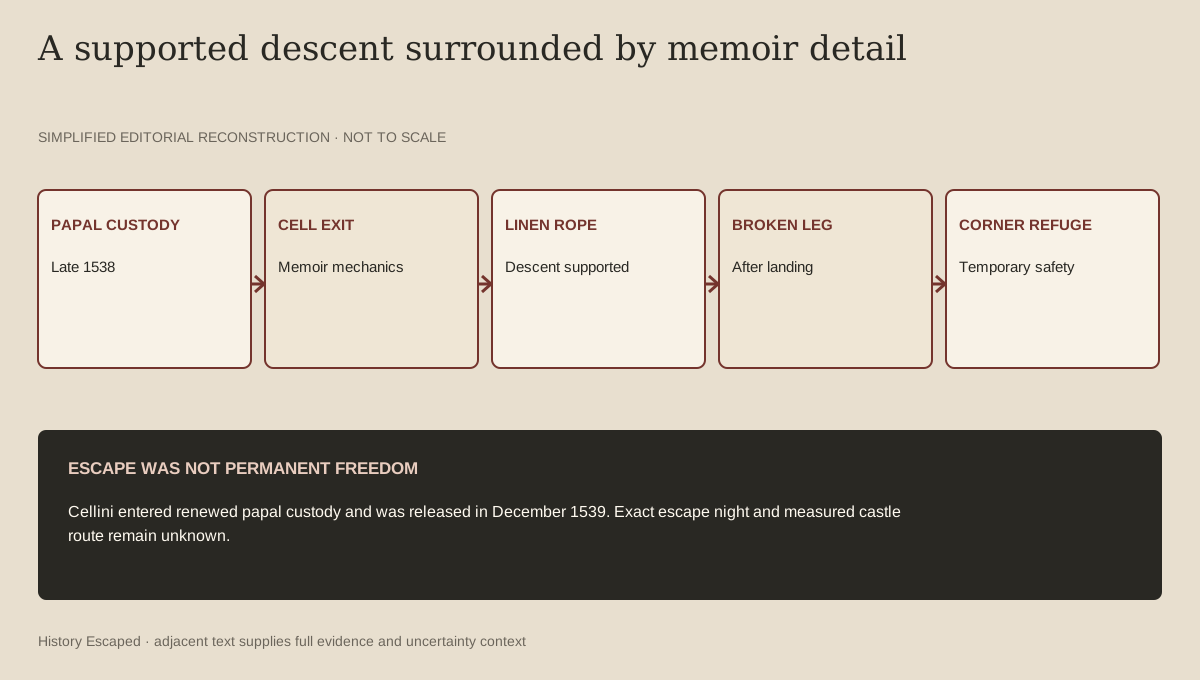
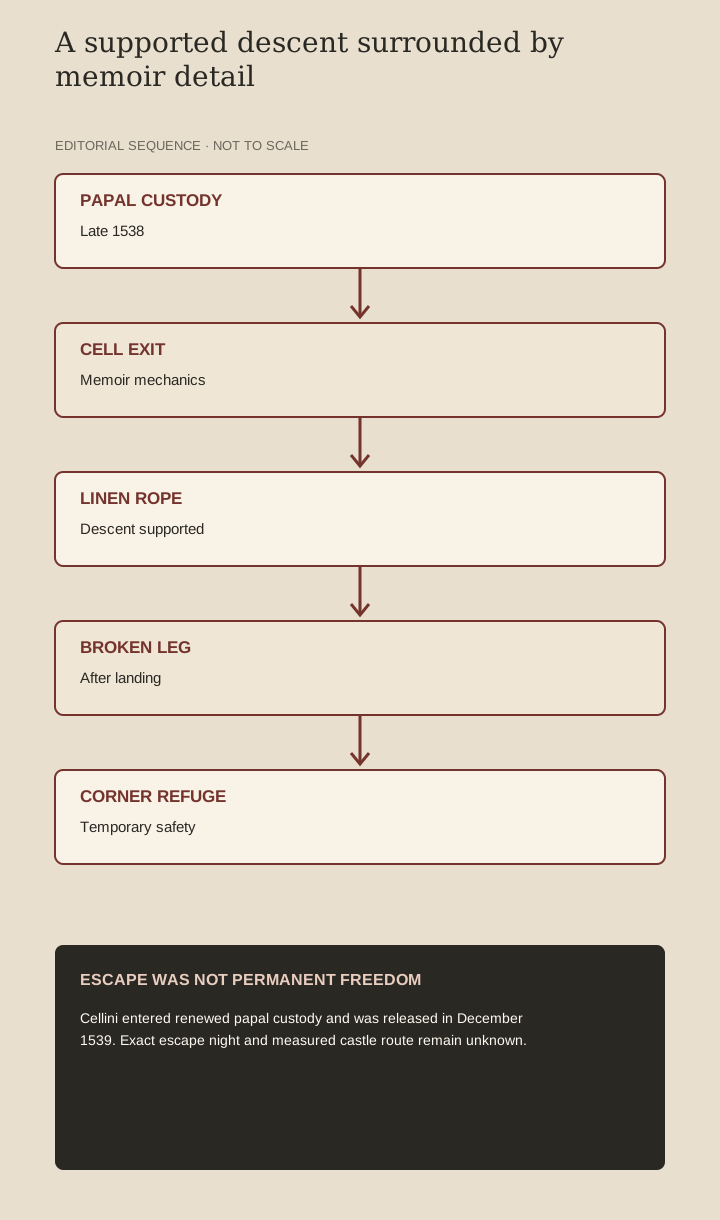
Simplified editorial sequence; not to scale. The exact night and measured route through Castel Sant’Angelo are unknown; several mechanics come from Cellini’s later autobiography.

The night of the escape
Cellini did not give the escape night a modern calendar date in the relevant passage. He called it a feast day.
According to his account, he waited until the fortress had settled into the night, removed the prepared fastenings, and worked his way through the door. He then moved toward the upper parts of Castel Sant’Angelo, passing by the latrine area and reaching the roof or elevated exterior of the keep.
From there, the problem changed. Opening a cell door did not mean leaving the castle. Castel Sant’Angelo was a layered fortress with walls, elevated structures, interior spaces, and guarded approaches. Cellini still had to get down.
This is where the part of the story supported beyond the autobiography becomes especially useful. The Ministry of Culture states that Cellini escaped by lowering himself from the high wall using a rope made from sheets. That broad mechanism is safe to present as history.
The spectacular sequence around it remains Cellini’s.
In the Vita, he says he fixed his first length of linen to a projecting piece of ancient masonry and descended from the keep. That did not place him outside. He found himself in an enclosed area between walls and needed another solution. He described finding a long pole, using it to negotiate the next barrier, and bringing a second length of linen into play.
Eventually, he reached the final rampart facing the district toward the Vatican.
Cellini then says he tied the linen to the battlement and began another descent. The rope did not deliver him neatly to safety. Near the bottom, he fell.
Problem → response
Escape was a sequence of problems
Each response solved a practical obstacle while often creating the next one.
- 01→
Obstacle
Secured prison door
The cell door had to be defeated without exposing the escape preparation in advance.
Response
Cellini later claimed he removed hinge fasteners gradually and disguised the missing nail heads.
- 02→
Obstacle
Elevated fortress walls
Leaving the cell did not place Cellini outside Castel Sant’Angelo; he still had to descend from the fortified structure.
Response
He used improvised linen made from bed-sheets as a descent line.
- 03→
Obstacle
Multiple internal barriers
Cellini’s account describes an initial descent that left him enclosed between additional walls.
Response
He said he used a long pole and a second length of linen to continue toward the outer rampart.
- 04→
Obstacle
Injury after the final descent
Cellini suffered a broken leg during the breakout.
Response
He reached Cardinal Corner’s protection and was treated there by the papal surgeon Giacomo Rastelli.

The broken leg
Here the story gains a useful point of corroboration.
Cellini wrote that the fall left him badly injured, with his right leg broken above the heel. A modern Treccani biography of the papal surgeon Giacomo Rastelli records that, in 1538, Cellini broke a leg during his escape from Castel Sant’Angelo and that Rastelli later treated him in the house of Cardinal Marco Corner.
The biography ultimately acknowledges Cellini’s Vita as the source for the episode, so this is not independent eyewitness proof of every detail of the fall. But it shows that the injury and Rastelli’s role are accepted within modern scholarly biography and fit the securely dated 1538 escape.
Cellini’s narrative becomes almost cinematic after the fall. He says he crawled, was harried by dogs, struggled toward the city, and encountered a water-carrier who helped transport him after hearing a false explanation for his injuries.
Those details should be read as Cellini’s later testimony rather than silently converted into independently documented fact.
What is much firmer is the destination of his flight. Cellini reached the protection of the Venetian Cardinal Marco Corner. Treccani’s biography of Andrea Centani confirms the tradition that Cellini, after fleeing Castel Sant’Angelo, found shelter with Corner. Treccani also preserves Cellini’s claim that Pope Paul III later obtained his surrender from the cardinal in connection with a promised bishopric for Centani. The biography is careful to say that Cellini himself is the source for the alleged exchange, even though Centani did in fact receive the bishopric of Limassol in July 1539.
That distinction is exactly the kind of boundary this case requires: the shelter is well supported; the political bargain is a later claim with some externally verifiable context.
The final accounting
Outcome
Fortress escaped
Cellini successfully got out of Castel Sant’Angelo in 1538.
Serious injury
Cellini broke a leg during the escape and was treated by Giacomo Rastelli at Cardinal Corner’s residence.
Freedom was temporary
Papal authorities regained custody of Cellini; the detailed story of the political bargain surrounding his surrender rests mainly on his later account.
Final release
Cellini remained imprisoned during 1539 and was released in early December.
Escaped from the castle, not from papal power
Cellini’s breakout was a real escape, but it was not permanent freedom.
The official Castel Sant’Angelo account says he was captured again and was later pardoned and released. Treccani’s biography of Cellini gives the chronology more cautiously: after escaping in 1538, he was imprisoned again in 1539 and remained in confinement until December.
The sequence is therefore best described as a successful breach of the prison followed by renewed papal custody.
That distinction matters. Escape history often collapses several different achievements into one. Getting through a cell door is not the same as clearing a prison. Clearing a prison is not the same as reaching a safe jurisdiction. Cellini accomplished the first two. He did not permanently escape the authority that had imprisoned him.
By early December 1539, however, he was free. Treccani records his release and his subsequent move into the protection of Cardinal Ippolito d’Este. In 1540 he left for France, where he entered the service of Francis I.
Evidence discipline
What the record supports
Status labels distinguish secure conclusions from uncertainty and rejected claims. Color is never the only signal.
WELL-SUPPORTED
Benvenuto Cellini escaped Castel Sant’Angelo in 1538.
Treccani’s Cellini biography places the escape in 1538, the Ministry of Culture’s Castel Sant’Angelo history states that he escaped, and the Rastelli biography dates Cellini’s escape injury to 1538.
Sources: SRC-002, SRC-004, SRC-005MYTH
The famous escape took place on Corpus Christi 1538.
Cellini was not arrested until mid-October 1538, with property seizure on 23 October and interrogation on 24 October. His Vita associates Corpus Domini with a later 1539 phase of captivity, not the original breakout.
Sources: SRC-001, SRC-003WELL-SUPPORTED
Cellini descended using a rope made from bed-sheets.
This mechanism appears in Cellini’s account and is also stated in the official Ministry of Culture history of Castel Sant’Angelo.
Sources: SRC-001, SRC-004DISPUTED
The rope was simply a few intact sheets knotted together.
Cellini’s own account is more elaborate: he says he cut sheets into strips and sewed them together. The official source confirms a rope made from sheets but does not validate the exact construction.
Sources: SRC-001, SRC-004LATER CLAIM
Cellini secretly removed hinge nails and disguised them with false wax-and-rust nail heads.
The mechanism is described in Cellini’s autobiography, written about two decades later. The available research provides no independent documentary confirmation.
Sources: SRC-001, SRC-008WELL-SUPPORTED
Cellini broke a leg during the escape and was treated at Cardinal Corner’s residence.
Cellini describes the injury, and Treccani’s biography of surgeon Giacomo Rastelli records that Rastelli treated Cellini after the 1538 escape at Cardinal Corner’s house.
Sources: SRC-001, SRC-005UNKNOWN
The exact escape route through Castel Sant’Angelo can be reconstructed geometrically.
Cellini provides a narrative sequence, but the research used here does not establish enough independently verified 1538 spatial detail to publish an exact route, measured heights, or floor-plan reconstruction.
Sources: SRC-001, SRC-004The Corpus Christi mistake
A popular version of this story places Cellini’s escape on Corpus Christi 1538. The documentary chronology makes that impossible.
Cellini was not arrested until mid-October 1538. His goods were seized on October 23, and he was interrogated on October 24. Corpus Christi had already passed months earlier.
There is a likely source of confusion inside Cellini’s own autobiography. Later in the prison narrative—after the first escape and after he was again in papal hands—Cellini explicitly dates another episode to Corpus Domini 1539. That later passage concerns a different phase of his captivity and another escape plan, not the original 1538 breakout.
The safest dating for the famous escape is therefore late 1538, after the mid-October arrest, exact night unknown.
That answer is less tidy than attaching the story to a famous feast. It is also much harder to contradict with the surviving evidence.
Selected chronology
Selected chronology
Cellini is arrested
Cellini is arrested on an accusation that he had taken jewels belonging to Clement VII during the 1527 Sack of Rome.
His property is seized
Governor Benedetto Conversini orders the seizure of Cellini’s goods.
Conversini interrogates Cellini
Conversini questions Cellini. Treccani warns that Cellini’s later autobiographical version of the interrogation is not very reliable.
Escape from Castel Sant’Angelo
Cellini escapes the fortress. The use of a rope made from bed-sheets is well supported; most fine-grained mechanics come from his later Vita.
Renewed papal custody
Cellini is again held by papal authorities. The exact political mechanics of his surrender are partly dependent on his own later account.
Final release
Cellini is released from imprisonment and subsequently finds protection with Cardinal Ippolito d’Este.
Cellini writes his autobiography
Cellini composes the autobiographical work that preserves the detailed escape story. Modern authorities value it as literature and testimony while warning that it is not entirely factual.
Why the escape worked
If Cellini’s mechanical account is broadly accurate, the escape succeeded because it attacked several weaknesses rather than one.
First, he had access. His status and prison conditions appear to have allowed visits, materials, observation, and some ability to work rather than total isolation.
Second, he claims to have prepared slowly. Removing hinge fasteners over time and disguising the work would have turned the cell door from a fixed barrier into a barrier that only appeared intact.
Third, he used ordinary material in an extraordinary way. The official tradition of a rope made from sheets is plausible precisely because linen was available inside the prison and could be transformed without requiring a purpose-built rope to be smuggled through security.
Fourth, the escape was not one clean descent. Cellini’s version is a sequence of local problems: door, roof, wall, enclosed space, another wall, final rampart. That structure makes more sense for a fortress than the simplified image of a prisoner tying sheets to a window and landing directly in the street.
But it is important not to reverse the logic. Plausibility is not proof. A detail does not become documented simply because it sounds mechanically possible.
Cellini’s greatest invention may have been Cellini
The final reason this escape matters is not just that a famous Renaissance artist escaped a major fortress. It is that the case demonstrates how historical escapes become legends.
Cellini wrote his autobiography around 1558, roughly two decades after the event. Getty’s Union List of Artist Names calls the work important but “not entirely factual.” The problem is not that the Vita is useless. Without it, much of the escape mechanism would disappear. The problem is that Cellini is both the principal witness and the hero of his own story.
His account has the features readers remember: secret tools, clever deception, physical daring, providential survival, hostile guards, helpful strangers, a shattered leg, and powerful protectors. Those details may preserve genuine memory. Some almost certainly do. But the historian’s job is not to choose between believing all of Cellini and believing none of him.
The firmer core is already remarkable enough.
In late 1538, after being arrested on a jewel-theft accusation, Benvenuto Cellini got out of Castel Sant’Angelo. He used an improvised rope made from bed linen to descend from the fortress. He injured his leg during the escape and reached Cardinal Corner’s protection. Papal authority eventually reclaimed him, and he spent part of 1539 imprisoned again before his final release that December.
Around that core stands one of the Renaissance’s most entertaining autobiographical performances. The escape survives because Cellini got over the wall. The legend survives because Cellini also knew how to write it.