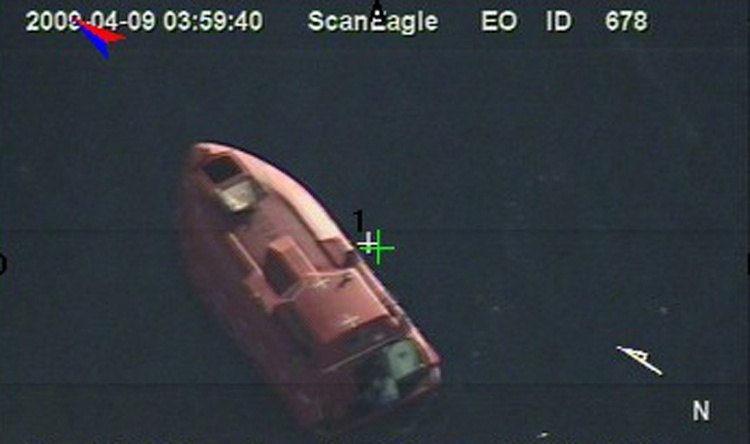
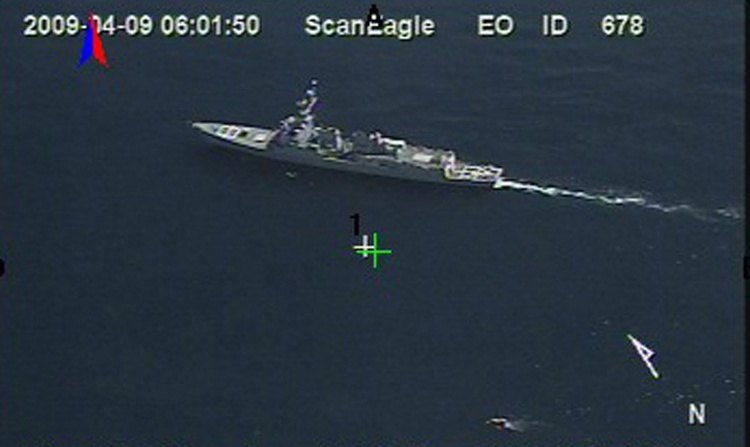
On 8 April 2009, four Somali pirates boarded the U.S.-flagged container ship Maersk Alabama in the Indian Ocean. By the end of the day, the pirates no longer controlled the ship. The American crew had disabled key systems, regrouped below decks, captured one of the attackers and forced the remaining pirates off the vessel. Yet the crisis was not over: Captain Richard Phillips was still their hostage, confined with three pirates in one of the ship’s enclosed lifeboats.
That split outcome is essential to understanding what followed. The Maersk Alabama incident was not one uninterrupted seizure resolved four days later by U.S. Navy commandos. It contained two distinct recoveries: first, the crew’s resistance restored control of the ship; then, after days of negotiation and an unsuccessful escape attempt, a U.S. Navy operation recovered Phillips from the lifeboat on 12 April.
The event quickly acquired a simpler public story. Early official statements praised Phillips as a captain who had sacrificed himself for his crew, and later popular culture centered the crisis on him. Phillips himself eventually disputed the most famous version of that story. He said he had not voluntarily traded himself for his crew but was already a hostage when the pirates took him into the lifeboat. Crew members also argued that their own resistance—especially the work of officers and engineers below decks—was crucial to preventing the pirates from retaining the ship.
Another dispute preceded the boarding. Several crew members later alleged that Phillips had sailed too close to the Somali coast despite piracy warnings. Phillips acknowledged receiving warnings but defended his navigational judgment and rejected the idea that a particular offshore distance guaranteed safety. Civil litigation arising from those allegations ended through confidential settlements rather than a public verdict on the merits. The result is a case in which both hero worship and retrospective blame can outrun what the record actually proves.
At a Glance
- Ship: Maersk Alabama, U.S.-flagged container ship
- Pirate boarding: 8 April 2009
- Best-supported crew count: 20 Americans aboard, including Phillips
- Pirates: 4
- Ship outcome: the other 19 crew members regained control on 8 April
- Phillips’s captivity: 8–12 April 2009, largely aboard an enclosed lifeboat
- Escape attempt: early 10 April; unsuccessful
- Rescue: 12 April 2009
- Pirate outcome: 3 killed during the rescue; Abduwali Abdukhadir Muse taken into U.S. custody
- Phillips outcome: rescued alive; returned to the United States
A Ship Already Sailing Through a Piracy Crisis
By spring 2009, piracy off Somalia had become an international maritime-security emergency. Hijackers were operating well beyond the immediate coastline, and naval coalitions were issuing repeated warnings to commercial shipping. The Maersk Alabama was carrying commercial cargo and humanitarian food aid toward East Africa when it entered this environment.
The crew had received anti-piracy training, and the ship operated with a security plan that emphasized detection, evasive maneuvering, communication and the creation of protected spaces rather than armed resistance. An official U.S. report issued on the day of the attack said the crew numbered about twenty Americans and had trained for pirate incidents. Maersk Line’s chief executive likewise described twenty U.S. crew members aboard.
Those contemporary figures matter because later official histories are inconsistent. Some U.S. military pages subsequently gave totals of twenty-one or twenty-two. The strongest reconciliation is twenty people including Phillips: contemporary company statements used twenty, and reports after the incident repeatedly described the return of nineteen crew members while Phillips was separately recovering from captivity. The later twenty-one and twenty-two figures are preserved as source errors or denominator ambiguities rather than blended into a false average.
The Warning Dispute
The most consequential controversy about Phillips’s decisions began before the pirates boarded. Maritime warnings in the region urged ships to maintain vigilance and, in some guidance, to remain hundreds of nautical miles from Somalia. Years later, crew members Mike Perry and John Cronan said the Maersk Alabama had received warnings recommending a distance of roughly 600 nautical miles and argued that Phillips had failed to take them seriously.
Phillips did not deny that warnings existed. In later deposition testimony discussed publicly, he acknowledged that crews were being warned away from high-risk areas but argued that distance alone did not make a ship safe. By the time of the attack, pirate groups had demonstrated an ability to operate far offshore, and official maritime advisories themselves warned of attacks hundreds of miles from Somalia.
The Maersk Alabama was roughly 250–300 nautical miles off the Somali coast when attacked, depending on the source and reference point. That was closer than the distance cited by the crew members who later sued, but the historical record does not produce a simple finding that Phillips violated a binding rule and thereby caused the attack. A captain retained navigational responsibility; pirate threat information evolved; and the later negligence litigation ended in confidential settlements rather than a public merits judgment.
The safest historical conclusion is therefore limited. Warnings existed, some crew members believed Phillips chose an unnecessarily risky route, and Phillips defended that decision. Whether his navigation amounted to legal negligence was never publicly adjudicated to a final verdict.
Four Pirates Board
On the morning of 8 April, four Somali pirates approached and succeeded in boarding the Maersk Alabama. They were armed, but the crew was not. The attackers quickly gained access to the bridge and took Phillips and several other men under their control.
The pirates did not, however, gain effective command of the whole ship. Crew members below decks shut down systems and denied the boarders straightforward control of the vessel. Men who had moved into protected engineering spaces used their knowledge of the ship to frustrate the attackers’ attempts to operate it.
The resistance was collective rather than incidental. In testimony to the U.S. Senate later that month, Phillips emphasized that the outcome had depended on his crew, specifically naming the chief mate, chief engineer and first engineer among those integral to what happened. That testimony is important because the public story was already beginning to focus overwhelmingly on the captain.
The Crew Captures Muse
The crew’s strongest leverage came when they captured Abduwali Abdukhadir Muse, the pirate who had boarded the ship and emerged as the group’s leader. Accounts from crew members describe Muse being led into the darkened engineering area, where sailors overpowered and restrained him after a struggle.
With one pirate in their custody and the ship no longer functioning as the attackers expected, the crew negotiated. The broad plan was an exchange: Muse would be returned, and the pirates would release Phillips and leave the ship.
The exchange did not end as intended. The three remaining pirates moved into an enclosed lifeboat with Phillips. Muse was eventually returned to them, but Phillips remained in their hands. Chief mate Shane Murphy later described Phillips’s retention in the lifeboat as something that had not gone according to plan.
This sequence is the strongest reason to reject the simple claim that Phillips deliberately “gave himself up” in a clean exchange for the crew. Early official and family accounts repeated a self-sacrifice narrative, but Phillips later stated explicitly that he had not volunteered himself in that way: he was already a hostage. The exact moment at which the attempted exchange failed is less important than the distinction between a failed negotiation and a planned substitution.
The Ship Was Already Back in American Hands
By the end of 8 April, the nineteen other crew members were in control of the Maersk Alabama. They could not recover their captain, but the pirates no longer possessed the cargo ship itself.
That fact is sometimes blurred by accounts that jump directly from the boarding to the dramatic rescue four days later. The Navy’s mission was not to retake a still-hijacked ship. The immediate hostage problem had become the lifeboat drifting in the Indian Ocean with Phillips and three armed captors aboard.
The distinction also clarifies what the crew accomplished. Their resistance prevented the pirates from converting an initial boarding into durable control of the ship, and their capture of Muse helped force the crisis into a smaller, more contained form. It did not free Phillips, but it changed the problem the Navy inherited.
Bainbridge Arrives
The guided-missile destroyer USS Bainbridge reached the area and established contact with the lifeboat. Other U.S. naval assets joined the operation, including USS Halyburton and USS Boxer. The Navy’s immediate approach emphasized containment and negotiation rather than a rushed assault.
Commanders sought Phillips’s release while preventing the pirates from reaching the Somali coast, where the hostage situation could have become much harder to resolve. The lifeboat had limited fuel and increasingly difficult conditions aboard. The Navy eventually took the craft under tow, bringing it into a more controlled relationship with Bainbridge.
The operation sat within a larger command structure. Combined Task Force 151, then led by Rear Adm. Michelle Howard, was engaged in counter-piracy operations, while Bainbridge commander Cmdr. Frank Castellano controlled the immediate scene. Later Navy accounts emphasize that Castellano negotiated with the pirates and held authority to act if Phillips faced imminent danger.
Phillips Tries to Escape
Before the final rescue, Phillips made his own attempt to get free. Early on 10 April, he jumped from the lifeboat and began swimming away.
The attempt failed. The pirates reacted, fired shots and forced or compelled him back aboard. Subsequent reports said he was restrained more tightly after the attempt.
The episode matters because it demonstrates that Phillips was not passively waiting for a military solution. It also increased the risks surrounding any further escape attempt. The Navy continued negotiations rather than treating the failed swim as a trigger for an immediate assault.
What Authority Had Obama Given?
A separate mythology developed around President Barack Obama’s role. Viral accounts later claimed that the White House had repeatedly blocked rescue attempts or delayed authorization until the last possible moment. Contemporary records do not support that story.
Obama authorized the use of force if the on-scene commander concluded that Phillips was in imminent danger. That authority was available before the final shots were fired. The president did not personally direct sniper timing or micromanage the tactical decision aboard Bainbridge.
This distinction preserves both civilian authority and operational reality. The administration established the condition under which lethal force could be used, while commanders at sea had to determine whether that condition had been met.
12 April: Imminent Danger
On 12 April, one of the pirates came aboard Bainbridge for medical attention and negotiations. He was taken into U.S. custody, leaving three captors with Phillips in the lifeboat.
Later that day, the situation changed sharply. Official U.S. accounts state that Navy personnel observed one of the pirates directing an AK-47 toward Phillips at close range. The on-scene commander determined that the hostage was in imminent danger.
A U.S. Navy special-operations element positioned aboard Bainbridge then used lethal force. Three pirates in the lifeboat were killed in the rescue action, and Phillips was recovered alive. The rescue occurred at approximately 7:19 p.m. local time on 12 April.
The historical significance does not require reproducing firing geometry, exact positions or other tactical details. What is secure is the decision threshold: negotiation had continued for days, the commander judged that Phillips faced an immediate lethal threat, and force was used under previously granted authority.
Muse Survives and Faces Trial
Muse, the pirate who had been taken aboard Bainbridge, survived the operation and entered U.S. custody. Federal prosecutors charged him in New York with offenses arising from the seizure of the Maersk Alabama and Phillips’s hostage-taking.
He later pleaded guilty to federal charges including hijacking, hostage taking and kidnapping-related offenses. In 2011, a federal judge sentenced him to 33 years and 9 months in prison.
His prosecution provides an unusually strong legal record for parts of the case. It confirms the organized seizure, the transfer into the lifeboat and the continuing hostage detention. It does not, however, resolve every later argument among crew members about navigation or every disputed detail of the attempted prisoner exchange.
The Hero Story and the Crew Story
Phillips was unquestionably a hostage and survived a dangerous captivity. His composure, failed escape attempt and eventual rescue are central to the event. The problem begins when those facts expand into claims that the entire outcome resulted from a solitary act of self-sacrifice.
Early government statements helped establish that interpretation by describing Phillips as having placed himself at risk for his crew. It was an understandable public narrative immediately after a successful rescue, but it hardened before all participants had given detailed accounts.
Phillips later rejected one of its defining details. He said he did not voluntarily surrender himself as an exchange for the crew. Crew accounts also emphasized that engineers and deck officers had disabled the ship, hidden, resisted the pirates, captured Muse and negotiated from a position the crew itself had created.
A more accurate account leaves room for both. Phillips endured the hostage crisis and tried to escape; the crew prevented the pirates from retaining the ship; naval forces contained the lifeboat and rescued the remaining hostage. No single participant owns the whole outcome.
The Lawsuits and What They Did Not Prove
The route dispute eventually entered civil litigation. Eleven crew members were initially associated with claims against companies responsible for the vessel, and later reports described nine continuing plaintiffs. They alleged that the ship had sailed too close to Somalia despite warnings and that this exposed them unnecessarily to piracy.
The defendants disputed those allegations. The cases were resolved through confidential settlements, with no public trial verdict establishing that Phillips’s navigation was negligent or that the attack would have been avoided had the ship followed the distance urged by the plaintiffs.
A settlement can resolve a lawsuit without deciding the historical argument. For that reason, the crew members’ warnings claim belongs in the record as a serious dispute, but not as a proven causal finding.
From Event to Film
The 2013 film Captain Phillips, starring Tom Hanks, brought the incident to a much larger audience. It drew on Phillips’s account and dramatized both the boarding and the rescue.
The film also intensified arguments about whose story had become dominant. Some crew members objected that Phillips had been elevated into a heroic figure while their own decisions and their criticism of his route were minimized. Those objections do not make the film historically worthless, but they reinforce the need to keep a dramatization separate from the evidentiary record.
The title itself captures the compression. The actual event involved twenty American mariners, four Somali pirates, commercial shipping companies, multiple Navy ships, senior military commanders, negotiators and a special-operations rescue element. A captain’s captivity was the most dramatic surviving thread, but it was not the only one.
What Was Actually Rescued?
By 12 April, two separate achievements had become fused in public memory. The crew had already saved the Maersk Alabama from continued pirate control on 8 April. Four days later, U.S. forces saved Phillips from captivity.
The first depended on preparation, engineering knowledge, collective resistance and the capture of Muse. The second depended on containment, negotiation, command authority and a final judgment that the hostage faced imminent danger. Treating those stages separately makes the event less cinematic but more accurate.
It also changes the meaning of “rescue.” Phillips did not single-handedly save nineteen crew members by exchanging himself for them, according to his own later account. The Navy did not retake a ship that remained in pirate hands. Instead, the crisis narrowed through successive actions by different people until only one hostage remained. His rescue was the final act of a larger recovery already underway.
Evidence diagram
Two recoveries in one crisis
Two recoveries, different actors. Voluntary one-for-crew surrender and route-warning negligence claims remain disputed. No tactical geometry.
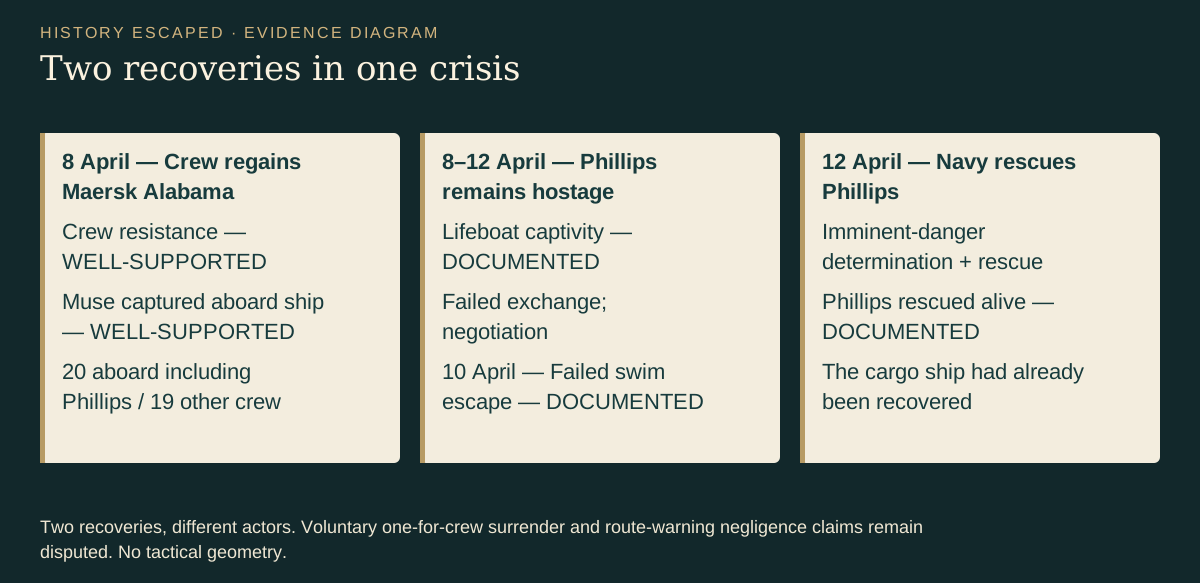
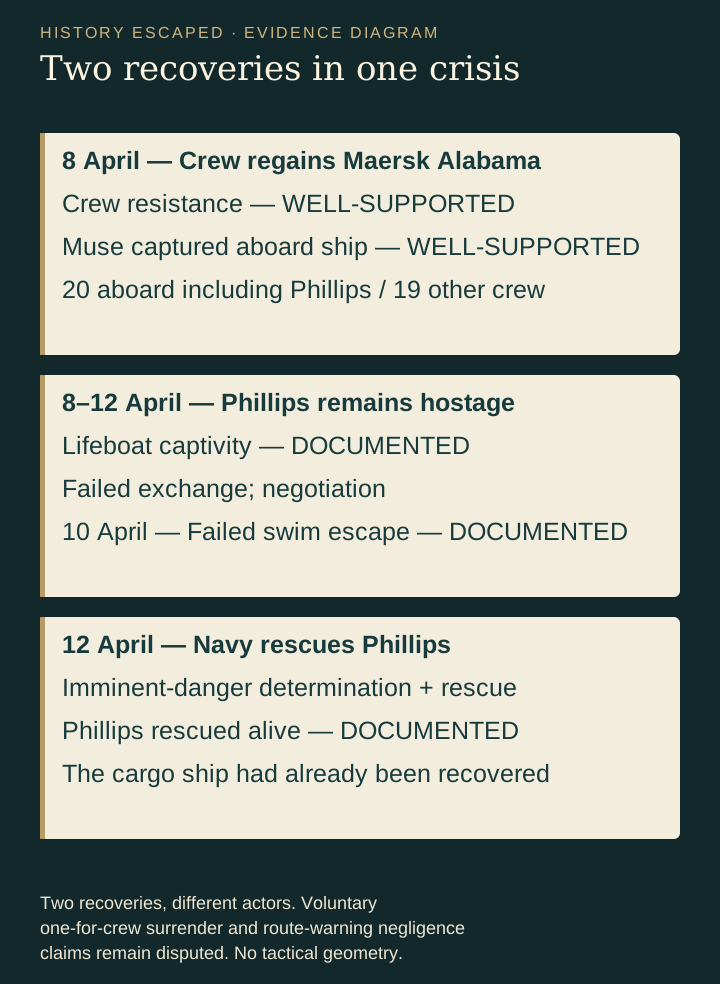
Two recoveries, different actors. Voluntary one-for-crew surrender and route-warning negligence claims remain disputed. No tactical geometry.
Problem → response
Escape was a sequence of problems
Each response solved a practical obstacle while often creating the next one.
- 01→
Obstacle
Pirates controlling the bridge
The armed boarders initially controlled key personnel and bridge spaces.
Response
Crew members used protected engineering spaces and control over ship systems to deny the pirates effective command of the vessel.
- 02→
Obstacle
Phillips isolated in an enclosed lifeboat
After the ship was recovered by the crew, Phillips remained confined with three armed pirates in a small lifeboat.
Response
U.S. naval forces contained the craft, negotiated, and maintained rescue authority if the hostage faced imminent danger.
- 03→
Obstacle
Failed self-escape
Phillips's early 10 April swim attempt did not succeed and resulted in his recapture.
Response
Negotiations and containment continued until the final rescue two days later.
The final accounting
Outcome
American mariners who survived
Using the best-supported contemporary crew count, Phillips and all nineteen other American crew members survived the incident.
Crew members who regained Maersk Alabama before Navy rescue
The crew had retaken the ship on 8 April while Phillips remained hostage.
Hostage rescued by U.S. naval forces on 12 April
Richard Phillips was recovered alive from the lifeboat.
Pirates killed during final rescue
Pirate prosecuted in the United States
Abduwali Abdukhadir Muse survived, pleaded guilty, and received a federal prison sentence.
Selected chronology
Selected chronology
Updated maritime warning
Combined Maritime Forces issued an updated advisory warning mariners that pirate attacks were occurring hundreds of miles from Somalia and urging heightened preparedness.
Maersk Alabama boarded
Four Somali pirates boarded the vessel; the crew later regained control of the ship and captured Muse, while Phillips remained hostage.
Navy containment under way
U.S. naval forces were on scene as the lifeboat hostage crisis continued.
Phillips attempts escape
Phillips jumped from the lifeboat and attempted to swim free but was recaptured.
Phillips rescued
U.S. naval personnel killed three pirates after the on-scene commander judged Phillips to be in imminent danger; Phillips was recovered alive and Muse entered U.S. custody.
Muse pleads guilty
Muse pleaded guilty in U.S. federal court to charges arising from the seizure and hostage-taking.
Muse sentenced
A federal judge sentenced Muse to 33 years and 9 months in prison.
Captain Phillips film released
The dramatized film brought the incident to a mass audience and renewed disputes over Phillips's decisions and the crew's role.
Evidence discipline
What the record supports
Status labels distinguish secure conclusions from uncertainty and rejected claims. Color is never the only signal.
DISPUTED
Phillips voluntarily surrendered himself to the pirates in exchange for the safety of his crew.
Early official and family accounts promoted a self-sacrifice narrative, but Phillips later said explicitly that he had not given himself up and was already a hostage. Chief mate Shane Murphy also described the lifeboat outcome as something that did not go according to plan.
Sources: SRC-006, SRC-008, SRC-010MYTH
The U.S. Navy retook Maersk Alabama from the pirates on 12 April.
The other crew members had regained control of the ship on 8 April. The Navy's final action rescued Phillips from the lifeboat four days later.
Sources: SRC-002, SRC-003, SRC-010WELL-SUPPORTED
Twenty Americans, including Phillips, were aboard Maersk Alabama.
Contemporary Maersk/company reporting gives twenty and later reports describe nineteen crew members returning while Phillips was separately recovering. Some later military histories give twenty-one or twenty-two, creating a source inconsistency.
Sources: SRC-001, SRC-002, SRC-016DISPUTED
Phillips ignored a 600-nautical-mile warning and thereby caused the attack.
Crew members later alleged that he sailed too close despite warnings, and Phillips acknowledged receiving risk warnings while defending his judgment. The related civil litigation settled without a public merits verdict, so legal negligence and causation were not finally adjudicated in public.
Sources: SRC-004, SRC-007, SRC-008, SRC-009MYTH
President Obama repeatedly blocked Navy rescue attempts before finally permitting action.
Contemporary command accounts and later fact-checking show that the president had authorized force if Phillips faced imminent danger; the on-scene commander determined when that threshold was met.
Sources: SRC-011, SRC-012, SRC-013MYTH
The crew's actions were secondary to Phillips's individual heroism.
Phillips himself told the Senate that the crew, chief mate, chief engineer, and first engineer were integral to the outcome. Crew resistance denied the pirates continued control of the ship and captured Muse before the Navy arrived.
Sources: SRC-003, SRC-005, SRC-006