
Charles de Gaulle spent most of the last thirty-two months of the First World War as a prisoner of Germany. The future leader of Free France did not accept captivity passively. Between October 1916 and July 1918, he carried out five escapes recognized in his own 1927 official report: from a military hospital at Ingolstadt, twice from Rosenberg fortress, and twice from Wülzburg.
None brought him to neutral or Allied territory. Each ended in recapture, sometimes after days on the road and sometimes within hours. The record is nevertheless unusually rich because de Gaulle later supplied an administrative account of the attempts, German judicial material survives for one aftermath, and later French and German reconstructions preserve additional details—while also introducing a few date and duration conflicts that need to be kept visible.
At a Glance
- Captured: 2 March 1916 near Douaumont during the Battle of Verdun
- POW period: about thirty-two months, until the Armistice in November 1918
- Executed escapes counted by de Gaulle in 1927: five
- Earlier escape projects: at least two substantial plans were not included in that official five because they were not carried through as escapes
- Durable escapes: none; de Gaulle was recaptured after all five
- Main escape sites: Ingolstadt, Rosenberg near Kronach, and Wülzburg near Weißenburg
- Repeated destinations: Switzerland or, on later attempts, the Netherlands by way of western Germany
From Verdun to German captivity
De Gaulle entered captivity after the fighting around Douaumont on 2 March 1916. He was wounded and captured as the French position collapsed under German attack, then treated at Mainz before being moved through a succession of prisoner-of-war camps. Later French accounts sometimes frame the circumstances of his capture through the heroic language of his wartime citation; that citation is evidence of how the French Army described him, not a neutral German eyewitness record of every moment of the capture.
The young captain quickly became preoccupied with escape. The surviving 1927 report is especially useful because its introductory material draws a boundary between ideas and attempts: it excludes a plan associated with Neisse to travel by boat and another at Sczuczyn to reach Russian lines through marsh country because they were not actually put into execution. Later retellings describe still more preparation at Sczuczyn, including work on a wall, but those episodes do not change the official count used by de Gaulle himself.
That distinction matters. Saying simply that de Gaulle “tried to escape five times” can imply that he had only five escape projects during thirty-two months of captivity. The better-supported formulation is narrower: he later reported five escapes that were put into execution, while earlier schemes were abandoned, detected, or stopped before they reached the same threshold.
First escape: out through the Ingolstadt hospital
By early October 1916 de Gaulle had been sent to Fort IX at Ingolstadt, a place used for officers regarded as persistent escape risks. His first executed escape began with a dangerous ruse. According to his 1927 report, he deliberately swallowed picric acid to produce symptoms resembling jaundice so that German doctors would transfer him to the prisoner annex of the military hospital in town. The source gives no reason to treat that act as safe, and it should be understood as a hazardous historical expedient rather than a model technique.
At the hospital, de Gaulle and Captain Dupret assembled disguises and civilian clothing with help from contacts inside the institution. On Sunday, 29 October 1916, they passed from the prisoner annex into the German hospital, changed into civilian clothes, and walked out amid ordinary movement around the building. De Gaulle’s report says they intended to reach the Swiss enclave of Schaffhausen, roughly 300 kilometres away, travelling by night and hiding by day.
They stayed free for more than a week. On the evening of 5 November, at Pfaffenhofen, de Gaulle wrote that the pair had covered about two-thirds of the intended route when local people noticed them. A pursuit followed, their identities were discovered, and they were returned to Ingolstadt.
The episode established a pattern that would recur: a successful breach of custody was only the first part of the problem. Under the law of war then in force, a recaptured POW who had not rejoined his own army or left the captor’s controlled territory remained liable to disciplinary punishment for the escape. Reaching open country, a railway, or even travelling for days therefore did not amount to a completed escape in the legal sense.
Rosenberg: the most elaborate attempt
After months without another executed attempt, de Gaulle secured a transfer in July 1917 to Rosenberg fortress above Kronach. The move gave him a different problem to solve. His own report describes walls, ditches, guarded passages and a steep outer face; later reconstructions reproduce the same broad system, although their exact measurements should not be treated as a modern survey.
De Gaulle planned this escape with Lieutenants Tristani, Angot and Prévôt. Captain de Montéty joined the group shortly before departure. They loosened a stone to reach a ditch, prepared a way through a passage, assembled a sectional ladder, and made a rope from bedding. The plan depended on getting over the fortress perimeter before beginning a long journey toward Switzerland.
The date has an important documentary wrinkle. The Fondation Charles de Gaulle’s published transcript of de Gaulle’s 1927 report prints “1 October 1917” at the point where the group moves, but later institutional reconstructions, the surviving manuscript description, and other accounts consistently give 15 October 1917. Because 15 October is supported across multiple independent descriptions of the same episode, it is the stronger date; the “1 October” reading remains an outlier in the published transcript and should not be silently erased.
The group reached the outer wall, but the rope proved too short for the descent as first planned. Montéty remained behind to manage the rope while de Gaulle, Tristani, Angot and Prévôt got down and moved away from the fortress. They then travelled for ten nights toward Switzerland before being cornered after taking shelter in a pigeon loft or dovecote. De Gaulle and Tristani were captured there; the wider group’s movements diverged briefly, but the escape did not produce durable freedom for any of the men in de Gaulle’s party.
This was the closest of the five attempts to the classic image of a fortress breakout followed by a prolonged cross-country flight. It was also the clearest demonstration that de Gaulle was not acting alone. His recurring escapes depended on other prisoners who shared information, fabricated or obtained materials, created diversions, or physically joined the attempt.
Third escape: Rosenberg again, two weeks later
De Gaulle did not wait long after being brought back to Rosenberg. Fearing another transfer to the more restrictive Ingolstadt, he and Tristani prepared a quicker method that depended less on scaling the outer fortifications. On 30 October 1917 they changed into civilian clothing, used false moustaches and glasses, descended from a window after a bar had been cut, and passed out through the same general access used by civilians connected with the fortress.
Someone saw the descent and raised the alarm. De Gaulle and Tristani nevertheless reached Lichtenfels, where they intended to take a train westward through Frankfurt and Aachen and then try for the Dutch frontier. They boarded in the early hours of 31 October, but German gendarmes arrested them almost immediately.
The consequences reveal one of the best source checks in the case. De Gaulle later remembered receiving three weeks in prison after a confrontation with a German gendarme connected to the recapture. A later French reconstruction based on the German military-court file gives the judgment of 18 April 1918 as fourteen days for insult. The contemporary judicial record is stronger evidence for the formal sentence, so fourteen days should control even though de Gaulle’s later recollection is worth preserving as a conflicting claim.
Separate from that judicial sentence, de Gaulle’s escape report records severe disciplinary arrest for the Rosenberg attempts. The distinction should not be collapsed into one total punishment figure. German authorities could punish the escape as a disciplinary matter while separately prosecuting conduct alleged to have occurred after recapture.
Wülzburg: an escorted exit in disguise
Fort IX at Ingolstadt was dissolved in May 1918, and de Gaulle was transferred to Wülzburg, another fortified place of detention in Bavaria. He soon prepared a fourth executed escape with a fellow prisoner identified as Lieutenant Meyer. This Meyer should not be confused with the German gendarme Heinrich Meyer involved in the aftermath of the Lichtenfels arrest.
The plan relied on appearance rather than climbing. The French lieutenant wore a German uniform and posed as an escort, while de Gaulle carried civilian clothing for use after they were outside. On 10 June 1918 the pair passed through the fort’s exit and changed once clear of the immediate prison environment, intending to move toward Nuremberg and eventually west.
Sources disagree by about a day over how long this attempt lasted. The 1927 manuscript description used in an auction catalogue says the two were arrested the next day, while later institutional accounts say two days later. The secure conclusion is that de Gaulle and Meyer cleared Wülzburg on 10 June and were recaptured within one or two days; forcing a single recapture date would give the evidence more precision than it supports.
Fifth escape: the laundry basket
The final attempt used concealment instead of an escort disguise. Wülzburg’s laundry was transported to Weißenburg, and de Gaulle hid in the large basket used for the load. Helpers arranged for him to enter the basket and later emerge after it had been taken out of the fort. Once outside, he moved toward Nuremberg and boarded a train as part of another effort to reach the west.
The best-supported date is 7 July 1918. A Verdun-Meuse reconstruction gives that date explicitly, and a German account in Die Zeit independently repeats it. De Gaulle’s own 1927 manuscript description is less exact, placing the attempt at the beginning of July.
One later Fondation Charles de Gaulle article introduces a conspicuous contradiction by narrating this fifth attempt after the 10 June escape, introducing it as a July event, and then printing “3 June” in the detailed story. That cannot fit that Fondation article’s own sequence. The internal chronology points instead to a likely editorial or transcription error, not an extra June escape: the surrounding narrative places the laundry-basket attempt in July.
De Gaulle reached a train but was stopped during a papers check and returned to Wülzburg. Die Zeit places the recapture near Aschaffenburg. As with the previous four attempts, he had broken out of immediate custody without crossing the threshold into lasting freedom.
Five attempts, not five successes
The five-attempt count rests on unusually direct evidence. In January 1927, while applying under the rules for the newly created Médaille des Évadés, de Gaulle prepared a signed report concerning “the five escapes” he had made in German captivity. The administrative context is important: the report was produced years after the events and is therefore retrospective, but it was also written to document discrete attempts under an official award process rather than to create a later popular legend.
That report also helps prevent a common counting mistake. Earlier schemes at Neisse and Sczuczyn were real parts of de Gaulle’s escape activity, yet the published introductory note says they were omitted because they never reached execution. The five therefore form a defined evidentiary category, not a claim that exactly five escape ideas ever crossed his mind.
All five executed escapes ended in recapture. De Gaulle did not reach Switzerland, the Netherlands, Allied troops, or another durable place of freedom before the Armistice. His release came with the end of the war rather than through a successful sixth escape.
Escape as a prisoner network
The methods changed from one attempt to the next, but none emerged from solitary ingenuity. Dupret shared the first break from Ingolstadt; Tristani, Angot, Prévôt and Montéty were part of the Rosenberg operation; Tristani joined de Gaulle again at the end of October; Lieutenant Meyer accompanied the June 1918 exit from Wülzburg. Other prisoners and contacts obtained clothing, worked on barriers, handled materials, passed information, or helped create the appearance that made an exit plausible.
Later storytelling sometimes compresses those collective efforts into the future general’s personal cleverness. De Gaulle’s own report is more useful precisely because it repeatedly names accomplices and the division of labor. His persistence was central, but the mechanics of escape depended on a POW culture in which knowledge and practical assistance circulated among prisoners. Fort IX at Ingolstadt, intended to concentrate troublesome escape-minded officers under heavier surveillance, also placed such men together.
The record is less secure for every helper’s later fate, and that uncertainty should remain visible. The five-attempt count concerns de Gaulle’s executed escapes, not five identical teams moving together from prison to freedom. Companions separated, stayed behind, or were recaptured at different moments, so the case cannot be reduced to one aggregate number of “escapees” without mixing distinct denominators.
Punishment, persistence and captivity
Repeated escape carried consequences. De Gaulle’s account states that the two Rosenberg escapes brought a combined 120 days of rigorous arrest, served during the winter of 1917–1918, while the two Wülzburg escapes each drew another sixty-day punishment that he said had not begun before the Armistice intervened. Those figures describe sentences attached to particular attempts; they should not be converted into a claim that he physically served 240 days of rigorous arrest.
The legal setting explains why unsuccessful escape itself could be punished. Article 8 of the 1907 Hague Regulations allowed disciplinary punishment for an escaped POW retaken before rejoining his army or leaving territory controlled by the captor. De Gaulle’s separate fourteen-day judicial sentence after Lichtenfels concerned an alleged insult, not merely the act of escaping.
Captivity was not only a sequence of breakout plans. De Gaulle studied German, read available news, analysed the war, gave talks to fellow officers and formed relationships with other prisoners. Those activities matter because they show how escape fitted into a larger refusal to treat captivity as an end to his military life, but they should not displace the central fact of this case: five times, he got beyond the immediate prison boundary and five times the German system recovered him.
Why the failures matter
It is tempting to read these episodes backward from the de Gaulle of 1940 and turn every decision into an early sign of destiny. The evidence does support traits that later biographers emphasize—persistence, confidence, planning, willingness to exploit changing circumstances—but the attempts also contained miscalculation, bad luck, dependence on helpers, uncertain information and repeated defeat. The rope at Rosenberg was too short; civilians or police noticed fugitives; railway controls and identity papers repeatedly closed routes that looked open on a map.
The historical value lies partly in that friction. Escape from a First World War officers’ camp was not a single dramatic moment at a wall or gate. It required leaving confinement, moving through a hostile administrative landscape, avoiding recognition, obtaining transport or walking long distances, and finally reaching neutral or friendly territory. De Gaulle repeatedly solved the first problem and never solved all the others before recapture.
His five escapes are therefore best understood neither as five triumphs nor as five meaningless failures. They are a documented series of increasingly varied attempts made by a captive officer who kept searching for a route back to the war. In 1927 France formally recognized that record with the Médaille des Évadés; by then, de Gaulle’s own paperwork had already supplied the clearest framework for counting what he had actually tried.
Evidence discipline
What the record supports
Status labels distinguish secure conclusions from uncertainty and rejected claims. Color is never the only signal.
DOCUMENTED
De Gaulle executed five POW escapes during his German captivity.
His January 1927 official medal documentation explicitly describes five escapes, and later institutional accounts follow that count.
Sources: SRC-001, SRC-002, SRC-003MYTH
Earlier projects at Neisse and Sczuczyn belong inside the official five.
The published introduction to de Gaulle’s 1927 report explicitly says those projects were not included because they were not put into execution.
Sources: SRC-001WELL-SUPPORTED
The major Rosenberg breakout occurred on 15 October 1917.
The manuscript catalogue, later Fondation reconstruction, and Verdun-Meuse account give 15 October. A published transcript of the 1927 report prints 1 October, creating an unresolved textual discrepancy.
Sources: SRC-001, SRC-002, SRC-003, SRC-005DISPUTED
De Gaulle and Lieutenant Meyer were recaptured on a single precisely established date after the 10 June 1918 Wülzburg escape.
The manuscript catalogue says they were arrested the next day; later French institutional accounts say two days later. The report therefore preserves the range rather than forcing a date.
Sources: SRC-002, SRC-003, SRC-005WELL-SUPPORTED
The laundry-basket escape took place on 7 July 1918.
Verdun-Meuse and a German account in Die Zeit give 7 July; de Gaulle’s 1927 manuscript summary says only the beginning of July. A later Fondation article prints 3 June inside a narrative that itself places the attempt in July and after 10 June.
Sources: SRC-002, SRC-003, SRC-005, SRC-009DISPUTED
De Gaulle’s formal prison sentence for the Lichtenfels insult case was three weeks.
De Gaulle later remembered three weeks, but the reproduced German military-court judgment dated 18 April 1918 states fourteen days. The contemporary judgment controls the formal sentence.
Sources: SRC-001, SRC-003MYTH
The two Wülzburg sixty-day rigorous-arrest punishments were served before the end of the war.
De Gaulle’s 1927 report states that he did not serve those punishments because the Armistice intervened before execution began.
Sources: SRC-002, SRC-003Documentary reconstruction
Five attempts, five recaptures
A case-local editorial visual separates the secure historical sequence from uncertainty without exposing reusable modern operational detail.
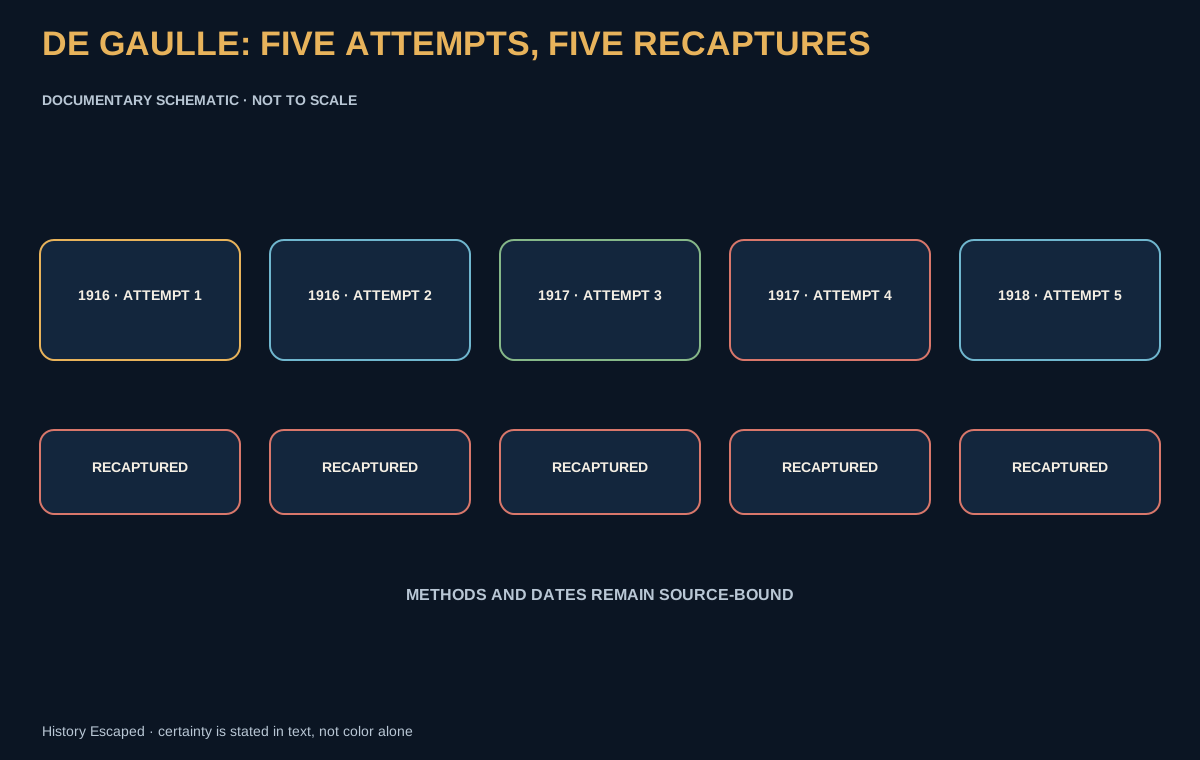
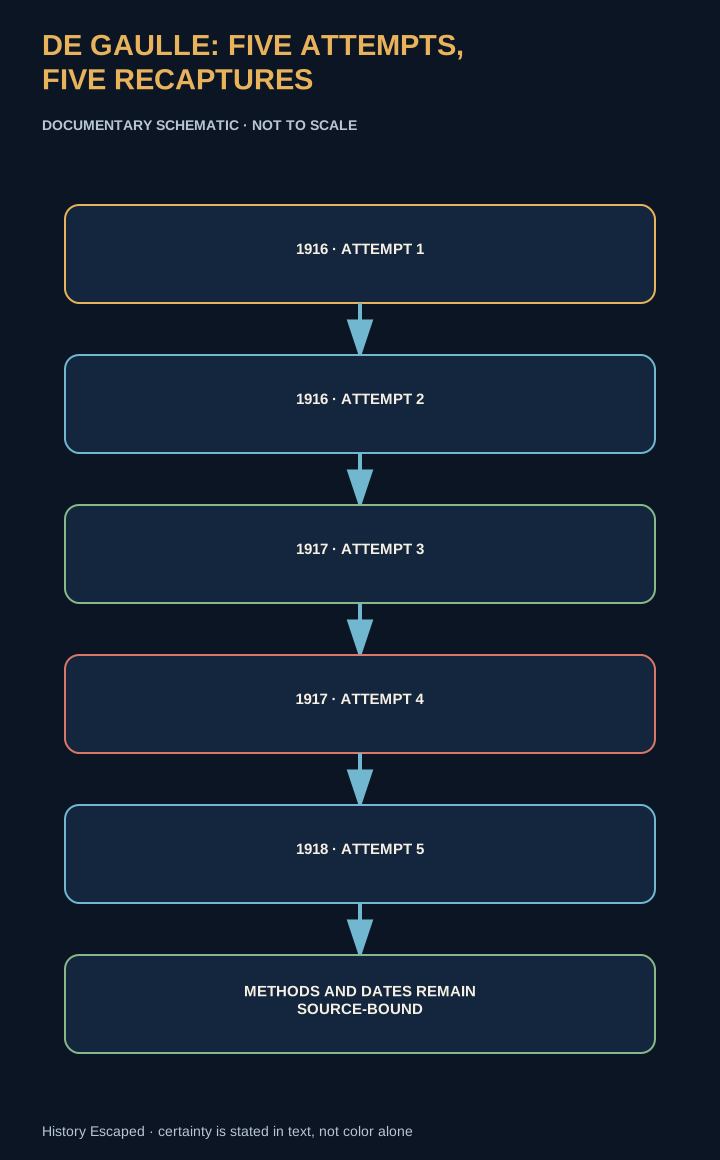
Simplified evidence-led editorial reconstruction based on the cited record; not to scale. Uncertainty is stated directly in the visual and adjacent text.

