
At a Glance
- Escape: Late April 1719, most plausibly the night of 28–29 April
- Starting point: Habsburg detention at Innsbruck
- Escapee: Maria Clementina Sobieska
- Rescue organizer: Charles Wogan
- Escape type: Political rescue and clandestine extraction
- Main method: Deception, clothing substitution and rapid escorted travel across the Alps
- Route: Innsbruck → Brenner corridor → northern Italy → Bologna → Rome
- Outcome: Reached Bologna, married James Francis Edward Stuart by proxy, and entered papal protection in Rome
The most famous version of Clementina Sobieska's escape sounds almost too theatrical to be true. A princess pretends to be ill. A maid enters her quarters and stays behind. Clementina leaves in the servant's clothes. Irish Jacobites wait outside in a snowstorm, then hurry her through the Alps while imperial authorities realize they have been deceived.
Unlike many escape legends, the core of that story is not a nineteenth-century invention. Charles Wogan, the Jacobite officer who organized the rescue, published a detailed account in 1722, only three years after the event. His testimony makes the disguise and the basic rescue plan unusually strong.
It does not make every dramatic detail equally certain. Wogan was also writing for an audience sympathetic to the Stuart cause, and the rescue rapidly became propaganda. A careful reconstruction has to use his account without becoming captive to it.
Why Clementina was being held
Maria Clementina Sobieska came from one of Europe's most politically connected Catholic dynasties. Her grandfather was John III Sobieski, king of Poland and victor at Vienna in 1683. Through her mother she was related to the Habsburgs.
In 1718 she became betrothed to James Francis Edward Stuart, son of the deposed James II and the man Jacobites recognized as James III and VIII. James had failed to recover the British crowns in the rising of 1715, but a politically advantageous Catholic marriage could strengthen his position and, more importantly, produce legitimate heirs.
That possibility worried the government of George I. Britain and the Habsburg monarchy were closely aligned, and Emperor Charles VI faced pressure to prevent his cousin from reaching the exiled Stuart claimant.
Clementina and her mother were stopped while traveling through imperial territory toward Italy. By autumn 1718 they were detained at Innsbruck.
Popular accounts often describe this simply as imprisonment in "Innsbruck Castle" or at Ambras Castle. The surviving literature is not uniform enough to make the precise building the central fact. What matters is that Clementina was under Habsburg guard, her journey had been interrupted for political reasons, and normal diplomatic efforts had not produced her release.
She remained there through the winter.
Wogan proposes a rescue
Charles Wogan was already an experienced Jacobite fugitive. After the 1715 rising in Britain, he had escaped from Newgate before trial and made his way to the Continent. He later entered James's service and traveled through European courts searching for a suitable bride.
Clementina was in part his choice. When the marriage project was blocked by the detention at Innsbruck, Wogan proposed doing what diplomacy had failed to do: remove her.
The best-established members of the rescue party were Richard Gaydon, Lucius O'Toole and John Misset, all connected to the Irish military diaspora on the Continent. Misset's wife accompanied them, as did her maid, usually called Jeanneton or Jenny in English retellings. James's Italian servant Vezzozi also appears in the early narrative tradition.
Later lists sometimes add other Jacobites. John Walkinshaw of Barrowfield, for example, has been credited with helping the rescue. Yet the older Dictionary of National Biography notes that the evidence for his participation rests mainly on a memoir written decades later by his daughter. He belongs in the wider rescue tradition, not in the same evidentiary category as Wogan, Gaydon, Misset and O'Toole.
Selected chronology
Selected chronology
Stuart-Sobieska marriage arranged
James Francis Edward Stuart and Maria Clementina Sobieska were formally matched, creating a potential legitimate Jacobite succession.
Clementina detained at Innsbruck
Habsburg authorities stopped Clementina and her mother while they were traveling toward Italy.
Clementina escapes
Using a maid-clothes substitution arranged by Wogan's group, Clementina left Habsburg custody and departed Innsbruck.
The party crosses the Alpine frontier
The rescuers moved south along the Brenner route and through northern Italy beyond the immediate reach of Habsburg authorities.
Proxy marriage in Bologna
Clementina married James Francis Edward Stuart by proxy while he was absent in Spain.
Arrival in Rome
Clementina entered Rome and was housed with the Ursulines under papal protection.
Marriage in person at Montefiascone
James and Clementina were married in person in a ceremony supported by Pope Clement XI.
Getting inside the detention
The rescuers could not simply storm a guarded residence. Their advantage was deception.
Wogan traveled under a false identity, using papers that allowed the party to move through imperial territory without openly announcing its Jacobite purpose. John Misset went ahead toward Innsbruck disguised as a merchant and made contact with Clementina's household.
The essential plan was simple. Clementina would appear ill and withdraw from visitors. Madame Misset's maid would then be brought inside. The princess and the maid would exchange clothing, allowing Clementina to leave as a servant while the decoy remained behind.
This is one of the colorful details that survives unusually well because it appears in Wogan's own account rather than emerging only in later romance. Trinity College Dublin's modern exhibition on Clementina's marriage likewise summarizes the rescue as involving feigned illness and a maid in disguise.
The scheme still required Clementina's cooperation. She was not a passive package being removed by male rescuers. Wogan's narrative presents her as agreeing to the plan and insisting that the attempt continue despite bad weather and the obvious danger of discovery.
The date problem
Even the escape date requires care.
Older reference works commonly give 27 April 1719. The more detailed reconstruction published by History Ireland says Wogan originally intended to act on the 27th, but circumstances delayed the operation. Clementina withdrew on the 28th, and the actual substitution and departure occurred late that night.
The most defensible formulation is therefore the night of 28–29 April 1719, while acknowledging that 27 April remains common in older biographies.
The disagreement is minor compared with the certainty of the broader chronology: Clementina left Innsbruck in the closing days of April and was across the imperial frontier within days.
Clementina leaves in servant's clothes
According to Wogan's account, Clementina retired from company as planned. Jeanneton was taken inside and remained behind while Clementina emerged in the maid's clothing.
A servant from Clementina's household, usually rendered Konska, assisted the exchange. Wogan waited nearby and then helped move Clementina toward the party's lodging outside the center of Innsbruck.
From that point later retellings become increasingly cinematic. Wogan tells of severe weather, mud, a stream, clothing changes and a packet of Stuart jewels accidentally left behind. Those episodes may well preserve real memories, but they come principally from the organizer's own celebratory narrative.
The historically secure achievement is already remarkable without them: a politically detained dynastic bride had passed out of guarded quarters in another woman's clothes and reached the waiting rescue party before the substitution was discovered.
The Brenner route
Leaving the building was only the first stage. Innsbruck remained deep inside Habsburg territory.
The party moved south toward the Brenner Pass, the natural Alpine corridor into Italy. Misset had gone ahead to help arrange the next stages. The late-season weather made movement difficult, but the group continued.
The route preserved in Wogan's account and later histories runs through familiar Alpine nodes: Brixen, Trent, Rovereto, Ala and Peri. Those names are much stronger evidence than any attempt to draw the exact road, coaching stops or deviations.
At some point the escape also became a race against information. Once the decoy was discovered, messengers could be sent south to officials who controlled roads and posts.
Wogan's memoir famously describes members of the rescue party delaying one courier by drinking with him until he was incapable of continuing and taking his dispatch. That is a classic example of a detail worth preserving as participant-reported, but not turning into a universally documented fact. The same caution applies to the near-disaster on a mountain road and the carriage axle that supposedly failed near Rovereto.
Problem → response
Escape was a sequence of problems
Each response solved a practical obstacle while often creating the next one.
- 01→
Obstacle
Political house arrest under Habsburg guard
Clementina could not continue her journey normally and was being watched because of the proposed Stuart marriage.
Response
The rescue exploited household access and disguise rather than attempting an armed assault.
- 02→
Obstacle
Identity checks and imperial travel control
The rescue party had to move through Habsburg territory without openly identifying its Jacobite purpose.
Response
Wogan and companions used assumed identities and travel papers while moving Clementina toward Italy.
- 03→
Obstacle
Alpine distance and pursuit risk
Leaving Innsbruck did not itself put Clementina beyond Habsburg reach.
Response
The party moved rapidly south via the Brenner corridor toward jurisdictions where the marriage and papal protection could be secured.
The broken carriage
The broken-axle episode is one of the better-known moments in the rescue tradition. Wogan says the carriage became unusable near Rovereto and the party had to continue partly on foot before obtaining a smaller conveyance.
He later emphasized the incongruity: a granddaughter of the king of Poland and cousin of European sovereigns walking through the road network of northern Italy while fleeing imperial detention.
The symbolic force of the scene helped make it memorable. That is also why it needs qualification. Wogan had every reason to make the rescue demonstrate Clementina's courage and the loyalty of her rescuers.
What matters geographically is that the party continued south through Ala and reached Peri, which Wogan's tradition treated as beyond the immediate Austrian jurisdiction they were escaping.
After that point, the risk of straightforward Habsburg recapture decreased sharply.
Documentary reconstruction
The Alpine relay and its evidence layers
A case-local editorial visual separates the documented sequence from uncertainty without implying exact modern geography or operational detail.
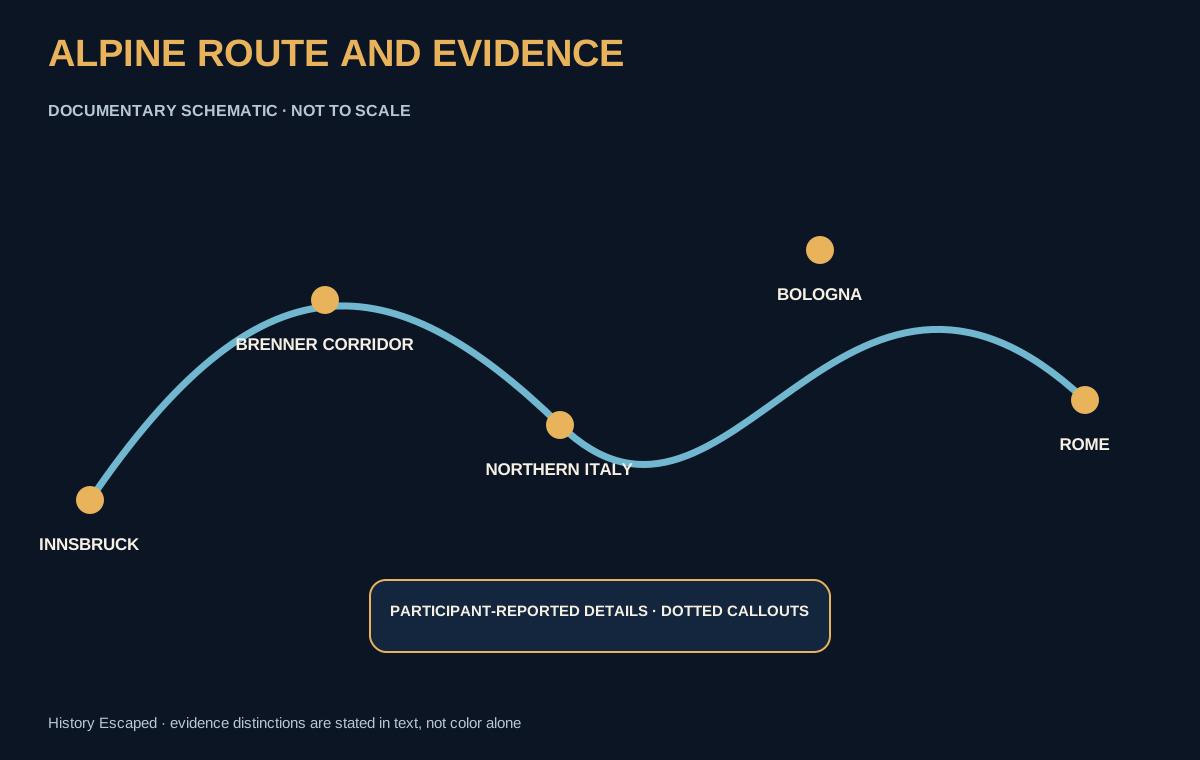
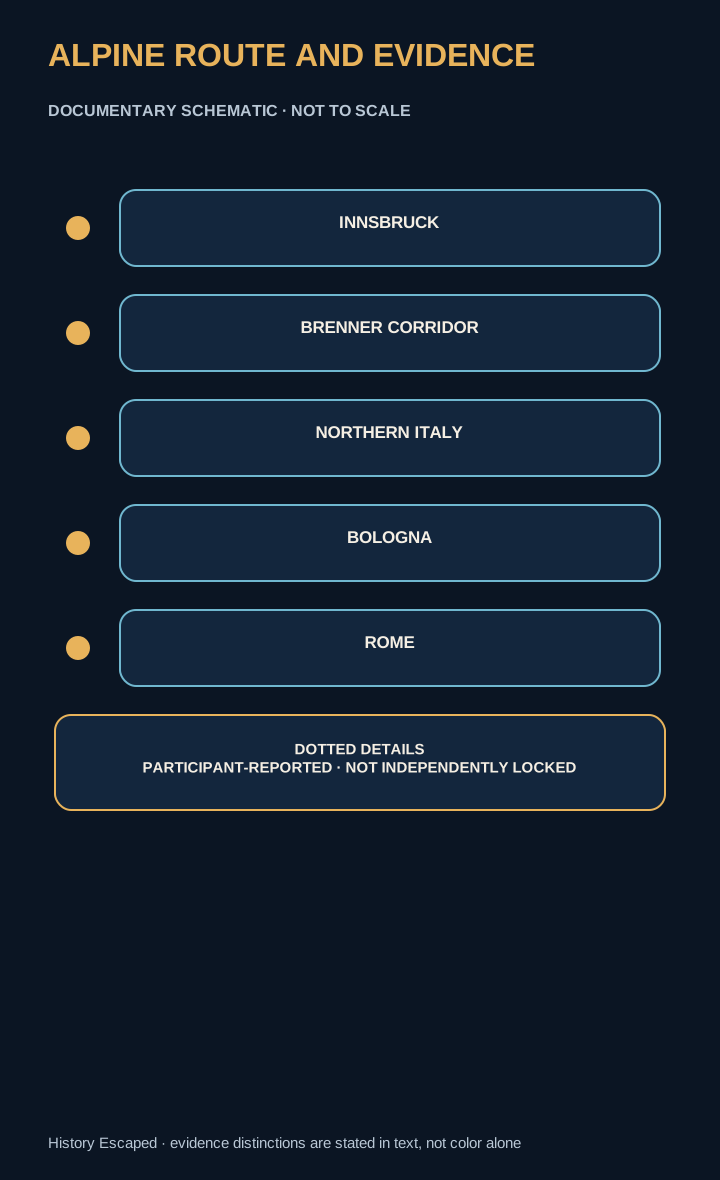
Simplified editorial reconstruction based on the cited historical record; not to scale. Uncertainty is stated directly in the visual and adjacent text.
Bologna
The rescue did not end the moment Clementina crossed an administrative frontier. The political objective was to place her somewhere the Habsburg government could no longer simply detain her and to formalize the Stuart marriage.
She continued to Bologna. A modern institutional account from the Museum of King Jan III's Palace at Wilanów dates her proxy marriage there to 9 May 1719.
James was not present. He was in Spain, involved in the wider Jacobite diplomatic and military maneuvering of 1719. The proxy ceremony gave Clementina a stronger public status as James's wife even before they could meet in person.
This also explains why describing the entire episode simply as an "elopement" is misleading. Clementina was not fleeing her family in order to marry against their wishes. Her father supported the Stuart match. The detention was a geopolitical intervention designed to stop it.
Rome
After Bologna, Clementina continued toward Rome, where Pope Clement XI supported the Stuart cause and offered protection.
Wilanów scholarship places her arrival in Rome on 15 May 1719. She entered through the Porta del Popolo and was lodged with the Ursuline community on Via Vittoria. There she could no longer be treated as a traveler passing through Habsburg territory.
The rescue had become an international political fact.
Rome celebrated her arrival, and Jacobite supporters quickly transformed the story into proof of devotion to James and his cause. One of the clearest surviving artifacts is a medal made by Ottone Hamerani in 1719. Its reverse shows Clementina departing in a carriage, with Rome in the distance, and celebrates the fact that the guards had been deceived.
That medal is not neutral evidence for the exact appearance of the escape. It is evidence for how quickly the escape was turned into political imagery.
Marriage in person
James and Clementina did not meet immediately after her arrival because James remained away.
The couple finally married in person at Montefiascone on 1 September 1719. Trinity College Dublin preserves their elaborate marriage certificate and identifies the ceremony as having taken place by papal order.
The marriage had consequences far beyond the rescue itself. Clementina gave birth to Charles Edward Stuart in 1720 and Henry Benedict Stuart in 1725. Charles would later lead the Jacobite rising of 1745.
The Innsbruck rescue therefore did exactly what George I's government had feared the marriage might do: it preserved a legitimate line of Stuart heirs.
It did not restore that line to the throne.
A rescue becomes propaganda
The escape embarrassed both London and Vienna. A bride whom imperial authorities had stopped for diplomatic reasons had been removed from their custody by a small Jacobite network and delivered into papal protection.
Wogan became celebrated in Jacobite circles. Pope Clement XI honored him, and James rewarded him as well. The rescue was retold in several forms before Wogan's own Female Fortitude appeared in London in 1722.
That publication has to be read in two ways at once. It is an extraordinary near-contemporary participant source. It is also part of the propaganda afterlife of the event.
Modern scholarship on Wogan's memoir emphasizes precisely this dual character. The narrative elevated Clementina's courage, Wogan's loyalty and James's dynastic legitimacy. Its vividness is a historical asset, but vividness is not the same as independent corroboration.
Evidence discipline
What the record supports
Status labels distinguish secure conclusions from uncertainty and rejected claims. Color is never the only signal.
MYTH
Clementina simply broke out of a conventional prison cell in Innsbruck.
The secure picture is political detention or house arrest appropriate to a royal prisoner. The rescue exploited household access, deception and identity substitution rather than a physical breach of prison architecture.
Sources: SRC-002, SRC-003, SRC-004MYTH
The maid-disguise story is only a much later romantic legend.
The clothing substitution appears in Charles Wogan's 1722 participant narrative and is repeated by modern institutional accounts. Exact dialogue and comic embellishments remain less secure.
Sources: SRC-001, SRC-003, SRC-006MYTH
Every colorful detail in Wogan's narrative is independently documented.
Wogan was a principal participant, but his account also served Jacobite commemorative and propaganda purposes. Incidents such as lost jewels, the maid's shoe dispute, courier drinking and near-precipice carriage danger should remain participant-reported.
Sources: SRC-001, SRC-008DISPUTED
27 April is an uncontested exact escape date.
Older reference works often give 27 April, while the detailed Wogan-based reconstruction places the actual departure late on 28 April after an originally planned 27 April attempt.
Sources: SRC-003, SRC-009DISPUTED
John Walkinshaw was unquestionably one of the core operational rescuers.
Later tradition credits him, but the Dictionary of National Biography notes that the evidence for his part depends mainly on a much later family memoir. He is not locked into the core rescue team.
Sources: SRC-011MYTH
Clementina was merely a passive object of rescue.
Early narrative tradition emphasizes her consent to the plan, participation in the disguise and determination to continue despite danger. The operation required her active cooperation.
Sources: SRC-001, SRC-003What is secure and what is not
The evidence supports a strong reconstruction of the structure of the rescue.
Clementina was held at Innsbruck for political reasons. Wogan organized a small Jacobite rescue team. Contact was established inside. Clementina feigned illness. Misset's maid was used in a clothing substitution. Clementina escaped disguised as a servant. The party traveled south by the Brenner corridor and through northern Italy. She reached Bologna, was married by proxy on 9 May, and arrived in Rome on 15 May.
The evidence becomes weaker when the story is reduced to individual dramatic beats.
Exactly how reluctant the maid was, what shoes she argued about, whether Clementina fell into a particular stream, how the jewels were forgotten, what words Wogan spoke, how a courier was incapacitated, and how close the carriage came to a precipice are best treated as details from Wogan's own narrative.
They should not be discarded. They should be labeled for what they are.
Why the escape worked
The rescue succeeded because it attacked the weak point in Clementina's confinement: identity rather than walls.
She was not being held in a purpose-built high-security prison. The Habsburg government needed to keep a royal woman under political control while still maintaining the forms appropriate to her rank. Servants could enter and leave. Visitors and household routines continued. A substitution could exploit the difference between supervision and continuous physical confinement.
The second advantage was speed. Once outside, Clementina did not remain near Innsbruck. The party moved immediately toward the Alpine corridor and a jurisdictional frontier.
The third was political geography. Reaching Italy did not merely increase distance. It brought Clementina closer to governments and institutions favorable to the Jacobite marriage, especially the papal court.
The escape therefore combined disguise, social access, rapid movement and diplomatic geography.
Why Clementina's escape matters
Clementina Sobieska's rescue is easy to remember as a romantic adventure because that is how Jacobites helped package it almost immediately.
Its deeper significance is political. The Habsburg emperor had detained a royal cousin to prevent a dynastic marriage desired by an exiled claimant and opposed by Britain's ruling dynasty. Clementina's decision to participate in the escape broke that intervention.
She was not simply "rescued" in the passive sense. The plan depended on her willingness to leave her mother, accept disguise, travel through dangerous weather and continue toward Italy knowing that capture could create another international crisis.
The operation succeeded. It embarrassed two governments, strengthened the Jacobite court, produced a marriage, and preserved a Stuart succession that later generated the most famous Jacobite challenge of the eighteenth century.
The later legends make the story brighter. The evidence is already dramatic enough.