
On July 20, 1966, Air Force Skyraider pilot Eugene Deatrick saw a figure moving near a river in Southeast Asia.
The man below waved. Deatrick circled again. Material on the ground formed an SOS.
No American airman had just been reported down in that immediate area. The person signaling had been missing for months. His name was Dieter Dengler.
Twenty-three days earlier, by official Navy accounting, Dengler had broken out of a prisoner-of-war camp in Laos with six other men. The fence was behind him, but the escape was not finished. Monsoon jungle, starvation, disease, rivers, villages, armed pursuers, and the simple problem of being visible from the air had replaced the stockade.
Only when a helicopter lifted him out did the escape become complete.
A crash put Dengler inside the war in Laos
Dengler flew A-1 Skyraiders from USS Ranger with Attack Squadron 145.
On February 1 his aircraft went down over Laos. Searchers eventually located the wreckage but not the pilot.
Pathet Lao forces captured him.
Official Navy history records mistreatment, interrogation, and an attempt to force him to sign a statement against the United States. He refused.
His captivity later brought him into contact with men who had already been prisoners much longer than he had. That matters because the famous version of the story often begins when Dengler arrives. The escape plan did not.
The seven prisoners had different histories
Gene DeBruin, Y.C. To, Phisit Intharathat, Prasit Prahmsuwan, and Prasit Thanee were connected to an Air America C-46 shot down in Laos in September 1963.
Duane Martin, an Air Force officer, had been captured in 1965. Dengler was the newcomer. By the time the men were brought together at Ban Hoeui Het, some had already spent years learning what captivity in Laos demanded. They had seen earlier plans fail.
They knew how guards behaved. They knew that simply getting outside a fence did not mean reaching safety. The successful breakout was therefore collaborative.

The camp could be studied
Later accounts describe a compact jungle prison with log structures, fencing, towers, armed guards, and a nearby stream. The prisoners watched it. They watched how many guards accompanied routine movements. They watched when the guards ate.
They watched where weapons were left. They worked on a way through the enclosure. And while they studied, their bodies deteriorated. Malaria, hunger, and prolonged captivity created their own deadline.
An escape plan that waited for perfect conditions might wait until the prisoners were physically unable to use it.

The men combined plans
Phisit Intharathat's later account is important because it changes the shape of the story. He remembered the prisoners discussing different ideas and combining them. The plan called for getting out of the enclosure, seizing weapons while the guards were concentrated around food, and then dividing after reaching the mountain. Weapons mattered.
The prisoners believed that unarmed fugitives could be hunted with little risk to their pursuers. An armed group at least had a chance to prevent immediate recapture.
This was not a simple fence break. It was an attempt to create enough distance and deterrence for seven weak men to disappear into jungle.
Even the breakout date is disputed
The official Navy Cross citation dates the stockade escape to June 30, 1966. That is the official date and the lead date used here. Bruce Henderson's later reconstruction uses June 29.
That is not a casual internet variation. Henderson's research incorporated interviews, military archives, and the official 78-page Dengler Debriefing obtained through the Freedom of Information Act.
A much later written account by Phisit contains late-July calendar markers that cannot be literally correct because Dengler's rescue on July 20 is securely documented. The evidence therefore requires a hierarchy. Use June 30 as the official date. Preserve June 29 as the serious alternative.
Do not force later inconsistent calendar markers into the chronology.
The plan changed as soon as the guards moved
The prisoners intended to seize control quickly. The guards did not cooperate. When some resisted or ran, the breakout became an armed clash. Later accounts disagree over exactly how many guards were killed or wounded.
There is no need to manufacture a number. The operational fact is enough: the attempt to control the camp without a prolonged fight failed, the prisoners obtained weapons, and the seven men had to leave immediately.
Seven men got out
The group consisted of:
- Dieter Dengler
- Duane Martin
- Gene DeBruin
- Y.C. To
- Phisit Intharathat
- Prasit Prahmsuwan
- Prasit Thanee
All seven escaped the stockade. That sentence needs a second sentence beside it:
They did not all reach safety.
The prison breakout and the successful return to friendly control were different events.
The groups split
Phisit later described four planned evasion groups:
Dengler and Martin
DeBruin and Y.C. To
Prasit Prahmsuwan and Prasit Thanee
Phisit alone
Small groups were harder to track. They could move at different speeds. They also prevented one pursuit from capturing everyone. The split reflected health and loyalty too.
Y.C. was very sick.
DeBruin stayed with him.
That detail matters because popular dramatization has sometimes portrayed DeBruin as an obstacle to escape. The survivor record instead puts him inside the breakout and beside a sick companion afterward.
The jungle erased distance
A map makes Laos look traversable. The monsoon jungle did not.
Rain filled streams. Vegetation blocked the sun. Mountains made direction uncertain. Malaria weakened the body. Leeches and cold water accumulated their own damage.
A man could travel for hours and discover he had circled back toward where he began. This is why the stockade was only the first prison. The fence was visible. The jungle had no visible boundary.
Dengler and Martin stayed together
Dengler and Duane Martin tried to move toward a place where friendly forces might find them. Waterways offered water and a way to reduce obvious tracks. They also passed villages.
The prisoners had already understood that villages were dangerous. A settlement could mean food, but it could also mean armed locals or communist forces.
Starvation eventually made that risk harder to avoid.
Martin was killed
During the evasion, Martin approached a village area with Dengler. A villager attacked them. Martin was killed. Dengler escaped the encounter and hid.
The two-man evasion became a one-man survival problem.
The event should not be dramatized graphically. Its historical importance is operational: Dengler lost his companion and continued alone in worsening physical condition.
The second prison closed around him
Official Navy history says Dengler had fallen to about ninety pounds by the time he was found. Other later accounts give a somewhat higher figure.
Either way, his condition was severe. He was sick. He was starving. He struggled to navigate.
And the jungle that concealed him from hostile forces also concealed him from American aircraft. The last phase of the escape required the opposite of hiding. He had to become visible.
Eugene Deatrick saw something that did not belong
On July 20, Air Force pilot Eugene Deatrick saw Dengler near a river and came around again. The man kept signaling.
On another pass, Deatrick recognized an SOS on the ground. Air Force recollection says discarded flare-parachute material helped form it.
Deatrick checked whether an American airman had recently been shot down there. None had. The man below had traveled into that place from an older loss. Deatrick called for a rescue helicopter.
The helicopter ended the escape
An HH-3 came in and recovered Dengler. Twenty-three days had passed since the breakout in official Navy accounting. The stockade was gone. The jungle was gone.
Dengler was back in friendly hands. The next day he returned to USS Ranger. That is the point at which the escape was actually complete.
The other six had different endings
Duane Martin was dead.
Gene DeBruin and Y.C. To disappeared after leaving the camp and were never recovered in the selected source record.
The two Prasits got out of the stockade, but the sources used here do not justify inventing a successful recovery for them. Phisit escaped alone and survived roughly a month before he was recaptured. His story continued. On January 9, 1967, a separate rescue operation finally freed him from another prison.
The seven-person breakout therefore created seven different survival stories. Dengler's happened to end with an American helicopter after twenty-three days.
Why a flawed survivor chronology can still be useful
Historical sources do not have to be either perfect or worthless. Phisit's late published account contains date markers that cannot fit the securely documented rescue chronology. Those dates fail. Other parts of his testimony remain exceptionally important.
He identifies the prisoners. He describes how they discussed the plan. He explains why weapons mattered. He records the intended post-breakout groups.
He gives a first-person account of his own recapture and later rescue. A rigorous reconstruction asks which source is strongest for which claim. It does not demand that one document control everything.
The Navy Cross itself describes a group operation
Dengler received the Navy Cross. The citation praises his role in planning, preparing, and carrying out an escape involving fellow prisoners. That wording matters. Even the award designed to honor Dengler does not describe a solitary prison break.
It recognizes leadership inside a group operation. That lets the history preserve his extraordinary courage without erasing the six men beside him.
Rescue Dawn is a film, not the roster
Werner Herzog's Rescue Dawn brought the story to a wide audience. It is a dramatization. Even official publicity tied to the film compresses the prisoner group. Military records and survivor accounts provide a stronger historical basis.
The real breakout included seven men from different backgrounds and different years of capture. Planning was collaborative. DeBruin was not simply a man who refused the escape. The film belongs in the cultural history of the case.
It does not control the case.
What actually made the escape work
The breakout required observation. It required cooperation among sick prisoners. It required a physical exit. It required a moment when the guards were vulnerable.
It required weapons when the plan collapsed into violence. Then the escape required something completely different. Navigation. Water.
Food. Concealment. Luck. And eventually a signal visible from the sky.
Breaking out of Ban Hoeui Het solved the prison problem. Surviving long enough to be seen from the air solved the escape problem. Dieter Dengler escaped both.
Escape reconstruction
How the escape unfolded
An evidence-aware sequence of the principal stages.
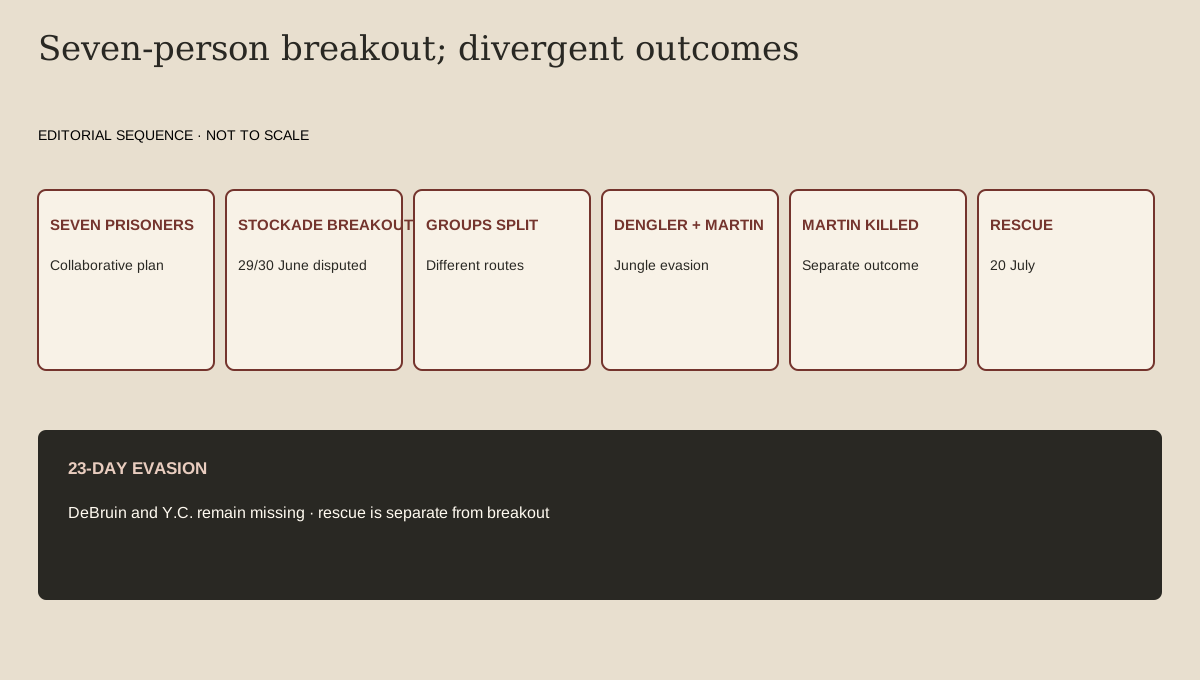
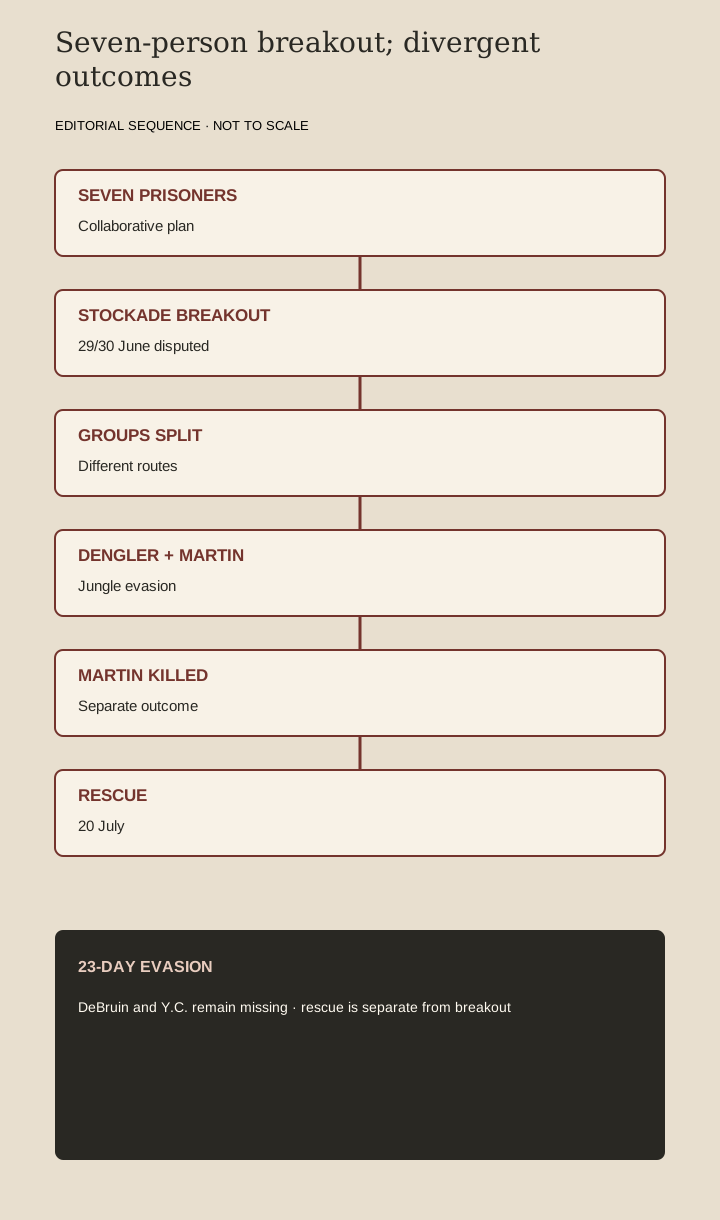
Simplified editorial reconstruction; not to scale. See adjacent text for evidence qualifications and unresolved details.
Material evidence
Tools of Escape
The objects used in an escape reveal how a plan worked under constraint.
- 01The prisoners believed arms were necessary to resist immediate pursuit.
Seized guard weapons
The plan depended on taking weapons while guards were concentrated near their meal area.
- 02It converted months of observation into a physical exit.
Prepared stockade opening
A concealed route through or under the camp barrier allowed the breakout to begin quickly.
- 03They aided movement but also led toward villages and cold-water exposure.
Streams and rivers
Waterways provided water, cover, and possible track concealment.
- 04It made Dengler distinguishable from jungle terrain to aircraft overhead.
Improvised SOS
Air Force recollection says visible material including discarded flare-parachute fabric helped form an SOS.
- 05The escape was not complete until friendly forces physically recovered him.
HH-3 rescue helicopter
An Air Force helicopter extracted Dengler after he was identified from the air.
Problem → response
Escape was a sequence of problems
Each response solved a practical obstacle while often creating the next one.
- 01→
Obstacle
Guarded stockade
The prisoners were enclosed by barriers, towers, armed guards, and remote terrain.
Response
They studied routines and prepared an exit timed to a predictable guard meal period.
- 02→
Obstacle
Starvation and disease
Malaria, inadequate food, and prolonged captivity weakened the group.
Response
The prisoners moved toward escape before declining health made the plan impossible.
- 03→
Obstacle
Breakout becomes violent
The plan to control the guards failed when guards resisted or ran.
Response
The prisoners used seized weapons and fled rather than trying to hold the camp.
- 04→
Obstacle
Monsoon jungle
Rain, vegetation, mountains, disease, and poor visibility made navigation extremely slow.
Response
Escapees used waterways, small groups, concealment, and aircraft signaling.
- 05→
Obstacle
Villages
Settlements offered food but could expose escapees to capture or attack.
Response
The plan emphasized avoiding villages, though starvation eventually forced Dengler and Martin toward one.
- 06→
Obstacle
Aerial invisibility
A person beneath jungle canopy could be almost impossible for aircraft to see.
Response
Dengler reached more open river terrain and used repeated waving and an improvised SOS.
The final accounting
Outcome
Prisoners who exited the camp
All seven members of the breakout group got out of the stockade.
Dengler rescued in July 1966
Recovered after 23 days of evasion.
Martin killed during evasion
Killed after the breakout.
Phisit later recovered
Recaptured after the breakout, then rescued January 9, 1967.
Other outcomes unresolved in selected sources
DeBruin and Y.C. disappeared; the selected source set does not securely establish successful recovery for the two Prasits.
Evidence discipline
What the record supports
Status labels distinguish secure conclusions from uncertainty and rejected claims. Color is never the only signal.
DISPUTED
The exact breakout date is uncontested.
The Navy Cross citation uses June 30. Henderson's reconstruction, informed by the official 78-page Dengler Debriefing, uses June 29. Phisit's later account contains a late-July sequence incompatible with Dengler's documented July 20 rescue, so it cannot control the date.
Sources: SRC-004, SRC-008, SRC-009, SRC-017MYTH
Dengler planned and executed a completely solo prison escape.
Seven prisoners broke out and both the award citation and survivor testimony describe a group operation with shared planning.
Sources: SRC-004, SRC-008, SRC-017MYTH
All seven prisoners had been captured with Dengler in 1966.
Several Air America prisoners had been captive since 1963 and Martin since 1965.
Sources: SRC-016DISPUTED
The exact number of guards killed during the breakout is securely known.
Later accounts differ. The evidence establishes that an armed clash occurred but does not support a precise casualty number.
Sources: SRC-008, SRC-017MYTH
Leaving the stockade completed Dengler's escape.
He still spent 23 days evading before recovery by friendly forces.
Sources: SRC-001, SRC-002, SRC-005MYTH
Duane Martin was rescued with Dengler.
Martin escaped with Dengler but was killed during post-breakout evasion.
Sources: SRC-001, SRC-008MYTH
Gene DeBruin refused to participate in the escape.
Survivor testimony places DeBruin inside the plan and breakout. He then chose to remain with the seriously ill Y.C. To.
Sources: SRC-016, SRC-017MYTH
Rescue Dawn is a reliable transcript of the prisoner group and camp events.
It is a dramatization. Military and survivor sources establish a seven-person breakout group and a more collaborative plan.
Sources: SRC-005, SRC-016, SRC-017DISPUTED
Modern sources consistently identify the exact same A-1 Skyraider subtype.
Some Navy summaries use A-1H, while airframe records identify Bureau Number 142031 as an A-1J. A-1 Skyraider is the secure description.
Sources: SRC-002, SRC-013Selected chronology
Selected chronology
Air America C-46 is shot down
DeBruin, Y.C. To, Phisit and the two Prasits are among personnel captured after an Air America C-46 is lost in Laos.
Duane Martin is captured
Martin is captured after a U.S. rescue helicopter is lost in Laos and later joins the other prisoners.
Dengler is shot down
Flying with VA-145 from USS Ranger, Dengler's A-1 Skyraider is lost over Laos.
Capture
Pathet Lao forces capture Dengler and eventually move him into the prison system with the other men.
Ban Hoeui Het
The prisoners are brought together at the jungle camp where the final breakout is developed.
Breakout
The Navy Cross uses June 30; Henderson's debriefing-based reconstruction uses June 29. All seven prisoners leave the camp.
Groups separate
The escapees divide into smaller evasion parties.
Duane Martin is killed
Martin is killed by a villager after he and Dengler approach a settlement seeking food.
Dengler is rescued
Air Force Skyraiders identify his signaling and an HH-3 helicopter extracts him.
Return to USS Ranger
Dengler is returned to the carrier and reunited with his squadron.
Phisit is rescued
After his 1966 breakout ended in recapture, Phisit is freed in a separate operation.