
On Monday, September 3, 1838, Frederick Augustus Washington Bailey left Baltimore wearing the clothes of a Black sailor. He was twenty years old. In his pocket was a document that could save him or expose him. It was not his.
The paper belonged to a free Black seaman and certified its bearer as a free American sailor. It carried official-looking authority, but the physical description on it did not fit Frederick closely. He later remembered that the document described a man much darker than himself.
If a conductor examined it carefully, the escape could end before he got out of Maryland. So Frederick did not build his plan around a perfect forged identity. He built it around speed, timing and performance.
He arranged to reach the train at the last possible moment. He boarded after it had begun moving. He dressed the part. Years working in Baltimore shipyards had taught him sailors' language and the details of ships well enough that the paper and the man holding it seemed to belong together.
Before the next morning, he would travel by train, ferry, train again, steamboat and another train. He would pass people who knew him. He would cross two slave states. He would survive an official check of the borrowed paper.
He would reach Philadelphia and keep going because even free soil did not make him safe. Less than twenty-four hours after leaving Baltimore, he arrived in New York. The man who became Frederick Douglass had escaped slavery.
Douglass deliberately hid this story for decades
There is a reason the most famous Frederick Douglass autobiography does not tell readers exactly how he escaped. When Narrative of the Life of Frederick Douglass, an American Slave appeared in 1845, Douglass refused to publish the operational details. That omission was deliberate. He believed an escape story could become an instruction manual for enslavers.
If he revealed what documents had worked, where fugitives changed transportation or who helped them, slaveholders could watch those routes more closely. People who had aided freedom seekers could be prosecuted. Methods still available to enslaved people could be destroyed.
His 1855 autobiography maintained essentially the same position. Only after slavery had been abolished did Douglass decide the danger had passed. In Life and Times of Frederick Douglass, published in 1881, he finally reconstructed the journey in detail. That gives this escape an unusual source history.
The broad fact of his self-liberation was famous for decades. The mechanism was intentionally secret.
The first escape had already failed
The 1838 plan was not Douglass's first attempt. In 1836, while living on Maryland's Eastern Shore, he and several other enslaved men planned to escape together. The plan was discovered. Douglass was arrested and jailed.
He eventually returned to Baltimore. Failure changed the problem.
A second attempt could not simply repeat the first. It had to reduce the number of people who knew the plan, exploit skills he could personally control and move him out of Maryland before anyone could organize a response.
Baltimore gave him the tool he needed. The city put him among sailors.

Ship caulking taught him how to become someone else
Douglass worked as a caulker in Baltimore's shipyards.
Caulkers sealed seams in wooden vessels to keep them watertight. The work placed him inside a maritime labor culture containing both enslaved and free Black workers.
For an escape planner, that environment offered more than wages. It offered an identity. Douglass learned ships. He learned the language sailors used.
He knew enough of a vessel's structure to talk convincingly about maritime work. He saw how Black seamen dressed. And he became familiar with a class of documents carried by sailors. The escape eventually turned that occupational knowledge into camouflage.
He would not merely wear sailor clothes. He could perform the person those clothes represented.
Identity and route
A disguise system and a four-state journey
The escape depended on clothing, real maritime knowledge, a borrowed federal document and rapid public travel.
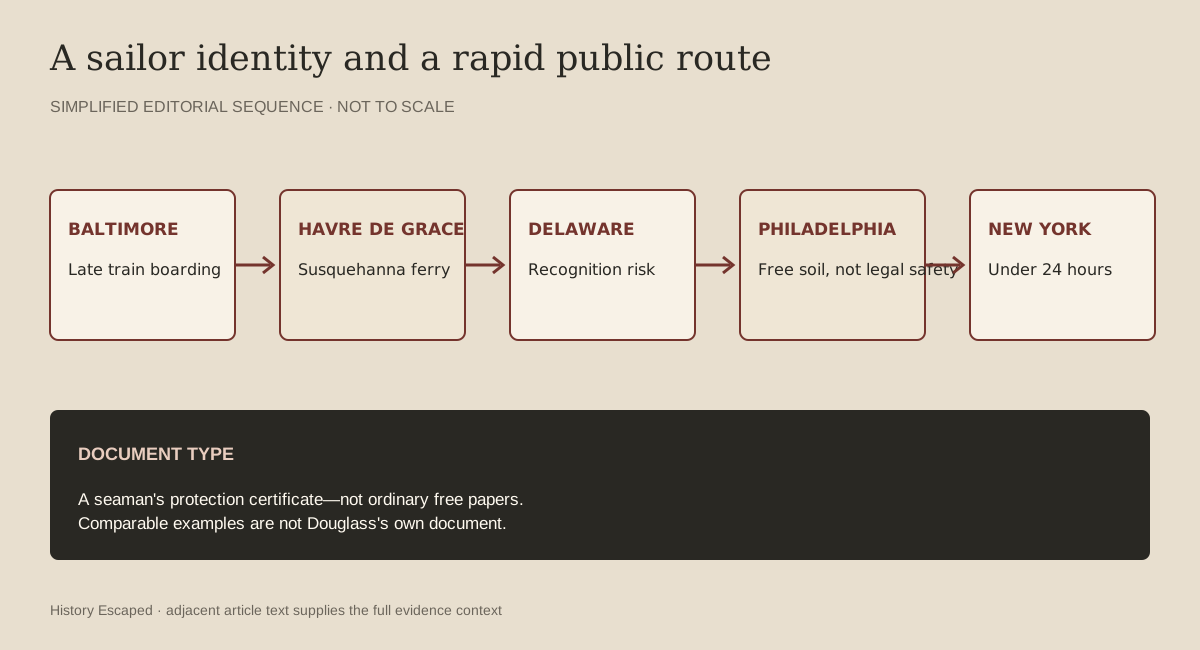
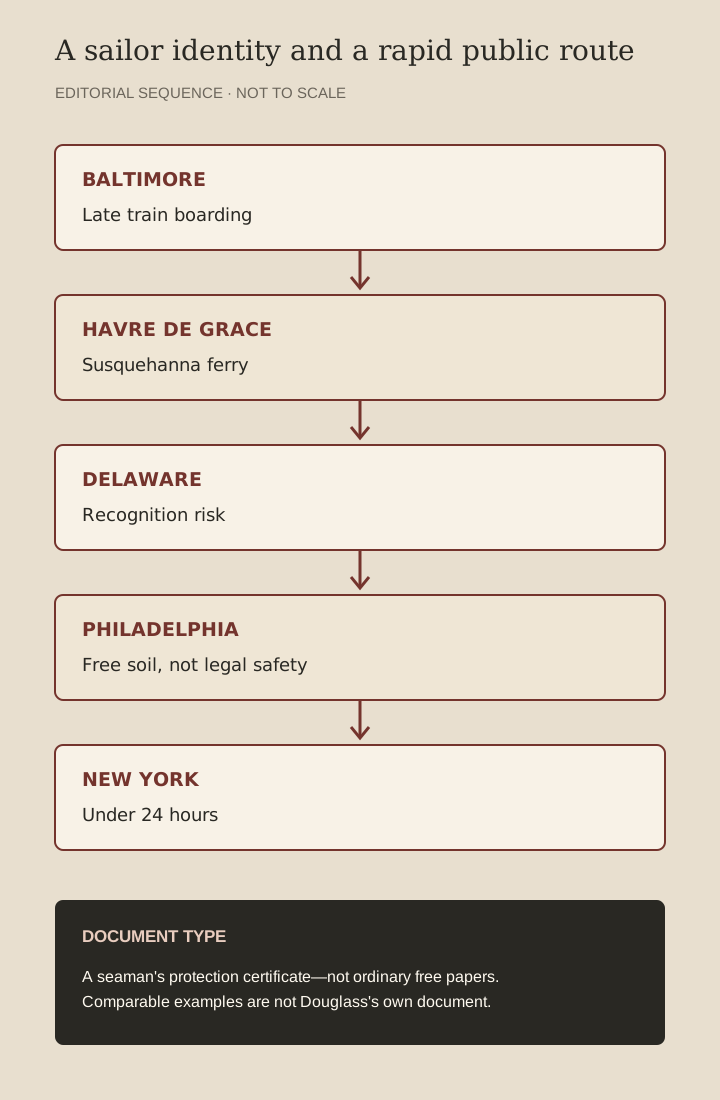
- 01
Identity system
Sailor clothing, maritime knowledge and a borrowed seaman's protection certificate reinforced one another.
- 02
Inspection
Late boarding and a quick conductor inspection reduced scrutiny; the paper did not closely match him.
- 03
Maryland
The route crossed the Susquehanna at Havre de Grace while recognition risks persisted.
- 04
Delaware and Philadelphia
Wilmington and Philadelphia were transfers, not automatic legal security.
- 05
New York
Douglass arrived in under twenty-four hours and entered David Ruggles's protection network.
Simplified editorial route; not to scale. Exact station and track details are not asserted, and the document shown in the explanatory treatment is a comparable period certificate—not Douglass's own paper.
What a seaman’s protection certificate actually was
Black mobility in the antebellum United States was heavily documented and policed. Free Black people could be required to prove their status. American seamen had another kind of document: the seaman's protection certificate.
These papers developed as evidence that sailors were American citizens and were intended in part to protect American mariners against foreign impressment. They typically listed identifying characteristics such as age, height, complexion, hair, eyes and distinguishing marks.
Black sailors carried them too. That created an unintended possibility. A document intended to certify a sailor's identity and citizenship could also provide evidence that a Black bearer was not enslaved. Douglass understood the opportunity.
He also understood the weakness. He did not resemble the sailor named in the document closely enough to survive a careful comparison. The paper gave him a claim. His performance had to prevent anyone from testing that claim too hard.
The unnamed sailor took an enormous risk
In Life and Times, Douglass did not identify the sailor who lent him the protection. He described him simply as a friend. That anonymity is significant. When slavery existed, helping an enslaved person escape could expose a free Black person to severe punishment and danger.
If Douglass were arrested carrying another man's protection certificate, investigators could pursue the owner of the paper as well. The document therefore represented more than a borrowed identity. It represented trust. A free Black sailor placed his own security at risk so another man could attempt to become free.
The specific certificate Douglass carried has not been identified as a surviving museum artifact. That means modern examples of seamen's protection certificates can explain the mechanism, but they must never be captioned as "Douglass's paper."

Anna Murray was part of the escape before he boarded the train
The story also becomes distorted when Anna Murray enters only after Frederick reaches New York. She was already part of the operation in Baltimore. Anna was a free Black woman who had come to Baltimore from Maryland's Eastern Shore and found work as a domestic servant. She and Frederick developed a relationship before his escape.
Institutional sources consistently credit her with helping finance the journey. The National Portrait Gallery and Maryland State Archives preserve the tradition that she sold a feather bed to help pay his expenses.
One National Park Service biography goes further, crediting Anna with sewing a sailor's uniform and helping obtain a protection certificate. There is a small source problem here. Douglass's own later escape account says he had a sailor friend who owned the protection and does not identify Anna as the person who borrowed it from him.
That does not undermine Anna's importance. It means the exact division of preparation is less certain than the broad fact of her assistance. Money, clothing and planning were necessary before the train moved. Anna helped make those things possible.
The sailor disguise had to survive conversation
Douglass described the clothing clearly. A red shirt. A tarpaulin hat. A black cravat tied loosely in sailor fashion.
The outfit mattered because it made the protection certificate plausible. But clothes alone were not enough. A person checking the paper could ask where he worked. A sailor could talk about ships.
Douglass could too. He later emphasized that his knowledge of vessels and sailors' speech gave him confidence in the role. That was the difference between a costume and a working identity. The document said sailor.
The clothing said sailor. His language said sailor. Every layer supported the others.
Why he boarded after the train started moving
The most ingenious part of the plan may have happened before the conductor ever saw him. Douglass believed entering the station normally and buying a ticket would expose him to close inspection. So he arranged a different sequence. A hackman named Isaac Rolls was to bring his baggage to the train at the moment it was leaving.
Douglass then got aboard when the train was already moving. The point was not cinematic daring for its own sake. It was administrative avoidance. Inside a station, an official had time to look at a Black traveler's documents.
On a moving train crowded with passengers, a conductor had other work to do. Douglass was creating haste. He wanted the first serious document check to happen in a place where the person checking had an incentive to keep moving.
The conductor comes into the Black car
The strategy worked exactly where it needed to. The conductor eventually entered the car where Black passengers were seated and began examining their papers. Douglass watched him move closer. Other Black travelers produced their free papers.
Douglass did not have free papers. He had the sailor's protection. When questioned, he presented himself as a mariner who did not normally carry ordinary free papers while at sea. He produced the protection certificate.
The conductor looked at it. Not carefully enough. That was the critical moment. The document's description could have exposed him.
Instead, the conductor accepted it and moved on. The escape had survived the checkpoint most directly built to stop it.
Getting past one conductor did not mean getting out of Maryland
Douglass remained in a slave state. He also remained surrounded by people. Several passengers could have known him from Baltimore. That was one of the dangers of escaping publicly.
A hidden fugitive fears searchers. A disguised fugitive fears ordinary acquaintances. The train headed toward Havre de Grace. Douglass could do little except remain in character and wait.
The Susquehanna crossing nearly exposed him
Rail travel north did not yet provide a continuous bridge across the Susquehanna River. At Havre de Grace, passengers crossed by ferry. That transfer forced Douglass into another public space. There he met a Black worker named Nichols.
Nichols knew him or believed he knew him. He began asking questions. Where was Douglass going? When was he coming back?
Those were ordinary questions under normal circumstances. They were dangerous questions during an escape. Douglass disengaged and moved to another part of the ferry. The disguise did not fail.
But anonymity had.
Then a man from the shipyard appeared
After the ferry crossing, the northbound train met a southbound train. Sitting where he might have seen Douglass was Captain McGowan. Douglass had recently worked on a revenue cutter under McGowan's supervision at a Baltimore shipyard. If McGowan looked directly at him and recognized him, the sailor costume would no longer matter.
According to Douglass, he did not look in time. The trains separated. It was luck in its purest form. No document trick solved it.
No planning solved it. A man simply failed to notice another man at the right second.
The German blacksmith may have chosen silence
Another acquaintance appeared on the train. Douglass remembered a German blacksmith staring at him as if trying to place his face. Douglass believed the man recognized him. He also believed the man decided not to say anything.
That interpretation comes from Douglass's later memory and cannot be independently verified. But it reflects a recurring feature of escape history. Successful flight is often built not only from active helpers but from people who choose not to become obstacles. If the blacksmith understood what was happening, silence was enough.
Delaware was still dangerous
Crossing the Susquehanna did not mean crossing into freedom. Douglass still had to pass through Delaware, another slave state. He later remembered border regions as especially dangerous because slave catchers watched places where freedom seekers were likely to pass. The transportation network that made rapid escape possible also concentrated risk.
Rail stations. Ferries. State boundaries. Ports.
These were the places fugitives had to use and the places pursuers could monitor. The speed of the system and the surveillance of the system existed together.
Wilmington was the last major slave-state transfer
Douglass remembered Wilmington as the final point he especially feared. There he left the train. He transferred to a steamboat bound for Philadelphia. A transfer meant standing still.
It meant presenting himself again in public. It meant waiting among strangers. Nothing happened. Soon the boat was moving north along the Delaware River.
Philadelphia came into reach.
Philadelphia was free soil—but Douglass did not stop
Douglass reached Philadelphia in the afternoon. He had left the two slave states behind. But he did not treat the city as the end of the journey. The legal structure of the United States still permitted claims against people who had escaped slavery into other states.
The Fugitive Slave Act of 1793 already existed. A border between slave state and free state did not erase an enslaver's claim under federal law. Douglass asked a Black man how to continue to New York. He was directed to the Willow Street depot.
That night he boarded another train. The escape continued.
Less than twenty-four hours
Douglass arrived in New York on Tuesday morning, September 4. The full journey had taken less than twenty-four hours. That speed is one of the most important facts in the case. The plan did not require Douglass to remain hidden for weeks.
It required the transportation network to carry him beyond Maryland before anyone who claimed control over him could organize effectively. Railroads and steam travel compressed distance. Douglass exploited that compression. But arrival produced a new discovery.
Freedom was not the same as security.
New York frightened him almost immediately
Douglass later wrote of enormous joy when he realized he had escaped immediate enslavement. The feeling did not last undisturbed. He encountered another man who had escaped slavery and learned how dangerous New York could be. Slave catchers operated there.
Informants could betray fugitives for money. Wharves and Black boarding houses might be watched. Douglass's own trade made the waterfront particularly dangerous because anyone pursuing him could reasonably expect a caulker to seek work around ships. He had reached a free state.
He was still legally vulnerable. He needed people he could trust.
David Ruggles turns arrival into protection
A sailor eventually connected Douglass with David Ruggles. Ruggles was a Black abolitionist and a leader in New York's vigilance movement. His network assisted freedom seekers and fought kidnapping and recapture. This was Douglass's first direct encounter with an organized Underground Railroad operative after reaching the North, according to his later account.
Ruggles sheltered him. That distinction matters. The escape from Baltimore itself was not a continuous hidden journey from safe house to safe house. It was public transportation under a false occupational identity.
The organized abolitionist protection network became critical after he reached New York.
Anna comes north
Once Douglass had a measure of safety, he sent word to Anna Murray. She came to New York. On September 15, twelve days after his departure from Baltimore, they married.
The minister was James W. C. Pennington, himself a former freedom seeker from Maryland.
The marriage joined two parts of the escape story that are sometimes separated in retelling. Frederick had physically made the journey. Anna had helped make it possible and then moved north to build the life that followed.
From Johnson to Douglass
The couple did not remain in New York. Ruggles believed New Bedford, Massachusetts, would offer Frederick better prospects for caulking work and greater security. They traveled there after the marriage. Frederick had already used the surname Johnson as a protective alias.
In New Bedford, their host Nathan Johnson pointed out how common the name was and helped select another. Frederick Bailey became Frederick Douglass. The name by which history remembers him was therefore not the name that got on the train in Baltimore. It belonged to the life built after the escape.
Why the 1845 book still refused to tell readers how it happened
By 1845 Douglass had become a nationally known abolitionist speaker. Publishing his autobiography made him more famous. It also identified him publicly as a man who had escaped slavery and named people and places connected with his enslavement. Yet even then, he would not give the escape method.
The reason was strategic. He believed publicizing a successful method while slavery continued could close that method to other freedom seekers. It could also expose helpers. This matters because modern readers often expect historical testimony to reveal everything the witness knows.
Douglass had a different ethical priority. Accuracy to his own experience mattered. So did protecting people still trying to escape. Silence could be part of resistance.
The later account turns the escape into an engineering problem of identity
When Douglass finally published the details after emancipation, the story that emerged was not a wilderness chase. It was a transportation-and-document problem. Every stage had a function. Sailor clothing made his appearance plausible.
Shipyard knowledge allowed him to support the role. The protection certificate supplied official-looking proof. Late boarding reduced station scrutiny. Rail travel created speed.
The ferry crossed infrastructure the railroad could not. The Wilmington steamboat completed the path to Philadelphia. The night train kept him moving after reaching free soil. Ruggles's network turned arrival into temporary protection.
The escape succeeded because these systems overlapped.
Evidence discipline
What the record supports
Status labels distinguish secure conclusions from uncertainty and rejected claims. Color is never the only signal.
MYTH
Douglass published the full details of his escape in his famous 1845 Narrative.
The 1845 Narrative deliberately withholds the method. Douglass said publication could endanger helpers and teach enslavers how to close routes still usable by others. He maintained the same basic caution in 1855 and gave the detailed sailor-paper route only after emancipation, in Life and Times.
Sources: SRC-001, SRC-003, SRC-021MYTH
The sailor's protection certificate matched Douglass well enough to serve as normal identification.
Douglass explicitly said it described a man much darker than himself and that close scrutiny would have exposed him. The escape depended on occupational performance and hurried inspection, not on a strong physical match.
Sources: SRC-001MYTH
The paper Douglass used was an ordinary set of free papers.
Douglass distinguished ordinary free papers from a sailor's protection certificate. The latter certified the bearer as a free American sailor and carried official-looking national imagery. It could serve some of the same practical purpose but was a maritime citizenship/protection document.
Sources: SRC-001, SRC-012, SRC-013MYTH
Anna Murray played only a later domestic role and was not important to the 1838 escape.
NPS, Smithsonian, Library of Congress and Maryland State Archives sources agree that Anna materially helped the escape, especially through money and preparation. Several institutional accounts say she sold a feather bed to finance the trip.
Sources: SRC-004, SRC-007, SRC-008, SRC-010, SRC-011DISPUTED
Anna Murray personally obtained the exact protection certificate from the sailor.
An NPS Anna Murray biography says she borrowed a freedman's protection certificate, while Douglass's own later escape account says he had a sailor friend who owned the protection and describes borrowing it without identifying Anna as the intermediary. The broad fact of Anna's assistance is secure; the precise chain by which the certificate changed hands is not.
Sources: SRC-001, SRC-008MYTH
Douglass rode one train directly from Baltimore to New York.
His own account describes a multi-mode journey: train from Baltimore toward Havre de Grace, ferry across the Susquehanna, continued rail travel through Delaware, steamboat from Wilmington to Philadelphia, and a night train from Philadelphia to New York.
Sources: SRC-001, SRC-006MYTH
Reaching Philadelphia or New York made Douglass legally secure from his enslaver.
The Fugitive Slave Act of 1793 and constitutional fugitive-service provisions supported interstate recapture claims. Douglass himself described New York as dangerous and sought immediate assistance from an abolitionist vigilance network.
Sources: SRC-001, SRC-015MYTH
The name Frederick Douglass was the identity used throughout the escape.
He escaped as Frederick Bailey and used Johnson after reaching the North. The surname Douglass was adopted after the newly married couple reached New Bedford, with Nathan Johnson helping choose it.
Sources: SRC-001, SRC-014UNKNOWN
The exact sailor clothing and paper used in 1838 survive as known museum artifacts.
No authenticated escape-day garment or the specific borrowed protection certificate is identified in the institutional sources used here. Comparable period certificates can illustrate the document type but must be labeled as examples, not Douglass's actual paper.
Sources: SRC-013, SRC-017What the borrowed paper teaches us
The strongest object in this story is not a weapon. It is a piece of paper. A seaman's protection certificate existed because the United States wanted to identify and defend its sailors. For a Black sailor, it also asserted citizenship and freedom in a society where Black legal status could be questioned constantly.
Douglass turned that official document against a slave system. The paper was meant to describe one man. For a few critical hours, it described another man well enough. That was all the escape required.
Material evidence
Identity, document and knowledge
The objects used in an escape reveal how a plan worked under constraint.
- 01The paper gave an official-looking basis for his claim to be a free Black sailor even though its physical description did not match him closely.
Seaman's protection certificate
A federal-style identity and citizenship document carried by American seamen. Douglass used a borrowed certificate belonging to a free Black sailor.
- 02The clothing made the borrowed maritime document and his shipyard knowledge mutually reinforcing rather than appearing as unrelated props.
Sailor clothing
Douglass described a red shirt, tarpaulin hat, and black cravat worn loosely in sailor fashion.
- 03If questioned, he could perform the occupational identity the document claimed.
Maritime vocabulary and trade knowledge
Caulking work had made Douglass familiar with ships and sailor speech.
- 04The escape depended on cash, clothing, and preparation that Douglass could not safely create alone.
Anna Murray's money and preparation
Institutional and archival sources credit Anna with financing the journey; several accounts say she sold a feather bed, and one NPS biography credits her with sewing sailor clothing and helping obtain a protection certificate.
- 05Speed shortened the interval in which his absence could be discovered and pursuit organized.
Rapid public transportation
Rail, ferry, steamboat, and another night train carried Douglass from Baltimore to New York in less than a day.
Problem → response
Escape was a sequence of problems
Each response solved a practical obstacle while often creating the next one.
- 01→
Obstacle
Protection paper did not match his appearance
Douglass said the borrowed certificate described a man much darker than himself.
Response
He avoided station scrutiny, performed the sailor identity convincingly, and depended on the conductor giving the paper only a quick glance.
- 02→
Obstacle
Railroad inspection of Black passengers
The conductor examined papers carried by Black travelers.
Response
Douglass produced the seaman's protection rather than conventional free papers and used sailor language to reinforce the claim.
- 03→
Obstacle
Recognition by people from Baltimore
Several people who knew Douglass were encountered during the trip.
Response
Clothing, movement, luck, and in at least one case the apparent decision of an acquaintance not to expose him prevented identification.
- 04→
Obstacle
Slave-state borders
Maryland and Delaware both presented legal and practical danger, and Douglass remembered border areas as especially watched.
Response
He minimized stops, used public transportation, and maintained the sailor persona until reaching Pennsylvania.
- 05→
Obstacle
Wilmington transfer
Changing from rail to steamboat created another point at which he feared inspection or arrest.
Response
No one challenged him, allowing him to reach Philadelphia that afternoon.
- 06→
Obstacle
Free soil was not legal safety
Federal law permitted people claimed as fugitives from slavery to be pursued across state lines, and Douglass quickly learned that New York contained slave catchers and informants.
Response
He sought help through David Ruggles and the New York Vigilance Committee and then relocated with Anna to New Bedford.
What actually made the escape work
Douglass later downplayed the romance of the method. That is exactly why it deserves reconstruction. It worked because he understood the systems around him. He knew how Black travelers were inspected.
He knew what sailors looked like. He knew how sailors talked. He knew the difference between standing in a ticket office and dealing with a conductor on a moving train. He knew rapid transportation could outrun discovery.
Anna Murray helped provide the resources. A free Black sailor risked his own security by lending the crucial document. Isaac Rolls helped with timing. An acquaintance may have chosen silence.
David Ruggles supplied protection after arrival. No single element was enough. Together they moved Frederick Bailey from slavery in Baltimore to New York in less than one day. The transformation into Frederick Douglass came next.
Selected chronology
Selected chronology
First escape plan fails
A group escape attempt is discovered. Douglass is jailed and eventually returned to Baltimore.
Baltimore maritime work
Douglass learns ship caulking and gains familiarity with sailors, shipyards, maritime language, and documents.
Anna Murray becomes central to the plan
Douglass meets the free Black Baltimore woman who helps finance and prepare his successful escape.
Baltimore departure
Disguised as a sailor and carrying a borrowed seaman's protection certificate, Douglass boards a northbound train as it is already moving.
Havre de Grace / Susquehanna
He crosses the Susquehanna by ferry and survives a dangerous encounter with a Black ferry worker who knows him.
Through Delaware
Douglass continues north by rail, aware that Delaware remains a slave state and that border points are especially dangerous.
Wilmington to Philadelphia
He transfers from the train to a steamboat and reaches Philadelphia that afternoon.
Philadelphia to New York
Douglass leaves from the Willow Street depot on a night train.
New York
He reaches New York in less than twenty-four hours but quickly discovers that freedom from immediate control is not the same as safety from recapture.
Frederick and Anna marry
James W. C. Pennington marries the couple in New York, within David Ruggles's abolitionist circle.
New Bedford
The couple reaches New Bedford, Massachusetts, where Nathan Johnson helps them settle and the surname Douglass is adopted.
Douglass withholds the escape method
In his first autobiography, Douglass deliberately refuses to reveal the operational details because he fears endangering helpers and closing routes other enslaved people might use.
The full method is published
After slavery has been abolished, Douglass finally publishes the detailed sailor-paper and transport sequence in Life and Times.