
At 3:15 in the morning on 5 May 1963, an Austin-Healey Sprite approached the East German controls at Checkpoint Charlie. The car looked wrong.
Its roof was down. Its windshield had been removed. The tires had been softened by letting out some air. Behind the driver, in a space never meant to carry a passenger comfortably, was a young East Berlin woman named Margarete Thurau. In the luggage compartment was her mother.
At the wheel sat Heinz Meixner, a 20-year-old Austrian who was about to turn the geometry of the checkpoint against the border itself. A guard checked his papers and directed him toward customs. Meixner accelerated instead. He steered through the checkpoint obstacles, aimed the tiny sports car at the final closed barrier, ducked his head below the windshield line, and drove underneath it into West Berlin.
The escape lasted only seconds. Planning it had taken much longer.
A relationship divided by a border
The Berlin Wall had been standing for less than two years when Meixner made his attempt.
After 13 August 1961, East German authorities sharply restricted movement from East Berlin and the German Democratic Republic into West Berlin. The crossings that remained open did not all serve the same people. Checkpoint Charlie, on Friedrichstraße, had a special role: it was the crossing used by foreigners and Allied personnel.
That mattered to Meixner.
He was Austrian, not East German. Contemporary reporting described him as a young worker from Linz who had come to West Berlin and could cross into East Berlin using his foreign passport. During those visits he met Margarete Thurau. The two became engaged.
The problem was not getting Meixner into East Berlin. It was getting Margarete out.
Contemporary accounts reported that she applied for permission to emigrate to Austria and was refused. If the couple wanted to leave East Berlin together, they would need another route.
For Meixner, the legal crossing itself became the route.
The weakness was above the road
Checkpoint Charlie was not a single wooden arm across an empty street. A driver approaching from East Berlin had to move through a controlled border complex: identity checks, customs procedures, traffic obstacles, guards, and a final barrier before entering the western sector. Most escape plans tried to defeat such barriers by breaking them, avoiding them, or going around them.
Meixner noticed another possibility. He could go under one.
A near-contemporary report in TIME described how he deliberately stopped a motor scooter near the Friedrichstraße crossing under the pretense of engine trouble. While there, he measured the clearance beneath the final horizontal barrier.
The reported result was 37½ inches, roughly 95 centimeters. That measurement changed the problem.
Meixner no longer needed a vehicle powerful enough to smash a barrier. He needed a vehicle low enough to make the barrier irrelevant.

Finding the right car
He began looking through West Berlin car-rental agencies. The solution was a small British sports car: an Austin-Healey Sprite.
The Sprite was compact even by early-1960s standards. More important, its windshield could be removed. According to the contemporary account, the car measured about 35½ inches high without the windshield—roughly two inches below the barrier Meixner had measured.
Two inches was not much. So he looked for more.
Before the escape, Meixner let some air out of the tires, lowering the car slightly further. The precise final ride height is not preserved in a reliable measurement, and later retellings sometimes make the clearance sound more exact than the evidence allows. What matters is that Meixner had deliberately created a small but usable margin between the top of the car and the closed barrier.
He also had to solve a different problem. The Sprite needed to carry three people.

Human cargo in a car built for two
Margarete crouched in the narrow space behind the driver's seat. Her mother, then reported as 48 years old, was placed in the luggage compartment.
That arrangement was cramped and dangerous even before gunfire was considered. The women had to remain hidden from checkpoint personnel, and Meixner had to keep the car low enough to clear the barrier while still maintaining control at speed.
Contemporary reporting preserves one of the strangest details of the plan: 30 bricks were placed behind Mrs. Thurau.
They were not ballast. Meixner later explained that the bricks were intended as improvised protection if East German guards fired at the back of the car as it accelerated toward the West.
Whether that protection would have worked is impossible to know. The bricks tell us something more important about the planning: Meixner expected that guards might shoot.
This was not a stunt performed against a symbolic gate. It was a deliberate run through an armed border system.
The problem of oncoming traffic
Passing under the final barrier was only one part of the geometry.
Meixner also had to move through the checkpoint lanes and obstacles without colliding with another vehicle. A car entering the same narrow route from the West at the wrong moment could have made the escape impossible.
The TIME account says Meixner told another young Austrian about the plan and gave him a timetable. The friend was supposed to keep vehicles on the western side from entering the crossing at the critical moment.
The evidence does not support turning that helper into a major co-planner with a detailed operational role beyond what the contemporary source states. But the arrangement shows the sophistication of the plan. Meixner was not merely calculating height. He was calculating time, traffic, concealment, driver position, guard reaction, and the sequence of obstacles between the passport check and the West.
3:15 a.m., 5 May 1963
The institutional Chronik der Mauer records the crossing at 3:15 a.m. Meixner approached the border controls with Margarete and her mother hidden inside the Sprite. At the first stage, he did what a foreign visitor was expected to do: he showed his Austrian passport. The guard allowed him onward and directed him toward the customs inspection point.
That instruction created the final decision point. If Meixner stopped for inspection, the concealed passengers would almost certainly be discovered. He did not stop. He pressed the accelerator.
Through the checkpoint
The road through the border installation was not straight and empty. Contemporary accounts describe Meixner maneuvering around slalom-style obstacles as guards realized that the Sprite was not heading toward inspection.
The plan now depended on speed.
Before the run, Meixner had estimated how long it would take armed guards to recognize what was happening and bring their weapons into action. His estimate was only a few seconds.
Those seconds were the entire escape window. The car shot through the control area. Ahead was the final barrier. Meixner lowered his body.
With no windshield above the car's body line, the Sprite passed beneath the closed arm. Margarete remained hidden behind the driver's seat. Her mother remained in the luggage compartment. The barrier stayed down.
The car went under it. Then the Sprite was in West Berlin.
Why the guards did not stop him
Later retellings sometimes make the escape sound as though Meixner discovered an unattended gate. He did not.
The crossing was staffed and controlled. The important question is why the guards could not react quickly enough once the normal inspection sequence broke down.
The answer was surprise combined with a very short distance.
Meixner first behaved like an ordinary foreign traveler. His passport allowed him to enter the controlled sequence without immediately signaling an escape attempt. Only when he was directed toward customs did he convert that routine crossing into a dash.
By then, the small car was already inside the checkpoint system. The guards had to recognize the deviation, understand that it was an escape attempt, react, and stop a rapidly accelerating car before it passed beneath a barrier that was supposed to prevent passage. Contemporary reports say they did not have time to fire before Meixner reached the West.
The barrier itself, ironically, helped create their problem. It was designed to stop vehicles by blocking the roadway. Meixner had selected a vehicle for which the barrier did not block the roadway.
The two-inch escape
The most famous measurements attached to the story are 37½ inches for the barrier and 35½ inches for the Sprite without its windshield. That is why the escape is often reduced to a two-inch margin. The figure is useful, but it can also oversimplify what happened.
A static two-inch difference did not guarantee success. Tires compress. Pavement changes. Suspension moves under acceleration. A driver's head extends above the body of an open sports car. The vehicle still had to stay aligned while carrying hidden passengers and moving through a checkpoint designed to slow traffic.
Meixner therefore did more than identify a favorable measurement. He modified the car, lowered his own profile, concealed the passengers, planned around possible gunfire, accounted for traffic, and chose a time when he believed the crossing could be beaten before guards reacted. The measurement made the plan possible. The rest made it work.
What happened after the crossing
Once the Sprite stopped on the western side, Margarete and her mother could emerge from hiding. The escape quickly became international news. It also exposed a very specific weakness in the checkpoint. Here the sources do not line up perfectly.
The modern Chronik der Mauer states that vertical iron hanging rods were attached to the barriers after the successful 5 May escape. But the story did not end there.
A contemporary TIME report published in August described another man, Norbert Konrad, using essentially the same method. Konrad reportedly rented the same Austin-Healey Sprite from the same West Berlin agency, concealed his East German girlfriend, Helga, and again drove beneath the Checkpoint Charlie barrier.
That report says East German authorities then began fitting steel bars beneath the barrier to prevent a third low-car escape. Later automotive histories usually repeat that sequence.
The safest conclusion is therefore not that one precise modification happened at one uncontested moment. It is that Meixner exposed a vulnerability, the vulnerability was exploited again, and the border installation was altered so that a low sports car could no longer simply pass beneath the horizontal arm.
The escape method had worked. The border adapted.
Why the escape worked
Three things made Meixner's plan successful.
1. He used legal access to study the system
As an Austrian, Meixner could enter East Berlin through the foreigner crossing. That gave him something most East German escapees did not have: repeated lawful contact with the checkpoint he intended to defeat.
He turned access into reconnaissance.
2. He attacked a design assumption
The barrier assumed that a car had to be taller than the space beneath it. Most cars were. The Sprite, after modification, was not.
Meixner did not need to overpower the gate. He needed to choose a machine that fell outside the gate's design assumptions.
3. He minimized reaction time
The plan concealed its true purpose until the last possible moment.
Meixner showed a valid passport and entered the normal checkpoint process. Only after being directed toward customs did he accelerate.
The escape was therefore not just a contest between a sports car and a barrier. It was a contest between a prepared driver and the few seconds guards needed to understand that the normal crossing procedure had suddenly become an escape.
What the famous story gets wrong
The broad story is real: Meixner removed the windshield, lowered the Sprite, concealed Margarete and her mother, and drove under the barrier at Checkpoint Charlie. But several common retellings deserve care. Heinz Meixner was not himself escaping East Germany. He was an Austrian resident of West Berlin who used his ability to enter East Berlin to help two East German women escape.
The barrier did not need to be smashed. The brilliance of the plan was precisely that the closed barrier remained in place. The car was not simply "small enough" in factory form. Removing the windshield was central, and contemporary reporting says Meixner also reduced tire pressure. The mother was not sitting normally in a back seat. Contemporary reporting places Margarete behind the driver's seat and her mother in the luggage compartment.
The checkpoint was not permanently fooled. The low-car vulnerability was eventually closed with downward metal elements that prevented another vehicle from passing beneath the arm.
A machine chosen for one measurement
Many Berlin Wall escapes depended on tunnels, forged papers, hidden compartments, improvised aircraft, or extraordinary physical endurance. Meixner's depended on a ruler. He studied a barrier, found the height that mattered, and searched for a machine that could fit into the space beneath it. The Austin-Healey Sprite was not powerful enough to break the Berlin Wall.
It did not have to be. For a few seconds in the early morning of 5 May 1963, it was simply lower than the border was designed to stop. That was enough.
Escape reconstruction
How the escape unfolded
An evidence-aware sequence of the principal stages.
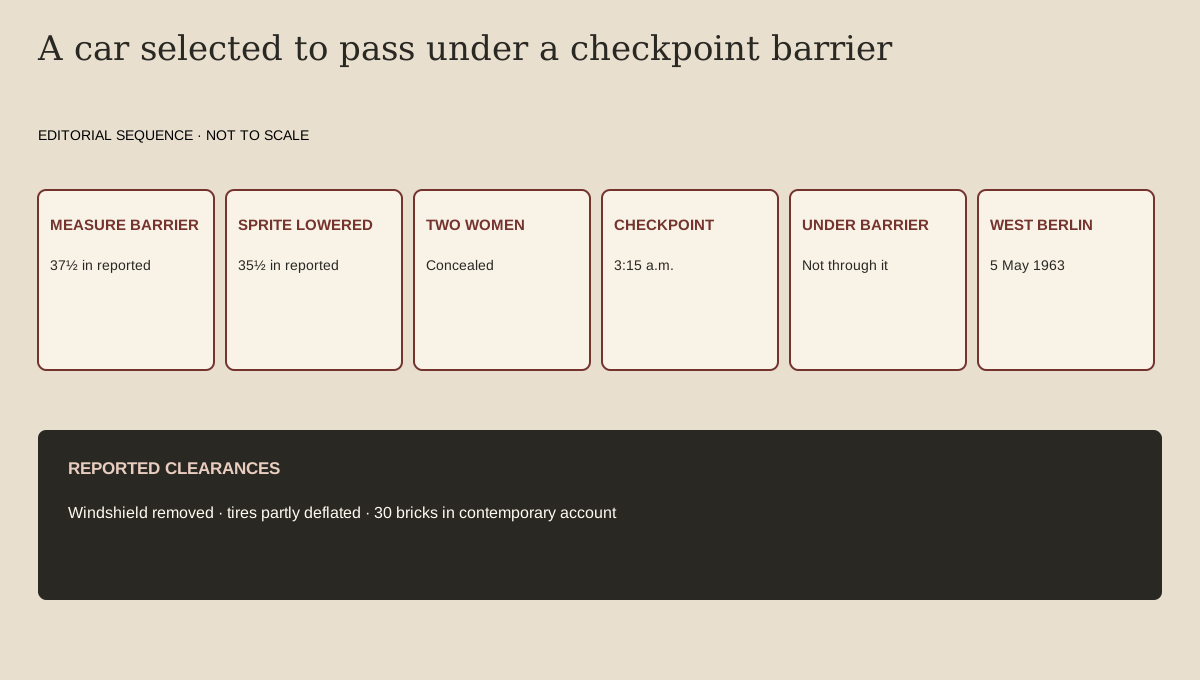
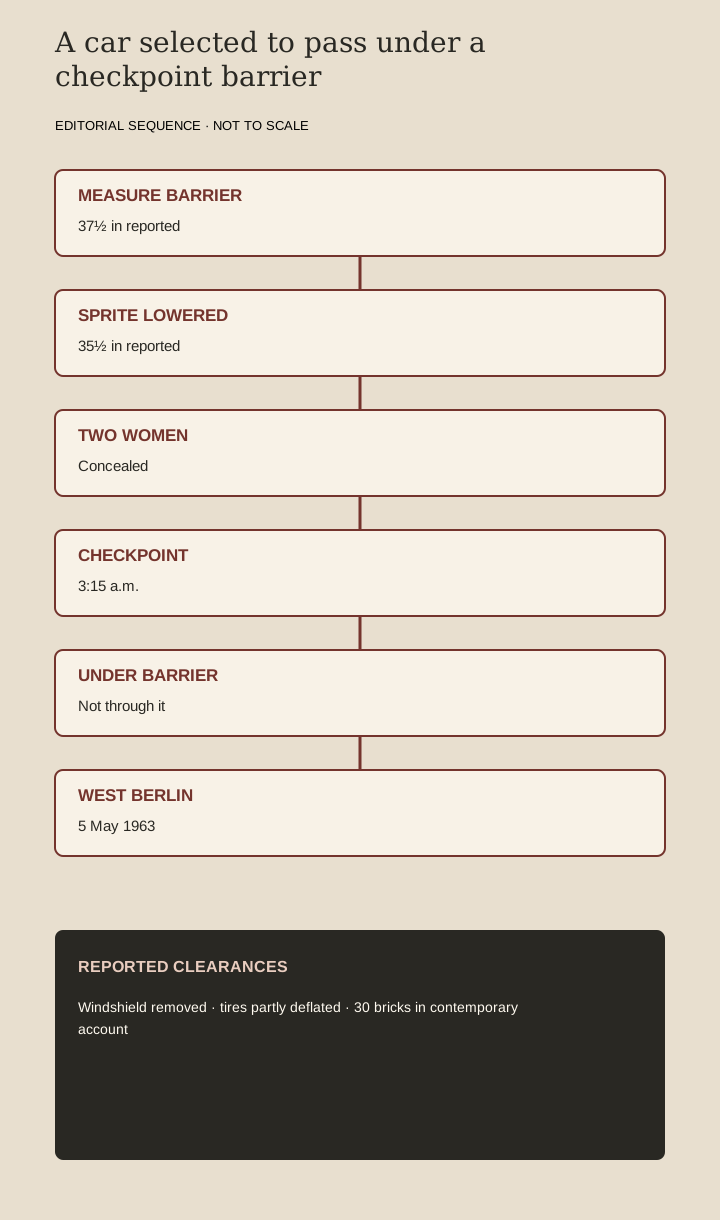
Simplified editorial reconstruction; not to scale. See adjacent text for evidence qualifications and unresolved details.
Material evidence
Tools of Escape
The objects used in an escape reveal how a plan worked under constraint.
- 01Decisive vehicle
Austin-Healey Sprite
A very low British sports car selected specifically because it could be made shorter than the measured border barrier.
- 02Critical modification
Removable windshield
Removing the windshield reduced the car's highest fixed point enough to allow passage beneath the horizontal barrier.
- 03Clearance margin
Partially deflated tires
Meixner let air out of the tires to lower the car further and increase the available clearance.
- 04Risk mitigation
Thirty bricks
Bricks were positioned behind Mrs. Thurau as improvised protection against possible gunfire from behind.
- 05Access and cover
Austrian passport
Meixner's foreign nationality allowed him to use the Friedrichstraße crossing and enter the normal checkpoint process before initiating the escape.
Problem → response
Escape was a sequence of problems
Each response solved a practical obstacle while often creating the next one.
- 01→
Obstacle
Closed final barrier
The horizontal barrier was intended to prevent vehicles from proceeding into West Berlin.
Response
Meixner measured its clearance and selected a car that could be lowered enough to pass beneath rather than break through it.
- 02→
Obstacle
Customs inspection
A normal stop at the customs shed would have exposed the concealed passengers.
Response
Meixner waited until he was directed toward inspection and then accelerated instead of stopping.
- 03→
Obstacle
Armed border guards
Guards could potentially fire once they recognized the escape attempt.
Response
The plan minimized recognition time, relied on rapid acceleration, and used bricks as improvised protection for the passenger in the luggage compartment.
- 04→
Obstacle
Vehicle height
Even a small sports car would not clear the barrier if its fixed upper structure remained too high.
Response
The windshield was removed and tire pressure reduced to lower the vehicle profile.
- 05→
Obstacle
Conflicting traffic and checkpoint obstacles
The escape car had to negotiate the controlled lane and avoid other vehicles during a very short acceleration window.
Response
Meixner planned the timing and reportedly assigned a western-side acquaintance to reduce the risk of entering traffic.
The final accounting
Outcome
East German escapees reaching West Berlin
Margarete Thurau and her mother successfully reached West Berlin.
Driver/helper reaching West Berlin
Heinz Meixner completed the crossing with the two concealed passengers.
Checkpoint tactic later blocked
The border barrier was modified with downward steel elements so another low sports car could not repeat the maneuver indefinitely.
Evidence discipline
What the record supports
Status labels distinguish secure conclusions from uncertainty and rejected claims. Color is never the only signal.
DOCUMENTED
Meixner drove an Austin-Healey Sprite beneath the closed barrier at Checkpoint Charlie on 5 May 1963.
The event is confirmed by the institutional Chronik der Mauer, contemporary TIME reporting, Associated Press coverage, later Austrian reporting, and Berlin Wall museum-era accounts.
Sources: SRC-001, SRC-003, SRC-004, SRC-006, SRC-007DOCUMENTED
The escape occurred at 3:15 a.m.
Chronik der Mauer gives the specific time as 3:15 a.m.; English-language contemporary reports often use the looser phrase shortly after midnight.
Sources: SRC-001, SRC-003WELL-SUPPORTED
Meixner measured the final barrier at 37½ inches and selected a Sprite measuring 35½ inches without its windshield.
These paired measurements appear in TIME's near-contemporary account and are repeated in later histories; the available sources do not provide an independent engineering measurement.
Sources: SRC-003, SRC-006WELL-SUPPORTED
Margarete's mother was protected by 30 bricks in the luggage compartment.
TIME directly attributes the 30-brick detail to Meixner's own explanation after the escape.
Sources: SRC-003MYTH
Meixner himself was an East German defector.
Meixner was Austrian and used his foreign passport to cross into East Berlin. The East German escapees were Margarete Thurau and her mother.
Sources: SRC-003, SRC-004, SRC-005MYTH
The Sprite smashed through the checkpoint barrier.
The defining feature of the escape is that the lowered vehicle passed beneath the closed horizontal barrier.
Sources: SRC-001, SRC-003, SRC-004DISPUTED
The barrier was definitely reinforced immediately after Meixner's 5 May escape.
Chronik der Mauer places reinforcement after the May escape, while contemporary August TIME reporting says downward steel bars were fitted after Norbert Konrad later repeated the maneuver in the same Sprite.
Sources: SRC-001, SRC-008Selected chronology
Selected chronology
Berlin Wall closes the open border
East German authorities seal the sector boundary, fundamentally changing movement between East and West Berlin.
Meixner meets Margarete Thurau
Contemporary reporting places their meeting in East Berlin during the period after the Wall's construction.
Checkpoint reconnaissance and vehicle search
Meixner studies the Friedrichstraße crossing, measures the low final barrier, and looks for a rental car that can pass beneath it.
Sprite passes beneath the barrier
Meixner drives the modified Austin-Healey Sprite beneath the closed Checkpoint Charlie barrier with Margarete Thurau and her mother concealed inside.
RIAS reports the escape
RIAS broadcasts a report on the successful sports-car escape; the recording is preserved through the Deutschlandradio archive and Chronik der Mauer.
The low-car method is repeated
Contemporary reporting says Norbert Konrad later used the same rental Sprite to help another East German woman escape beneath the barrier.
Barrier design is altered
East German authorities add downward steel elements to prevent another low-profile car from passing under the barrier; sources disagree on whether reinforcement began immediately after Meixner or only after the later repetition.