
Henri de Rochefort did not escape New Caledonia by rowing hundreds of miles across the Pacific. The small boat in the famous story carried him only through the local extraction stage. The decisive transport was an ordinary commercial collier whose captain had agreed to hide six political deportees and sail them to Australia.
The operation took place on the night of 19–20 March 1874. That date is established by a participant’s detailed narrative, later scholarship, and the shipping record that places the escape vessel in Newcastle one week later.
At a Glance
- Date: Night of 19–20 March 1874
- Place: Ducos peninsula and Nouméa, New Caledonia
- Escapees: Six political deportees
- Key transport: The three-masted collier P.C.E.
- Captain: D. Law
- First free destination: Newcastle, New South Wales
- Arrival: 27 March 1874
- Rochefort’s onward route: Australia → Pacific → San Francisco → New York → Britain
- Classification: Political deportee / penal-colony escape
Why Rochefort Was in New Caledonia
Rochefort was one of France’s most famous radical journalists before the Paris Commune. He had built his reputation attacking Napoleon III, served briefly in the Government of National Defence after the fall of the Second Empire, and continued to publish fiercely political journalism as France fractured in 1871.
His relationship to the Commune itself needs precision. Rochefort sympathized with much of the revolutionary cause and was prosecuted in its aftermath, but he did not serve as a member of the Commune’s governing council. His political journalism and associations nevertheless made him one of the most visible prisoners caught in the Versailles repression.
In September 1871 he was sentenced to deportation in a fortified enclosure. After imprisonment in France and transport across the world, he reached New Caledonia in December 1873. The sentence placed him at the Ducos peninsula outside Nouméa.
A Penal Colony with Different Kinds of Confinement
“Deported to New Caledonia” can sound like one uniform punishment. It was not.
French authorities separated different categories of prisoners. Political deportees sentenced to fortified confinement were held under tighter restrictions at Ducos. Other deportees had different conditions and, in some circumstances, enough freedom to work or move through Nouméa.
The distinction made the 1874 escape possible. Rochefort, Paschal Grousset, and Olivier Pain were the men who had to get out of the Ducos area. François Jourde, Achille Ballière, and Charles Bastien—usually called Granthille or Grantille in the escape literature—could take on tasks that required access to Nouméa: finding transport, handling money, carrying messages, and moving a boat. This was therefore a six-person operation from the start of its final phase, not a solo exploit by the best-known member.
Finding a Ship
The problem was not simply leaving the peninsula. New Caledonia was surrounded by ocean, and Nouméa’s harbor lay behind reef passages controlled by normal maritime procedures.
Jourde’s 1877 memoir provides the most detailed account of the planning. He wrote that negotiations produced an agreement with Captain D. Law of the P.C.E., a three-masted collier connected with Newcastle, New South Wales.
Law’s role was limited but decisive. The fugitives had to reach his ship without being seen. He would conduct the vessel’s port business normally and request the pilot needed to clear the harbor approaches. Once aboard, the six would remain hidden until the ship was safely outside French colonial control.
Jourde said a hiding place would be prepared in the coal-hold area. The arrangement converted an escape problem into a shipping problem. If the men could become invisible passengers aboard a legitimate vessel, Captain Law could carry them through the same controlled passage that would have stopped an improvised open-sea escape.
A Coded Departure Time
The escapees did not know the exact sailing date far in advance. Jourde recalled arranging a simple code with the men at Ducos. A letter promising to send a certain number of “volumes” would identify the hour of the rendezvous without explicitly describing an escape.
On Wednesday evening, 18 March, Jourde learned that the P.C.E. was expected to sail on Friday morning. The fugitives therefore had to board in the night of 19–20 March.
This participant chronology is unusually valuable because it corrects a modern institutional error. A current Histoire par l’image page dates Rochefort’s escape to July 1874. That cannot be reconciled with Jourde’s dated sequence, Joël Dauphiné’s scholarly reconstruction, or Australian newspapers recording the P.C.E. in Newcastle on 27 March. March is the secure date.
Leaving Ducos
Jourde’s account says Rochefort, Grousset, and Pain moved along the edge of the peninsula, using the water to reduce the chance of encountering patrols. The plan brought them toward a rendezvous point called Knauri in Jourde’s text and Kuauri in other versions.
The exact shoreline geometry should not be reconstructed too confidently. Jourde supplied distances and physical detail years later, and modern retellings vary in how they map the place names.
The broad mechanism is clearer. Near the rendezvous, the men entered the water and swam. Jourde, Ballière, and Bastien approached in the small boat.
Once the two groups met, the three men from Ducos climbed aboard and put on clothing that had been brought for them. The escapees then turned back toward Nouméa harbor rather than heading for Australia in the little boat.
Searching for the P.C.E.
The next task was finding one commercial vessel among the ships in the dark roadstead. Jourde described a confused search that brought the boat close to other vessels before the men recognized the white initials of the P.C.E.. A rope ladder hung over the side. They climbed aboard and waited for Captain Law to return.
Some of Jourde’s more colorful details—especially his interpretations of guards, weather, alcohol, and what other people thought—belong to a partisan memoir and should not be read like a police report. The fundamental shipboard sequence is more stable. Law knew Rochefort would be among the fugitives. The plan was kept from most of the crew. The six men went below to remain concealed while the vessel prepared to sail.
Jourde remembered entering the hiding place at about two in the morning.
Escaping through Ordinary Port Procedures
The most interesting part of the operation came after the men were aboard. The P.C.E. did not dash secretly past the reefs in the dark. It still had to leave like a normal ship. The harbor pilot and weather remained real constraints, and Jourde recalled a delay when the pilot initially considered conditions unsuitable for departure.
The fugitives waited below while the vessel’s legal and navigational procedures continued above them. A contemporary shipping notice later published in New Zealand records the P.C.E., 291 tons, D. Law master, clearing Nouméa for Newcastle in ballast. It listed one passenger: W. Sutherland.
The six French fugitives were not on the declared passenger list. That document does not prove every detail in Jourde’s memoir, but it fits the concealment mechanism exceptionally well. They escaped through a functioning port by remaining outside the paperwork that described who was supposedly aboard.
Seven Days to Newcastle

Once the P.C.E. was safely at sea, concealment was no longer necessary. Jourde wrote that the voyage to Newcastle took seven days. Contemporary Australian shipping notices record the P.C.E. arriving from New Caledonia on 27 March 1874.
The fugitives became news almost immediately. Rochefort’s later travel narrative describes the moment when Australian customs officials confronted the awkward fact that six men had appeared aboard a ship whose departure documentation had not included them. Whether every exchange in his published version happened exactly as remembered is less important than the documented outcome: Australian authorities did not return them to French custody. The clandestine penal escape had become an international political story.
The Captain’s Price
Money had helped make the operation possible. Kenneth Dutton’s modern French-Australian biography says Captain Law agreed to the passage for 10,000 francs. Jourde’s memoir gives more detail: 1,500 francs in gold at boarding and a promised balance of 8,500 after arrival.
Jourde later wrote that Law received the 8,500 francs. Those accounts are broadly compatible because 1,500 plus 8,500 produces the same 10,000-franc total. The distinction matters only because some retellings mistakenly describe 8,500 as the entire payment. Jourde framed the money as compensation rather than a simple reward, adding that the shipowners dismissed Law after the escape damaged their relationship with French authorities.
Freemasons and the Growth of a Rescue Legend
Masonry also appears in the story. Jourde wrote of exchanging a Masonic sign with Captain Law, and Rochefort had Masonic connections. This helped generate later versions in which an international Freemason network appears to have designed and executed the entire rescue.
Historian Joël Dauphiné has specifically reexamined that claim and cautioned against giving Freemasonry more explanatory weight than the evidence supports. The primary narrative shows a more concrete network: deportees with different degrees of mobility, local intermediaries, coded messages, money, a boat, and a sea captain willing to carry them.
Masonic relationships may have assisted trust. They do not replace the practical architecture of the escape.
From Newcastle to Sydney
Newcastle was only the first free destination. The men soon moved toward Sydney, where their arrival generated political debate, press interest, hospitality, and fundraising. French officials objected to the reception given to people whom France regarded as convicted political prisoners, while Australian sympathizers treated them as refugees from repression.
Their group then began to separate. Jourde later wrote that Ballière went toward Melbourne and Bastien found another route. Rochefort and Pain intended to reach London by way of San Francisco and New York.
That route is supported beyond the memoir tradition. Sydney shipping records for 11 April list Rochefort and several of the escapees among passengers cleared on the Cyphrenes for the Pacific route.
Across the Pacific and the United States
Rochefort later made the journey itself the subject of Retour de la Nouvelle-Calédonie: De Nouméa en Europe, published in 1877. The book follows the escapees through Australia and across the Pacific, then devotes substantial attention to the United States. The Cyphrenes formed part of the trans-Pacific mail network, with onward movement through Pacific stops toward San Francisco.
Once in California, Rochefort crossed the United States toward New York and continued across the Atlantic. Jourde’s memoir independently summarizes the strategic route: Rochefort and Pain headed for London by San Francisco and New York. By June 1874, Rochefort was back in the European exile world.
What Manet Painted
The escape remained famous long after the practical details had disappeared from newspaper headlines. Around 1880–81, Édouard Manet painted versions of L’Évasion de Rochefort. One version makes the boat and figures more legible; another reduces the fugitives against an immense expanse of water.
The paintings are among the most recognizable images associated with the event, but they were made more than six years afterward. Manet was interpreting a celebrated political story, not recording something he had witnessed.
His image also encourages the most persistent visual misunderstanding: a small boat surrounded by Pacific water can make it look as though Rochefort’s party crossed the ocean that way. They did not.
The boat got them to the ship. The P.C.E. got them to Australia.
Why the Escape Worked
The six men succeeded because they linked together forms of freedom that existed on different scales.
Some deportees could move through Nouméa. Others could not. A small boat could bridge that local difference but could not solve the ocean. A commercial ship could cross the ocean but first had to pass the colonial port system. Money and personal trust connected the fugitives to its captain. Concealment kept them out of the formal passenger record until the ship had moved beyond French control.
Australia then changed the problem again. Once the men were publicly free there, Rochefort could use normal international travel rather than clandestine escape methods.
That sequence makes the case especially valuable within the history of penal colonies. Geography itself was supposed to be part of the sentence. In March 1874, six deportees defeated that geography not by crossing the Pacific on their own, but by finding a way into the commercial network that already crossed it.
Documentary reconstruction
Transport and jurisdiction changed at each stage
A case-local visual focused on the historical question that the surviving evidence can answer.
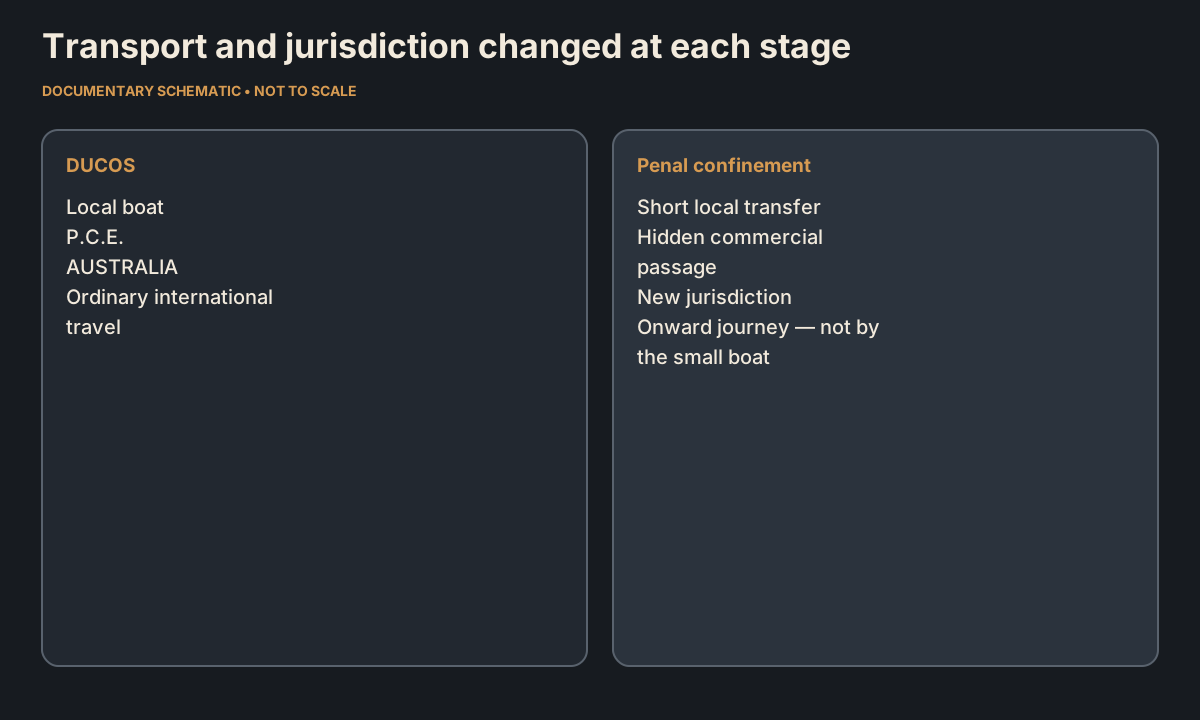
Simplified documentary reconstruction; not to scale. Evidence qualifications are written directly into the visual and explained in the adjacent text.
Evidence discipline
What the record supports
Status labels distinguish secure conclusions from uncertainty and rejected claims. Color is never the only signal.
MYTH
Rochefort escaped New Caledonia in July 1874.
A current Histoire par l’image page gives July, but Jourde’s firsthand account fixes the boarding operation to the night of 19–20 March, contemporary shipping records place the P.C.E. in Newcastle on 27 March, and Joël Dauphiné’s scholarly study dates the escape to 20 March.
Sources: SRC-001, SRC-003, SRC-006, SRC-007MYTH
Rochefort escaped alone.
The operation involved six deportees: Rochefort, Grousset, Pain, Jourde, Ballière, and Bastien/Granthille.
Sources: SRC-001, SRC-003, SRC-007MYTH
Rochefort personally rowed from New Caledonia to Australia.
The small boat was only the local extraction stage. The six men then boarded the P.C.E., which carried them to Newcastle.
Sources: SRC-001, SRC-004, SRC-007MYTH
The P.C.E. was an American ship.
The strongest Australian and participant sources identify the P.C.E. as a Newcastle-linked Australian/British commercial vessel under Captain Law, not an American rescue ship.
Sources: SRC-001, SRC-004, SRC-005, SRC-007DISPUTED
The payment to Captain Law is known to have been exactly 10,000 francs.
Kenneth Dutton’s synthesis says Law agreed to take them for 10,000 francs. Jourde’s firsthand account says 1,500 francs were paid initially and 8,500 francs were later paid as the promised balance. The total implied by Jourde is also 10,000, but his wording distinguishes the later 8,500-franc payment from the full arrangement.
Sources: SRC-001, SRC-004DISPUTED
A Freemason network single-handedly organized Rochefort’s escape.
Masonic contacts appear in participant testimony, but Joël Dauphiné’s source-critical study was written specifically to reassess and reduce later exaggeration of Freemasonry’s role. The operational evidence instead shows a mixed practical network involving fellow deportees, local intermediaries, money, and Captain Law.
Sources: SRC-001, SRC-003MYTH
Rochefort was an office-holding member of the Paris Commune government.
He was a radical journalist and political figure associated with and sympathetic to the Communard cause, but he did not serve as a member of the Commune’s governing council. His later deportation followed prosecution in the political aftermath of 1871.
Sources: SRC-004, SRC-005MYTH
Manet’s L’Évasion de Rochefort is an eyewitness image of the 1874 escape.
Manet painted the subject around 1880–81, years after the event. It is a famous historical interpretation informed by later knowledge, not a contemporary documentary image.
Sources: SRC-012, SRC-013