
Jane Johnson reached Philadelphia on 18 July 1855 because John Hill Wheeler, the man who enslaved her, brought her there. She became free because she chose to act on the opportunity. Johnson defied Wheeler's order not to speak with Black Philadelphians, told a hotel worker that she wanted freedom, and then walked away with her two sons after William Still and Passmore Williamson explained that Pennsylvania law protected her choice. The confrontation made headlines, but Johnson's own testimony is the clearest guide to what happened.
At a Glance
- Date: 18 July 1855
- Place: Philadelphia, Pennsylvania
- Freedom seeker: Jane Johnson, with her sons Daniel and Isaiah
- Enslaver: John Hill Wheeler
- Classification: Self-emancipation with public abolitionist assistance
- Main turning point: Johnson told Black Philadelphians that she was enslaved and wanted freedom
- Outcome: Johnson and her sons left Wheeler, remained free, and later reached Boston
- Legal aftermath: Passmore Williamson was imprisoned for contempt; William Still and five Black dockworkers faced riot and assault charges
Brought into a free state
Jane Johnson had not fled north in secret before reaching Philadelphia. Wheeler brought her there himself.
Johnson had been enslaved in Virginia and was sold, with her sons Daniel and Isaiah, to Wheeler around the beginning of 1854. Another son remained in Richmond after being separated from her. Wheeler later became the United States minister to Nicaragua and intended to take Johnson south with his household, traveling through Philadelphia and New York on the way.
That route created an opportunity. Pennsylvania had gradually abolished slavery beginning in 1780, and in 1847 the state repealed the provision that had allowed visiting slaveholders to retain enslaved domestic servants for as long as six months. When Wheeler voluntarily brought Johnson and her children into Pennsylvania, local antislavery lawyers and activists regarded them as free under state law.
This made her case different from a conventional Fugitive Slave Act seizure. Johnson had not escaped from Wheeler in Virginia and then been pursued into Pennsylvania. Wheeler transported her into a free state himself.
Selected chronology
Selected chronology
Wheeler acquires Johnson and two sons
Cornelius Crew of Richmond sells Jane Johnson, Daniel and Isaiah to John Hill Wheeler; another son remains separated from her in Richmond.
Johnson claims freedom in Philadelphia
Johnson alerts Black Philadelphians that she wants liberty, receives assistance from Still, Williamson and dockworkers, and leaves Wheeler with her sons.
Federal habeas writ issued
Judge John K. Kane orders Passmore Williamson to produce Jane, Daniel and Isaiah in federal court.
Williamson imprisoned for contempt
Kane commits Williamson after rejecting his answer that Johnson and her sons are not in his custody or control.
Johnson gives voluntary affidavit in Brooklyn
Johnson states that she left Wheeler of her own free will and had intended to claim freedom when she came North.
Johnson returns to Philadelphia and testifies
Johnson appears as a defense witness at the trial of William Still and five Black dockworkers, contradicting Wheeler’s abduction narrative.
Williamson released
After more than three months in confinement for contempt, Passmore Williamson leaves prison.
Jane Johnson dies
After years in Boston and participation in its Black community, Johnson dies in 1872.
Johnson makes the first move
On 18 July Wheeler stopped with Johnson and her sons at Bloodgood's Hotel near the Philadelphia waterfront. He instructed her not to speak to Black people and, if questioned, to say that she was free.
Johnson ignored that instruction. She told Black people at the hotel that she was enslaved and wanted liberty. A message was carried to William Still, the Black abolitionist who served as a central organizer in Philadelphia's Vigilance Committee.
The surviving 1855 pamphlet records the note as a request for Still to come quickly because three people at the hotel wanted freedom. By the time Still and Passmore Williamson reached the hotel, Wheeler had moved his party toward the ferry for New York. Still and Williamson followed.
The sequence fixes the initiative. Johnson did not learn that she wanted freedom from the men who arrived at the wharf. Her own request brought them into the situation.
What Still and Williamson supplied
Still, Williamson and several Black dockworkers boarded the vessel before it departed. They told Johnson that Pennsylvania law recognized her as free and that she could leave Wheeler if she chose. They also gave her practical support in a public place where Wheeler could physically resist.
Johnson chose to leave.
The 1855 narrative describes Wheeler trying to stop her as she moved away. Johnson later testified that Wheeler restrained her and that the men assisting her did not force her from the vessel. Still helped Johnson and her sons move toward the exit while others prevented Wheeler from stopping them.
The exact physical actions of each helper vary slightly across sources and later recollections. The central sequence is secure: Johnson declared that she wanted freedom, received information about her legal status, and left Wheeler with her children.
A self-emancipation, not an abduction
Wheeler immediately tried to redefine the event. If Johnson voluntarily left a man who had no lawful right to hold her in Pennsylvania, the episode was self-emancipation supported by others. Wheeler instead alleged that abolitionists had forcibly taken his property and later portrayed Johnson as someone who had not wanted to leave.
Johnson repeatedly contradicted him.
On 31 July, after reaching New York, she appeared voluntarily before Brooklyn City Judge E. D. Culver and dictated an affidavit. Her words were unusually clear: “I went away of my own free will.” She added that she had always wanted freedom and intended to claim it when she came North.
The affidavit was also an intervention in the cases against her helpers. Johnson explained that Williamson had been imprisoned in connection with her case and that she hoped the truth would benefit him. Wheeler's legal story depended on other people having deprived him of Johnson by force; Johnson insisted that the decisive will had been her own.
Wheeler turns to federal court
The day after the escape, a federal writ of habeas corpus ordered Passmore Williamson to produce Jane, Daniel and Isaiah before U.S. District Judge John K. Kane. The demand treated Williamson as though he had custody of the family.
Williamson answered that he did not. Johnson and her sons were not being detained by him and were not under his control. That answer reflected the point at the center of the case: the family had left Wheeler but had not become Williamson's prisoners.
Kane rejected Williamson's return to the writ and eventually committed him for contempt. Williamson entered prison in late July and remained confined until 3 November 1855.
The federal litigation turned a short waterfront confrontation into a national dispute over slavery, personal liberty, state law and federal judicial power. Williamson became a celebrated abolitionist prisoner, but the fame of his case can easily obscure the woman whose choice triggered it.
Documentary reconstruction
Agency and the assistance network
A case-local editorial visual separates the documented sequence from uncertainty without implying exact modern geography or operational detail.
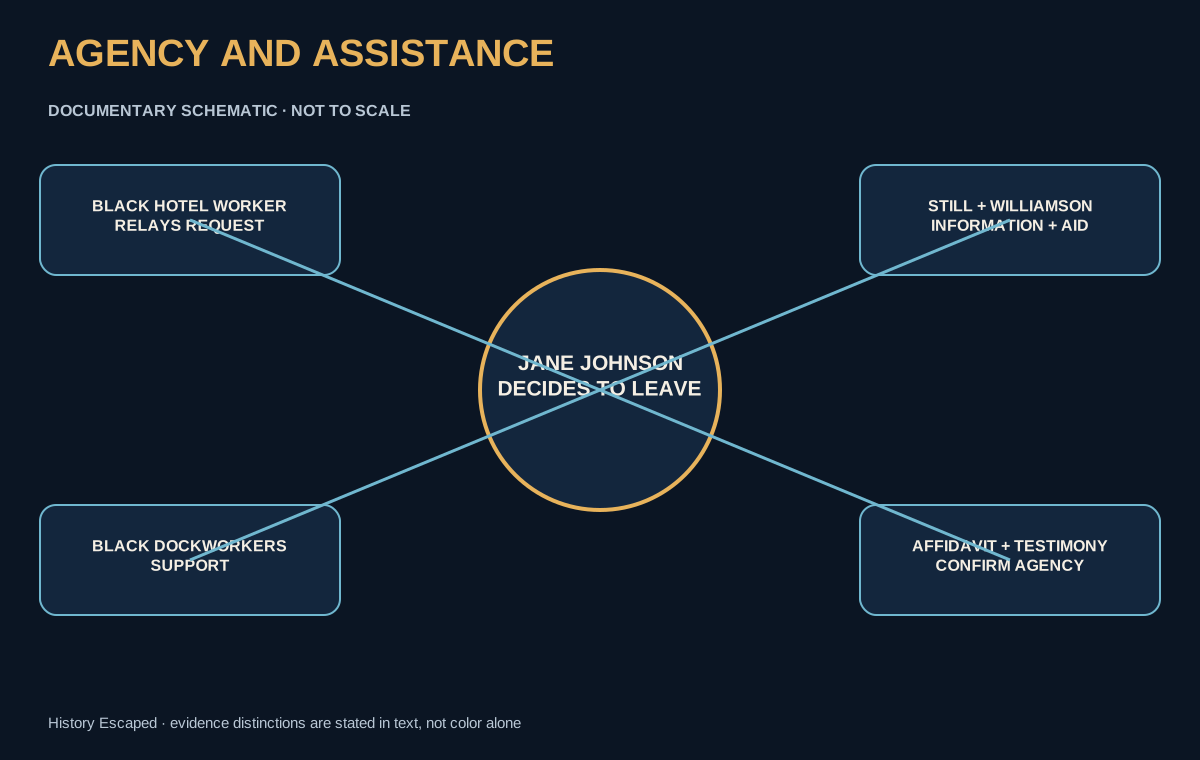
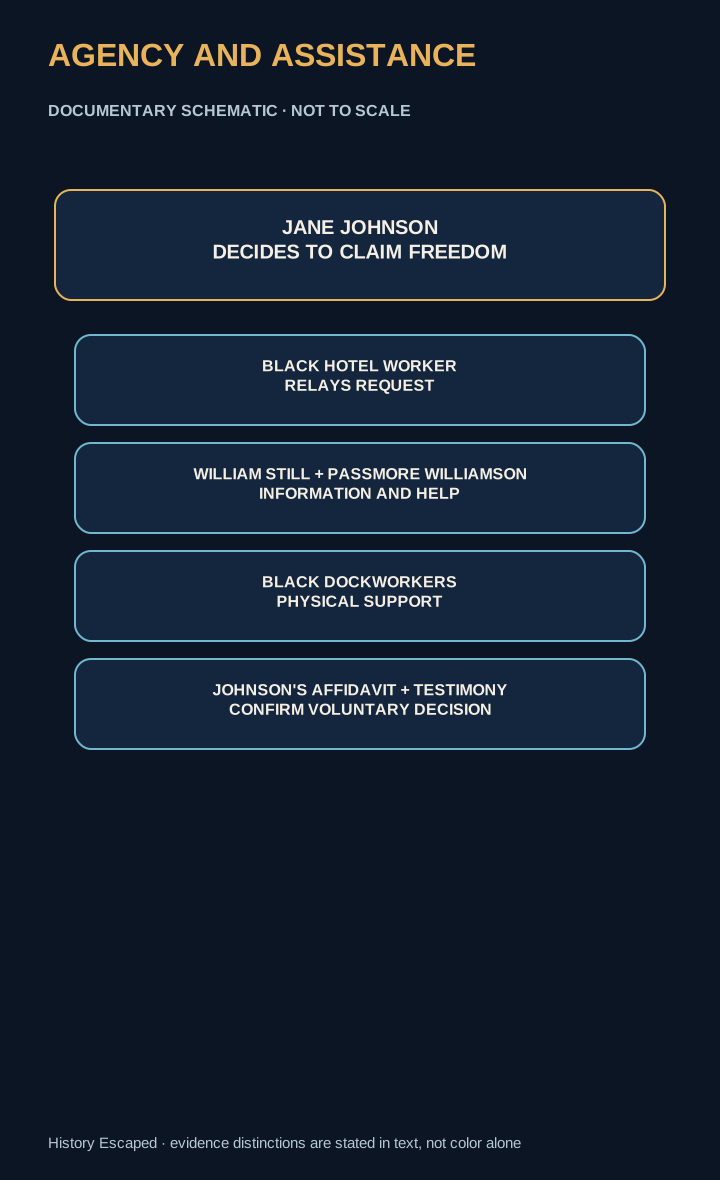
Simplified editorial reconstruction based on the cited historical record; not to scale. Uncertainty is stated directly in the visual and adjacent text.
She comes back to testify
Wheeler also pursued criminal charges against William Still and five Black dockworkers who had been present during the confrontation. They faced accusations of riot and assault and battery.
Johnson was then beyond Wheeler's immediate control in the North. Returning to Philadelphia meant entering the same city where he continued to assert ownership over her and where federal officials might try to intervene.
She returned anyway.
On 29 August 1855 Johnson appeared in court as a defense witness. Her testimony directly contradicted Wheeler on the decisive points. She said she wanted freedom, that Wheeler had tried to restrain her, and that Still and the others had not forced her to leave.
The courtroom record preserves Johnson explaining that a Black man had asked whether she desired freedom and that Williamson wanted to tell her her rights. Wheeler tried to call her back and prevent the exchange. Johnson's testimony put her own decision between the information she received and the physical assistance that followed.
Judge William D. Kelley instructed the jury that when Wheeler and the people he claimed as servants crossed into Pennsylvania, Johnson and her sons became as free as Wheeler. All defendants were acquitted of riot. On the assault charge, John Ballard and William Curtis were convicted; the others were acquitted. Ballard and Curtis served short jail terms.
The final accounting
Outcome
Johnson and her sons remain free
Jane, Daniel and Isaiah leave Wheeler in Philadelphia and are not returned to slavery.
Williamson imprisoned for contempt
The federal habeas dispute leads to Williamson’s confinement from late July until 3 November 1855.
Still and dockworkers face criminal trial
All defendants are acquitted of riot; John Ballard and William Curtis alone are convicted of assault and receive short jail terms.
Johnson establishes her own account under oath
Her July affidavit and August courtroom testimony state that she wanted freedom and left Wheeler voluntarily.
Johnson's testimony was an act of agency too
The August appearance is sometimes treated mainly as a dramatic surprise that saved the defendants' case. It also defended Johnson's own account of emancipation.
Wheeler had publicly described her departure as an abduction. Federal proceedings referred to Johnson and her children through claims of custody and ownership. By appearing in court, she asserted before the same legal system that she had understood the choice before her and made it herself.
The risk did not disappear when she left the witness stand. Contemporary accounts describe local and state officers, abolitionists and antislavery women protecting her departure from the courthouse because federal officers might try to detain her. Johnson later provided another affidavit supporting Williamson. Her participation in the legal aftermath was sustained, not accidental.
Evidence discipline
What the record supports
Status labels distinguish secure conclusions from uncertainty and rejected claims. Color is never the only signal.
MYTH
Jane Johnson was passively rescued by abolitionists who decided to free her.
Johnson initiated contact by telling Black Philadelphians that she was enslaved and wanted freedom. Still, Williamson and others responded to her request and assisted her decision.
Sources: SRC-001, SRC-003, SRC-004, SRC-006DOCUMENTED
Johnson said she left Wheeler voluntarily.
Her July 31 affidavit says she went away of her own free will, and her August 29 testimony again rejected Wheeler’s claim of forcible abduction.
Sources: SRC-001, SRC-003, SRC-004MYTH
Johnson was a fugitive who had already escaped before entering Pennsylvania.
Wheeler voluntarily brought Johnson and her sons into Philadelphia. Her self-emancipation occurred after arrival in Pennsylvania.
Sources: SRC-001, SRC-004, SRC-008DOCUMENTED
Pennsylvania’s 1847 law removed the old six-month sojourner protection for slaveholders.
Section 7 repealed the part of the 1780 gradual-abolition law that had authorized owners to bring and retain enslaved people in Pennsylvania for up to six months or any period of involuntary servitude.
Sources: SRC-005MYTH
William Still alone rescued Johnson from Wheeler.
Still was a central Black abolitionist assistant, but Johnson made the decision; Williamson supplied legal information, a Black hotel worker relayed her request, and multiple Black dockworkers helped during the confrontation.
Sources: SRC-001, SRC-004, SRC-006MYTH
All people prosecuted for the waterfront confrontation were convicted.
All defendants were acquitted of riot. Only John Ballard and William Curtis were convicted of assault; the others, including Still, were acquitted on that charge.
Sources: SRC-006, SRC-010DISPUTED
Williamson had physical custody of Johnson after she left Wheeler.
Wheeler’s habeas petition treated Williamson as controlling Johnson and her sons. Williamson answered that they were neither in his custody nor restrained by him; that dispute drove the contempt proceeding.
Sources: SRC-002, SRC-009The law did not act by itself
Pennsylvania law created the opening, but statutes do not automatically protect people. Wheeler tried to control whom Johnson could speak to. Johnson had to recognize the opportunity, disobey him and make her wishes known. A Black hotel worker had to relay the request, and Still, Williamson and the dockworkers had to respond quickly enough to reach the departing vessel.
At the waterfront, legal status and physical power collided. Johnson could be free under Pennsylvania law and still face Wheeler's attempt to hold her. The people assisting her helped make legal freedom usable in practice.
That is why the strongest classification combines self-emancipation with assistance. Calling the event only a rescue makes Johnson passive. Calling it a solitary escape would erase the Black community network and the people who responded when she asked for help.
Johnson made the decision. Others helped her carry it out.
Life after Philadelphia
Johnson and her sons moved through New York and then to Boston, where the city's Black abolitionist community helped them establish themselves. William Cooper Nell, who met Johnson there, described her as “a woman who can take care of herself.” The phrase captures how at least one contemporary Black abolitionist understood her independence.
Johnson later married Lawrence Woodfolk. National Park Service research places her in Boston for years and records that she assisted other freedom seekers herself. Her son Isaiah later served in the 55th Massachusetts Infantry during the Civil War.
Jane Johnson died on 2 August 1872. William Still published The Underground Rail Road the same year, preserving her affidavit and later engraved representations of the Philadelphia event.
Why Jane Johnson's words matter
The record around Johnson is unusually rich because other people tried to define what she had done. Wheeler called it forcible abduction. Abolitionists called it rescue. Courts argued about custody, state law and federal authority, while newspapers turned the episode into a political spectacle.
Johnson supplied the clearest account. She wanted freedom before Still and Williamson reached her. She asked for help, learned that Pennsylvania law protected her choice, left Wheeler with Daniel and Isaiah, and then returned at personal risk to say so under oath.
The abolitionist network made her escape possible at a dangerous moment. Jane Johnson made it hers.
