
John Hunt Morgan’s Ohio Penitentiary Escape: How Seven Confederates Broke Out in 1863
On the night of 27–28 November 1863, seven Confederate officers disappeared from the Ohio Penitentiary in Columbus. Among them was Brigadier General John Hunt Morgan, one of the Confederacy’s best-known cavalry commanders and, only four months earlier, the most important prisoner taken at the end of a raid across Indiana and Ohio.
The breakout is often reduced to a memorable formula: Morgan and his officers dug out with two knives, climbed the prison wall, caught a train south, and vanished. The real mechanism was more complicated—and better documented.
A War Department investigation ordered only days after the escape found an existing air chamber beneath the prisoners’ cells, a cut opening through a cell floor, a concealed lateral tunnel beneath the foundations of the prison building, six additional cell floors prepared for breakthrough, dummy bodies left in beds, and a rope system used to cross the final wall. It also found a prison whose supervision had become dangerously confused between state officials and the United States military.
The escape succeeded because the prisoners solved an architectural problem and because their jailers had stopped looking closely enough to notice them solving it.
Why Morgan Was in an Ohio State Prison
John Hunt Morgan was not captured while attempting an ordinary prison escape. His confinement was the end of a much larger military failure.
In the summer of 1863, Morgan led Confederate cavalry across the Ohio River and into Indiana and Ohio. The raid was undertaken against the express orders of his superior, which had restricted his movement north of the river. Morgan’s force nevertheless crossed into Northern territory, disrupted transportation and communications, seized supplies and property, and drew Union forces into a long pursuit.
The raid began to collapse at the Ohio River. On 19 July, Union forces struck Morgan’s command around Buffington Island as the Confederates attempted to cross back toward friendly territory. Morgan escaped that battlefield with part of his command but continued east and north through Ohio under growing pressure. On 26 July, Union cavalry finally surrounded and captured him and the remnants of his force near West Point in Columbiana County.
Most captured Confederate enlisted men were sent to military prison camps. Morgan and a group of officers were instead taken to the Ohio Penitentiary in Columbus. A surviving letter from Morgan’s brother Richard, written there on 25 August, confirms the officers’ presence in the institution well before autumn. Thomas Hines later dated the group’s arrival to 31 July and 1 August.
The penitentiary was designed for convicted criminals, not merely military detention. That made the imprisonment politically charged from the start. But it also gave Morgan’s men something they could study: a fixed building with routines, structural weaknesses, and layers of authority that did not always agree about who was responsible for what.
The Important Discovery Was Already Under the Cells
Thomas H. Hines later claimed that he worked out the central idea by noticing something unusual about his ground-floor cell.
Its floor and lower walls were comparatively dry. Hines reasoned that there might be some kind of ventilating space beneath it. His 1885 narrative presents the deduction almost as a flash of inspiration.
That particular moment depends on Hines’s memory. The air chamber itself does not.
The federal investigation described it in detail. Beneath the first range of cells, brickwork formed a long chamber between the foundations. Its height varied with the slope of the ground. It existed to separate the cell floor from the earth below and provide ventilation.
For an escape planner, it offered three advantages at once. First, a hole through one cell floor could provide access to a hidden space large enough for men to move inside. Second, the chamber offered somewhere to conceal debris from further excavation. Third, once underground, the prisoners could work beneath other cells and potentially beneath the building itself.
Hines brought the idea to Morgan. A small group was selected for the attempt.
The men chosen were John Hunt Morgan, Thomas H. Hines, Jacob C. Bennett, L. D. Hockersmith, J. S. Magee, Ralph Sheldon, and Samuel B. Taylor.
Other prisoners helped without being selected to leave.
Material evidence
Tools and supporting materials
Table knives are supported, but the complete inventory remains broader and less certain than the popular two-knives-only story.
- 01Opened access from the cell into the hidden chamber
Table knives
Improvised prison table knives were probably used to cut the first cell-floor opening and are emphasized in Hines's later account. Claims that two knives alone performed every excavation task remain disputed.
- 02Made underground inspection and work possible
Candles and matches
Used to explore and work inside the dark air chamber and excavation route.
- 03Supported concealed spoil movement
Coal box and cord
The federal investigation states that excavated earth and stones were hauled back into the air chamber using a small coal box and cord.
- 04Allowed the escapees to cross the final perimeter barrier
Improvised rope
Rope or rope-ladder material was manufactured from bed ticking, towels and other cloth; Hines later credited Richard Morgan with a long bed-ticking rope and a stove-poker hook.
- 05Delayed visual detection during the breakout window
Dummy bedding
Extra clothing and bedding were arranged in cots to resemble sleeping prisoners after the men descended through the floors.
- 06Helped convert the prison breakout into rapid geographic separation from Columbus
Rail timetable
Hines later said the group obtained a newspaper/timetable to coordinate southbound rail travel; the broad use of rail by Morgan and Hines is well supported, while procurement details come chiefly from later recollection.
Breaking Into the Air Chamber
Work began in early November, repeatedly dated to 4 November 1863. The first task was penetrating the floor of Hines’s cell without creating an opening that a guard would immediately see.
The official investigation found an elliptical cut beneath the bed area, concealed by luggage or clothing. It judged that stolen prison table knives were probably used in cutting the floor. Hines later described flat table knives made from steel files as the principal tools.
The famous claim that the entire escape was accomplished with only two small knives should be treated cautiously. The knives are well supported as part of the operation. Other prisoners later remembered additional tools, and the federal inquiry discovered that Confederate prisoners had been permitted to obtain small watch-spring saws for supposed handicraft work. The investigator found no evidence that those saws were actually used in the breakout.
Once the first opening reached the air chamber, excavation debris could be moved below instead of remaining in the cell. The men had made the first part of the prison disappear from the guards’ view. But the chamber did not lead directly to freedom.
Tunnel reconstruction
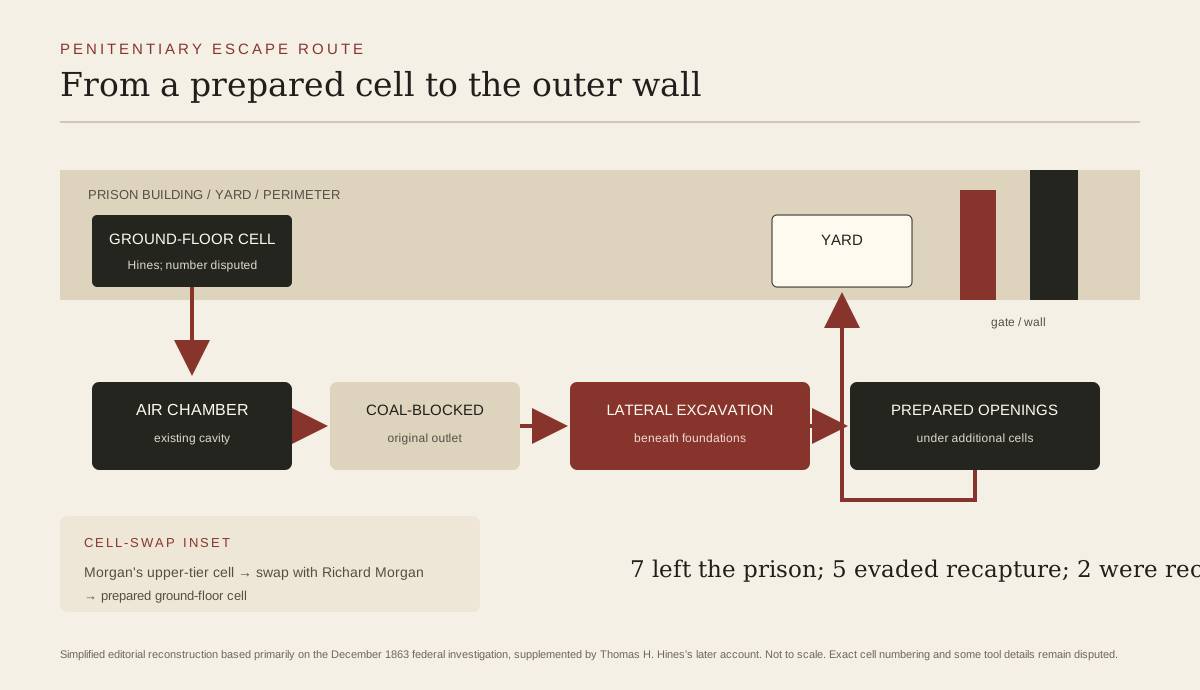
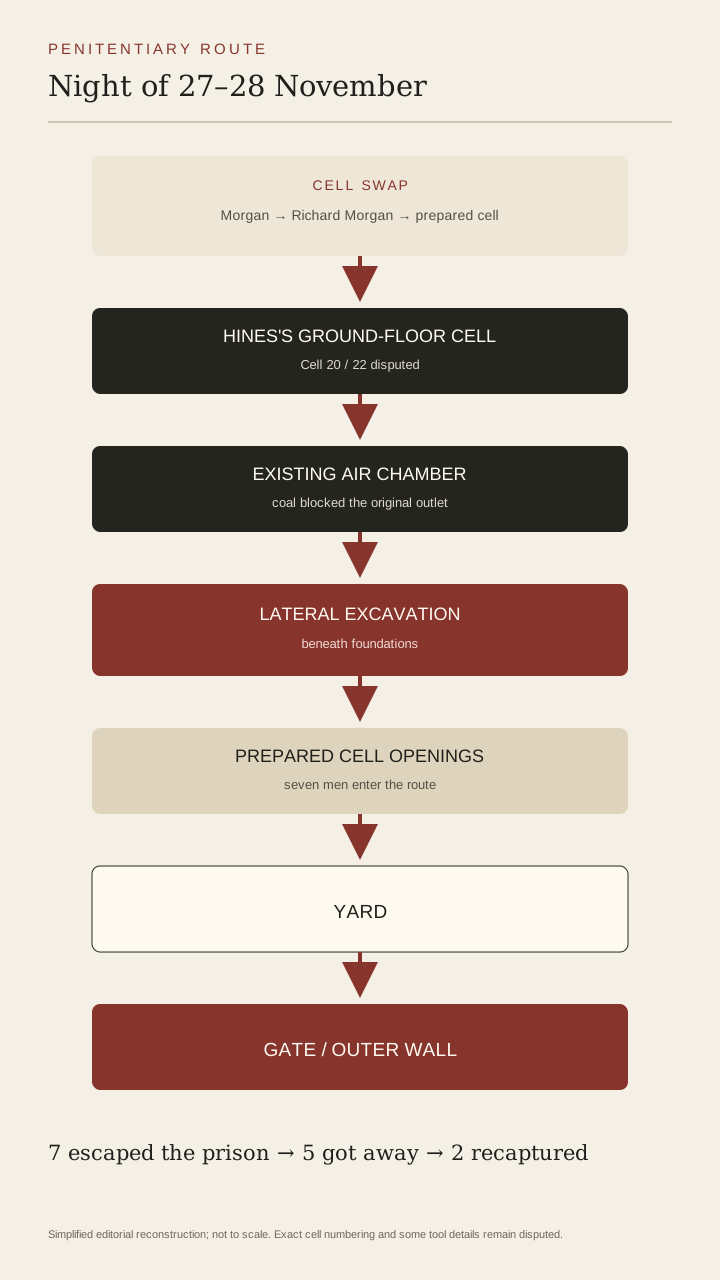
How the Ohio Penitentiary route worked
The cutaway follows the December 1863 federal investigation first, using Hines’s 1885 memoir only for later detail and clearly marking unresolved cell-number and tool questions.
- 01
Ground-floor cell
Hines’s prepared cell opened into an existing air chamber; the exact number remains disputed between 20 and 22.
- 02
Air chamber
The obvious outlet was blocked by coal, forcing a new lateral excavation beneath the foundations.
- 03
Prepared cells
Openings under six additional cells allowed the selected party to enter the shared route.
- 04
Cell swap
John Morgan exchanged his upper-tier cell with Richard Morgan, who remained behind.
- 05
Yard and wall
After midnight the seven entered the yard and crossed the about twenty-foot outer perimeter.
Simplified editorial reconstruction based primarily on the December 1863 federal investigation of the escape, supplemented by Thomas H. Hines's later account. Not to scale. Sources conflict between Cell 20 and Cell 22, and some tool details remain disputed.
A Coal Pile Ruined the Easy Route
The obvious plan was to follow the air chamber toward its end and get through the exterior opening. A large bank of coal blocked it. That forced the project to change direction. The federal investigation reconstructed the alternative: the prisoners dug beneath the foundation of the central cell block, cut through or under masonry, excavated laterally through earth toward the exterior foundation of the prison building, passed that obstacle as well, and then drove a vertical shaft upward toward the yard.
Earth and stones were hauled backward into the air chamber. The official report specifically mentions a small coal box and cord used for moving spoil.
This was no longer simply a hole under a bed. It was a concealed underground route running beneath multiple structural barriers of a functioning nineteenth-century penitentiary.
The air chamber was what made the project possible. It served as access corridor, work space and disposal area all at once.
Six More Floors Had to Be Prepared
Hines had another problem.
Only prisoners in the ground-floor range could descend directly into the chamber. The selected men occupied separate cells. If each had to begin digging from scratch on the final night, the plan would fail before it started.
So the escape route was extended upward.
From inside the air chamber, the prisoners removed brick and mortar beneath six additional cells. They stopped just short of breaking completely through the finished floor, leaving a thin shell that could remain invisible from above until the escape began.
The federal investigator found those prepared openings.
This is one of the strongest pieces of evidence in the entire case. It confirms that the breakout was organized around a synchronized release system, not simply one tunnel entrance through which men wandered when the opportunity appeared.
The men could remain in their own cells during normal inspections. Then, at the chosen moment, each could break through the weakened floor and drop into the hidden chamber below. Except John Hunt Morgan.
Morgan Had the Wrong Cell
Morgan’s assigned cell was on an upper tier. There was no hidden air chamber directly beneath its floor and no simple way to connect it to the prepared breakout route.
The solution depended on Morgan’s brother Richard C. “Dick” Morgan, who was not one of the seven selected to escape.
On the evening of 27 November, the brothers exchanged cells.
The federal investigator later asked how such a substitution could have happened. The warden’s explanation exposed a basic weakness in the lockup system: guards were primarily checking whether the correct number of prisoners had been secured, not closely verifying the identity of every man behind every door. John and Richard Morgan were similar enough in build that the substitution passed.
Now the general was in a prepared ground-floor cell connected to the underground route. This was a small administrative weakness with enormous consequences. The tunnel could not have freed Morgan without it.
The Prison Was Looking in the Wrong Direction
While the prisoners were excavating, a larger failure developed around them.
Responsibility for the Confederate officers had become divided between the Ohio Penitentiary administration and the United States military authorities assigned to guard them. Practices changed. Inspections that might have exposed tampering with the cells were reduced or discontinued. Different officials later disagreed over who had been responsible for the prisoners at particular times.
Major O. A. Mack, sent by the War Department to investigate, did not accept the idea that nobody was to blame.
His report concluded that the divided and undefined arrangement had produced a relaxation of vigilance that the prisoners exploited. He found it difficult to understand how the unusual activity around Hines’s cell could have continued for more than three weeks without attracting attention.
He also criticized the decision to allow the prisoners access to watch-spring saws, even though he could not establish that those tools had been used in the escape.
Most intriguingly, Mack examined the conduct of Sergeant Moon, who dealt directly with the prisoners. On the very day of the breakout, Moon took John Morgan’s watch into Columbus for repair without obtaining the required permission. Mack considered the relationship improper and wrote that Moon was liable to suspicion of complicity.
Suspicion is not proof.
The report did not establish that Moon deliberately helped Morgan escape. But it makes one thing clear: later stories portraying the prison security system as uniformly strict and the escape as entirely isolated from questionable outside contact are too simple.
Problem → response
Escape was a sequence of problems
Each response solved a practical obstacle while often creating the next one.
- 01→
Obstacle
Cell floor and brick arch
The escapees first had to penetrate the masonry separating Hines's cell from the subfloor air chamber without exposing the opening.
Response
They cut a small concealed opening beneath the bed area and covered it when not in use.
- 02→
Obstacle
Coal-blocked air-chamber outlet
A large coal bank prevented use of the chamber's direct external opening.
Response
The prisoners redirected the escape route laterally beneath foundation walls and upward into the yard.
- 03→
Obstacle
Separate locked cells
The seven selected escapees occupied different cells and could not simply gather after lockup.
Response
Openings were prepared from below into six additional cells, leaving only a thin surface for final breakthrough.
- 04→
Obstacle
Morgan's upper-tier cell
Morgan's assigned cell did not connect directly to the air-chamber route.
Response
John exchanged cells with his brother Richard before lockup on the escape night.
- 05→
Obstacle
Nighttime occupancy checks
The prisoners' cells were expected to appear occupied after they entered the hidden route.
Response
They arranged bedding and clothing as dummy forms in their cots.
- 06→
Obstacle
Outer prison wall
Reaching the yard still left an approximately twenty-foot perimeter barrier.
Response
The escapees used improvised rope and existing gate/wall structures to gain the top and descend outside.
- 07→
Obstacle
Distance from Confederate territory
The men remained deep inside Union territory after clearing the prison.
Response
They dispersed; Morgan and Hines used rail travel, crossed the Ohio River and moved through sympathetic territory toward Confederate lines.
After Midnight, the Floors Opened
The final operation began after the prisoners had been locked down on 27 November.
Hines’s later account places the movement after the regular midnight round. The official investigation likewise describes the prisoners arranging dummies made from extra clothing and bedding in their cots, then breaking through the thin remaining layer of prepared flooring.
One by one, the seven entered the air chamber. They moved through the excavated passage and opened the vertical shaft into the prison yard. At that point, they had escaped their cells and the main prison building. They were still inside the perimeter.
The federal report estimated the final wall at roughly twenty feet high. The prisoners had prepared ropes from bedding and other cloth. Hines later credited Richard Morgan with making a roughly thirty-five-foot line from bed ticking and fashioning a hook from a stove poker.
The official reconstruction suggested that the men used a wooden gate or related structure to gain elevation, get the rope over the wall and establish a crossing point. The seven reached the outside. No alarm stopped them at the wall.

The Train Was Part of the Escape Plan
Getting beyond the penitentiary did not place the fugitives in Confederate territory. They were in Columbus, deep inside a Union state, with an alarm certain to follow. The group split up.
Morgan and Hines headed for the railroad and travelled south. Hines later supplied an adventure-filled account of the journey, including conversations, near discoveries and assistance from Southern sympathizers. Those details come principally from his postwar narrative and should not all be treated as equally secure.
The broad route is much stronger.
Morgan and Hines used rail travel from Columbus toward Cincinnati, left the train before reaching the city proper, crossed the Ohio River, and moved through Kentucky and Tennessee. The Indiana Historical Bureau places their return to Confederate lines near Dalton, Georgia, on 27 December 1863—one month after the breakout began.
The other five escapees followed separate paths. Ohio History Connection summarizes the final result simply: five of the seven ultimately made good their escape and returned to Confederate service, while two were recaptured. That distinction matters. Seven escaped the prison.
Not all seven escaped the subsequent search.

The Story Hines Told Twenty-Two Years Later
In June 1885, Thomas Hines published the account that would become the best-known narrative of the escape. It is invaluable. It is also not a stenographic record of November 1863. Hines described ingenious deductions, repeated deceptions of prison officials, a carefully choreographed construction system, smuggled money, a purchased timetable, an encounter with a Union officer aboard the train and even a possible literary inspiration: he had recently read Victor Hugo’s Les Misérables.
Some of those details may be true. Some cannot presently be corroborated.
The context in which Hines wrote matters. His account appeared in the Southern Bivouac, a publication associated with the growing Lost Cause interpretation of the Civil War. The Indiana Historical Bureau has shown how neatly the story fits that pattern: clever, honorable Confederate officers defeat complacent or foolish Union jailers through discipline and audacity, while inconvenient questions about assistance or security corruption fade into the background.
The strongest way to tell the story is not to discard Hines. It is to read him beside the evidence produced in 1863. The federal investigators saw the holes. They saw the chamber.
They traced the tunnel. They documented the prepared cell floors. They examined the wall-crossing system. And they concluded that lax, divided supervision had made the escape possible.
That contemporary evidence confirms the core of Hines’s story while giving us good reason to be more cautious about its most theatrical details.
Breakout and final evasion
7escaped the Ohio Penitentiary
Escaped the Ohio Penitentiary
John Hunt Morgan and six Confederate officers cleared the prison during the night of 27–28 November 1863.
Made good their escape
Ohio History Connection reports that five of the seven ultimately remained at large and rejoined Confederate forces.
Recaptured
Two of the seven were recaptured after the prison breakout.
Evidence discipline
What the record supports
Status labels distinguish secure conclusions from uncertainty and rejected claims. Color is never the only signal.
WELL-SUPPORTED
Morgan escaped on 27 November 1863 rather than 28 November.
Both dates refer to the same operation. Preparations and the cell exchange occurred on the evening of 27 November; the physical breakout followed the midnight round and continued into early 28 November. Use 'night of 27–28 November 1863.'
Sources: SRC-001, SRC-002, SRC-004, SRC-009DISPUTED
The original opening was definitely in Cell No. 20.
Hines, a near-contemporary newspaper report, and portions of the federal investigation use Cell No. 20, while one architectural paragraph in the same investigation says No. 22. The cell number remains unsettled.
Sources: SRC-001, SRC-002, SRC-008DISPUTED
The entire tunnel was dug using only two small knives.
Table knives are strongly supported and the federal investigator thought they probably cut the first floor opening. Other prisoner accounts mention additional tools, while watch-spring saws were present but not proven to have been used.
Sources: SRC-001, SRC-002, SRC-003MYTH
The escape was bought entirely through bribery and no tunnel existed.
The federal investigation physically reconstructed the air-chamber entry, lateral excavation, prepared cell openings and wall crossing. The no-tunnel theory is incompatible with contemporary physical evidence.
Sources: SRC-001, SRC-003UNKNOWN
No guard or insider could have improperly assisted the escapees.
Hines later denied bribery. The federal inquiry did not prove conspiracy but found Sergeant Moon's dealings with Morgan improper and considered him liable to suspicion of complicity. Deliberate assistance remains unproven.
Sources: SRC-001, SRC-002, SRC-003LATER CLAIM
Victor Hugo's Les Misérables inspired Hines to devise the escape.
Hines suggested in 1885 that recently reading the novel may have influenced his thinking. No comparable 1863 source currently establishes this as the documented origin of the plan.
Sources: SRC-002, SRC-003DISPUTED
The route was completed on one securely known date in November.
Hines later gives 24 November, the federal report narrative gives 20 November, and its appendix reproduces from memory a note reading 8 November. The start date of 4 November is much more stable than the completion date.
Sources: SRC-001, SRC-002, SRC-003What Actually Made the Escape Work
The Ohio Penitentiary escape was not one brilliant trick. It was a chain of solutions. A dry cell suggested hidden space. The prisoners reached the air chamber. Coal blocked the direct outlet. They dug laterally beneath the foundations.
Seven men occupied separate cells. They prepared openings from below and left only a thin surface intact. Morgan lived on the wrong tier. He exchanged places with his brother. Guards expected occupied beds. The prisoners left dummies. The prison yard still had a high perimeter wall. They prepared a rope and used existing structures to reach the top.
Escaping Columbus was not enough. They dispersed and used transportation and sympathetic networks to move south. Behind all of those solutions was another condition the prisoners did not create but understood how to exploit: their jailers had stopped inspecting the system closely enough. That is why the federal investigation matters so much. It turns a famous Confederate escape legend back into a documented prison failure—and reveals the engineering that made that failure decisive.
Selected chronology
Capture, excavation, breakout and evasion
Morgan's raid suffers a major defeat at Buffington Island
Union forces strike Morgan's command as it attempts to recross the Ohio River.
Morgan is captured in Ohio
Union cavalry captures Morgan and the remnants of his command near West Point in Columbiana County.
Morgan and senior officers enter the Ohio Penitentiary
Hines dates the group's arrival to 31 July and 1 August; a surviving Richard Morgan letter confirms confinement there later that month.
Escape excavation begins
The prisoners begin cutting through the floor of Hines's ground-floor cell toward the air chamber.
Morgan exchanges cells with his brother
John Morgan moves into Richard Morgan's prepared lower-tier cell before lockup.
Seven officers break out
After the midnight round, the seven descend through prepared floors, cross the underground route and scale the prison perimeter.
War Department orders an investigation
Major O. A. Mack is instructed to investigate the treatment, security arrangements, method of escape and responsibility for the breakout.
Morgan and Hines regain Confederate lines
Institutional reconstruction places Morgan and Hines near Confederate lines around Dalton, Georgia, about one month after leaving Columbus.
Morgan is killed
Morgan is killed near Greeneville, Tennessee, during a surprise attack by United States cavalry.