
Louis XVI’s Flight to Varennes: The Escape Plan That Broke the French Monarchy’s Credibility
During the night of June 20–21, 1791, Louis XVI walked out of the Tuileries disguised as a servant. His wife, children, sister, governess, and several trusted attendants were leaving by separate paths before regrouping for the journey east.
The plan was not simply to cross the nearest frontier. The royal family intended to reach Montmédy, where the Marquis de Bouillé had loyal troops and where Louis believed he could act beyond the political pressure he felt in Paris. Less than a day later, the family was stopped at Varennes.
At a Glance
Departure: Night of June 20–21, 1791
Stopped at Varennes: Around midnight, June 21–22
Returned to Paris: June 25, 1791
Starting point: Tuileries Palace, Paris
Intended destination: Montmédy
Organizer: Axel von Fersen, with the Marquis de Bouillé coordinating military support
Travel method: Disguised royal household in a large berline with supporting vehicles and relays
Key recognition point: Sainte-Menehould
Pursuer: Jean-Baptiste Drouet
Varennes official: Jean-Baptiste Sauce
Outcome: Royal family detained and returned to Paris; constitutional monarchy survives temporarily but loses political credibility
Why Louis Wanted Out of Paris
By June 1791, Louis XVI had spent more than a year and a half living at the Tuileries after the October Days of 1789 forced the royal family from Versailles to Paris. He had accepted major revolutionary changes, but acceptance did not mean that he considered himself politically free.
The most important evidence is Louis’s own declaration, signed June 20 and left behind when he departed. In it he argued that actions taken since October 1789 had occurred without genuine freedom, complained that royal authority had been stripped away, and condemned the political order that had developed around the National Assembly.
The declaration matters because it gives the flight an unmistakable political meaning. Louis was not merely moving his household to a quieter residence. He wanted to place distance between himself and the revolutionary government in Paris and reach a position from which he could negotiate or act with armed support nearby.
Montmédy, Not Simply “Across the Border”
Later summaries often say the royal family tried to flee France. That description captures the sense of political rupture but is geographically imprecise.
The immediate objective was Montmédy, a fortified town inside France near the northeastern frontier. The Marquis de Bouillé commanded troops in the region and had built a chain of detachments intended to protect the royal party once it reached the eastern stages of the route.
The distinction matters. The operation was designed to move the king from a capital where he believed he was constrained to a military position from which his political choices would be different. Crossing into foreign territory might have become relevant later, but it was not required for the first stage to succeed.
Fersen Builds the Escape Plan
Axel von Fersen, the Swedish nobleman close to Marie Antoinette, became one of the principal organizers of the journey. Versailles institutional history describes him as a key architect of the flight, and French archival cataloguing likewise identifies his central role.
Fersen favored speed. Later accounts say he preferred lighter carriages and a plan that would separate members of the royal family during part of the journey.
Louis and Marie Antoinette chose to keep the family together. That decision required a much larger berline, pulled by multiple horses and supported by repeated relay changes.
The choice had an understandable family logic and a serious operational cost. A large coach was slower, more difficult to handle, and more conspicuous than a smaller vehicle.
Becoming the Household of Madame de Korff
The royal family needed more than different clothes. They needed a plausible household identity.
Madame de Tourzel, governess of the royal children, took the role of a Russian aristocratic woman usually identified as Madame or Baroness de Korff. The royal family then fitted themselves into the household around her.
Louis travelled as a valet or household servant. Marie Antoinette appeared as a governess, companion, or servant depending on the source wording. Madame Élisabeth took another female household role, while the royal children were presented as children belonging to the travelling party.
Three former bodyguards accompanied them in servant, driver, or courier roles. The disguises did not make the travelers physically unrecognizable. They created an explanation for why this particular collection of adults, children, servants, luggage, and carriages might be moving east. That distinction would become important when people along the route began looking carefully at faces.
Leaving the Tuileries
The departure itself generated one of the event’s most persistent source disputes. The members of the royal family did not simply climb together into a carriage parked at the palace entrance. They left separately or in small groups, using the darkness and the routines around the Tuileries to avoid attracting attention.
Marie Antoinette joined later than intended. Some accounts say she became lost among the streets near the palace and lost close to an hour. The published narrative attributed to Madame Royale, the royal couple’s daughter, shows how unstable that story already was within a generation of the event. Its editor compared several eyewitness accounts and concluded that the famous hour-long wandering may have exaggerated a shorter delay while the queen avoided Lafayette.
The secure conclusion is narrower: the queen was delayed, and the royal party reached the main travelling carriage later than planned. Exactly how much of that delay came from getting lost remains disputed.
The Schedule Starts Slipping
The escape plan depended on more than concealment. It depended on timing.
Bouillé had military detachments positioned farther east. Those troops could not remain conspicuously assembled beside post roads indefinitely without alarming local communities.
The royal party therefore needed to move through the relay system close to the expected schedule. They did not.
The family had departed Paris late, and the heavy carriage was not ideal for a rapid journey. Later accounts also describe ordinary travel problems, including damage that required repairs.
No single delay destroyed the plan. Together they created a growing mismatch between the moving carriage and the military safety net waiting ahead.
Bondy: Fersen Leaves
Fersen accompanied the early stage of the escape and separated from the royal party near Bondy. His departure has sometimes become another target for counterfactual history: if he had stayed, perhaps he would have forced faster decisions at Varennes.
That cannot be proved. What can be said is that from this point the royal party continued without the organizer who had handled much of the Paris logistics. The operation now depended on the road, the post relays, the disguised attendants, and Bouillé’s troops farther east.
Châlons: Recognition Without Intervention
The royal coach passed through Châlons-sur-Marne during the afternoon. Madame Royale’s near-contemporary narrative places the party there around four o’clock and says people recognized them. According to her account, some observers were sympathetic and hoped the escape would succeed.
Recognition therefore did not automatically mean arrest. Political attitudes varied from town to town and person to person. The family could be noticed and still continue. That helps explain why Varennes was not inevitable from the first suspicious glance.
The Escort That Was No Longer There
At Pont-de-Somme-Vesle, the royal party expected to connect with a detachment associated with the Duke of Choiseul. The soldiers were gone.
The reason was not a mysterious betrayal. The royal party’s lateness had made the situation increasingly unstable. Troops waiting in small communities attracted attention, rumors, and hostility. Officers had to decide whether the king had failed to leave Paris or whether they were exposing themselves for no purpose.
Choiseul withdrew. The missing escort mattered because the plan’s eastern half was supposed to become safer as the king approached Bouillé’s military network. Instead, the royal party was moving deeper into the crucial zone while discovering that the network was coming apart.
Sainte-Menehould
The berline reached Sainte-Menehould in the evening. Here Jean-Baptiste Drouet became the most famous civilian in the story.
Drouet was connected to the local post station and had military experience. He became convinced that the people passing through were the king and queen.
Later tradition gives him an especially memorable clue: the image of Louis XVI on an assignat, one of the revolutionary paper currencies bearing a royal portrait or stamp. The detail is plausible and repeatedly reported, but it should not be treated as if Drouet had never seen the royal family and solved the mystery from a banknote alone. Accounts also say he had previously seen the king or queen in public settings and recognized them from that experience. Drouet’s importance lies less in the exact visual clue than in what he did with suspicion.
Suspicion Becomes Pursuit
Drouet did not immediately drag Louis from the carriage. The royal party left Sainte-Menehould.
Drouet communicated his suspicion to local authorities. He and a companion then rode east, taking a faster route toward Varennes.
That converted recognition into an organized interception. Meanwhile, the military escorts Louis expected were also proving unreliable. At Clermont and elsewhere, troops had become entangled with local hostility, uncertainty, or refusal to obey. The king was still moving toward a military refuge, but the protective chain ahead of him no longer resembled the plan that had been prepared in Paris.
Varennes Had Its Own Confusion

When the royal party reached Varennes-en-Argonne, the town did not present a clean relay point waiting for them. The travelers expected horses or support on a route through the town. The arrangement was confused, and the carriage lost time while people tried to determine where the relay was located.
Drouet had arrived with warning. Local officials and National Guardsmen began organizing a stop.
Varennes was now no longer just another post town. It had become the point where the royal timetable, failed escort network, and local revolutionary authority collided.
Jean-Baptiste Sauce
The official most closely associated with the detention inside Varennes was Jean-Baptiste Sauce, the town’s procureur-syndic. The royal carriage was stopped and the passport inspected. The travelers were brought under municipal control, eventually spending the decisive hours in Sauce’s house.
Contemporary and near-contemporary images often simplify the arrest into one dramatic instant. The real process unfolded through local officials, National Guardsmen, Drouet’s warning, passport scrutiny, identification, and the growing realization that the royal family was physically present in the town.
Other people who had experience of Versailles or the royal family helped remove any remaining doubt. Louis’s servant disguise had reached its limit.
Could Nearby Troops Have Freed Them?
Royalist troops were not infinitely far away. That fact has encouraged another counterfactual: the family had reached the edge of success and only needed a more forceful officer to break the local roadblock.
There were soldiers in the region, but the political and military situation around Varennes was deteriorating quickly. Units had already hesitated or disobeyed. Local National Guards were mobilizing. Crowds were gathering. Orders and loyalties could not be assumed.
The episode was therefore not a simple calculation of how many cavalrymen stood within riding distance. The escape plan depended on obedient troops arriving at the right place before a political crisis formed around the king. By the time Louis’s identity was confirmed, that condition had failed.
Paris Discovers the Empty Palace
The royal family’s disappearance was discovered in Paris on the morning of June 21. For a brief period, people could imagine that the king had been abducted.
Then Louis’s written declaration was read before the National Assembly. The document made the constitutional problem much larger. The king himself described the political order in terms that showed he did not regard his recent acts as fully free or the current balance of power as acceptable.
The question was no longer merely where the king had gone. It was whether the constitutional monarchy could continue if the monarch rejected the conditions under which it operated.
Orders to Bring the King Back
The National Assembly sent orders and commissioners. The royal family remained at Varennes until the decision to return them was beyond realistic challenge.
The journey back to Paris took several days. Assembly commissioners including Antoine Barnave, Jérôme Pétion, and Charles César de La Tour-Maubourg met the convoy and joined the return.
The political meaning of the carriage had now reversed. Going east, it had carried a disguised king trying to escape the political constraints of the capital. Going west, it carried an identified king under national authority.
June 25: Return to Paris
The convoy reached Paris on June 25. Contemporary and near-contemporary prints show the carriage surrounded by National Guards, troops, and spectators. Paris Musées preserves an image of the return at the Barrière du Roule and another reproduction based on Jean-Louis Prieur’s revolutionary imagery.
The return was deliberately controlled. For the royal family, it meant renewed confinement at the Tuileries.
For the Assembly, it meant a constitutional crisis that could not simply be solved by punishing an ordinary fugitive. Louis was still the king around whom the new constitution had been built.
The Convenient Story of Kidnapping
Moderates in the National Assembly wanted to preserve constitutional monarchy. One way to do that was to claim that Louis had not freely fled but had been abducted or coerced.
As a political strategy, the idea was understandable. As an explanation of the event, it was weak.
Louis had left a signed declaration explaining why he was departing Paris and condemning important parts of the revolutionary political settlement. The kidnapping story belongs in the political aftermath, not in the factual reconstruction of his intent.
Drouet and the Assignat
The most famous image of the failure is almost cinematic: Drouet looks at Louis, looks at a banknote, and instantly recognizes the king. The underlying evidence is messier.
Drouet had prior experience that could have made the royal faces familiar. The assignat offered a visual comparison, and later accounts highlighted it because it made an excellent story.
An authentic assignat from May 1791 does show Louis’s portrait and title. That object is useful evidence for what revolutionary paper money looked like. It is not evidence that one surviving museum note was the exact piece of paper Drouet held at Sainte-Menehould. The difference between context and proof should remain clear.
Was the Berline the Fatal Mistake?
The large carriage slowed the royal party and helped attract attention. It also kept the family together, which Louis and Marie Antoinette strongly preferred.
Calling it “the mistake that caused Varennes” makes the event easier to remember and harder to understand. The operation failed through accumulation.
The family left late. The carriage moved slowly.
Repairs and ordinary travel consumed time. The military escorts became unstable.
Recognition spread. Drouet rode ahead.
Varennes was not prepared in the way the travelers expected. Local authorities acted.
The king’s military support never reassembled fast enough to reverse the detention. The carriage was one important part of a fragile system.
Did Marie Antoinette Lose the Monarchy in the Streets of Paris?
No single wrong turn can carry that much historical weight. The queen’s late arrival mattered because the schedule was already tight. Some eyewitness traditions blamed a major navigational mistake around the Tuileries. Others minimized it.
Even if the longest version is accepted, the royal party later encountered many additional delays and political failures. The story is better understood as a warning against monocausal history: an operation depending on disguise, transport, horses, military timing, local compliance, and secrecy had many ways to fail.
What Varennes Changed
Louis XVI was not deposed in June 1791. The Assembly suspended his functions temporarily, then restored him within the constitutional framework. He accepted the Constitution of 1791 in September.
The monarchy continued for more than a year. Yet Varennes altered the political landscape because trust had become harder to reconstruct than the constitution.
Republicans could point to the king’s flight and declaration as evidence that monarchy itself was incompatible with the Revolution. Constitutional monarchists had to defend an arrangement whose king had just tried to remove himself from the capital and reach armed support.
The attempt did not mechanically cause the fall of the monarchy in August 1792. It helped destroy the credibility on which a workable constitutional monarchy depended.
Evidence, Myth and What the Sources Support
Was Louis XVI trying simply to cross out of France?
MYTH
The immediate strategic objective was Montmédy, inside France near the northeastern frontier, where Bouillé had loyal troops.
Did Louis leave a political declaration behind?
DOCUMENTED
Yes. The Bibliothèque nationale de France catalogues the 1791 printed declaration, signed June 20, and the Archives Parlementaires records its reading to the National Assembly on June 21.
Did Marie Antoinette lose about an hour because she got lost near the Tuileries?
DISPUTED
Several later accounts say so, while the published near-contemporary narrative of Madame Royale and its editorial comparison of eyewitnesses suggest the delay may have been shorter and connected with avoiding detection.
Did Fersen organize the escape?
DOCUMENTED
Versailles institutional history and archival records identify Axel von Fersen as a principal organizer of the flight.
Did the royal family travel under a Madame de Korff identity?
WELL-SUPPORTED
The passport and memoir tradition consistently place the party within the fictive or borrowed household identity of a Russian noblewoman generally called Madame or Baroness de Korff.
Did one oversized carriage single-handedly cause the failure?
MYTH
The berline contributed to delay and visibility, but the failure resulted from accumulated delays, collapsed military coordination, recognition, pursuit, and local interception.
Did Drouet recognize Louis only by looking at his portrait on an assignat?
DISPUTED
The assignat comparison is a strong and famous tradition, but accounts also state that Drouet had previous familiarity with the royal family’s appearance. Recognition was not necessarily a one-object revelation.
Did Drouet personally arrest the royal family at Sainte-Menehould?
MYTH
He became suspicious there and then helped organize pursuit. The royal family continued to Varennes, where local authorities and National Guardsmen stopped and detained them.
Was Jean-Baptiste Sauce the mayor of Varennes?
MYTH
Sauce was the procureur-syndic, a leading municipal official. Some later accounts loosely call him mayor, but that title is inaccurate.
Was Louis kidnapped from Paris?
MYTH
The kidnapping thesis was politically useful to constitutional monarchists after the event. Louis’s own declaration and the organized travel plan show deliberate departure.
Did Varennes immediately abolish the French monarchy?
MYTH
The monarchy survived until 1792. Varennes was a major political turning point because it damaged confidence in Louis as a constitutional monarch.
Why the Flight Failed
The operation depended on timing more than any single disguise. The family had to leave the Tuileries unseen, reach the main carriage on schedule, move quickly enough through the post-road system, and connect with military detachments that could not wait indefinitely without attracting suspicion.
Each delay weakened the next layer. By the time the berline reached the most politically dangerous section of the route, the military escort network was already fraying and the travelers had been noticed.
Drouet turned suspicion into pursuit. Varennes turned pursuit into detention.
The royal family covered most of the distance to its intended military refuge. The plan still failed because the last miles were the ones in which secrecy and timing mattered most.
Documentary reconstruction
The Varennes route and the accumulating escort failure
A case-local visual focused on the historical question that the surviving evidence can answer.
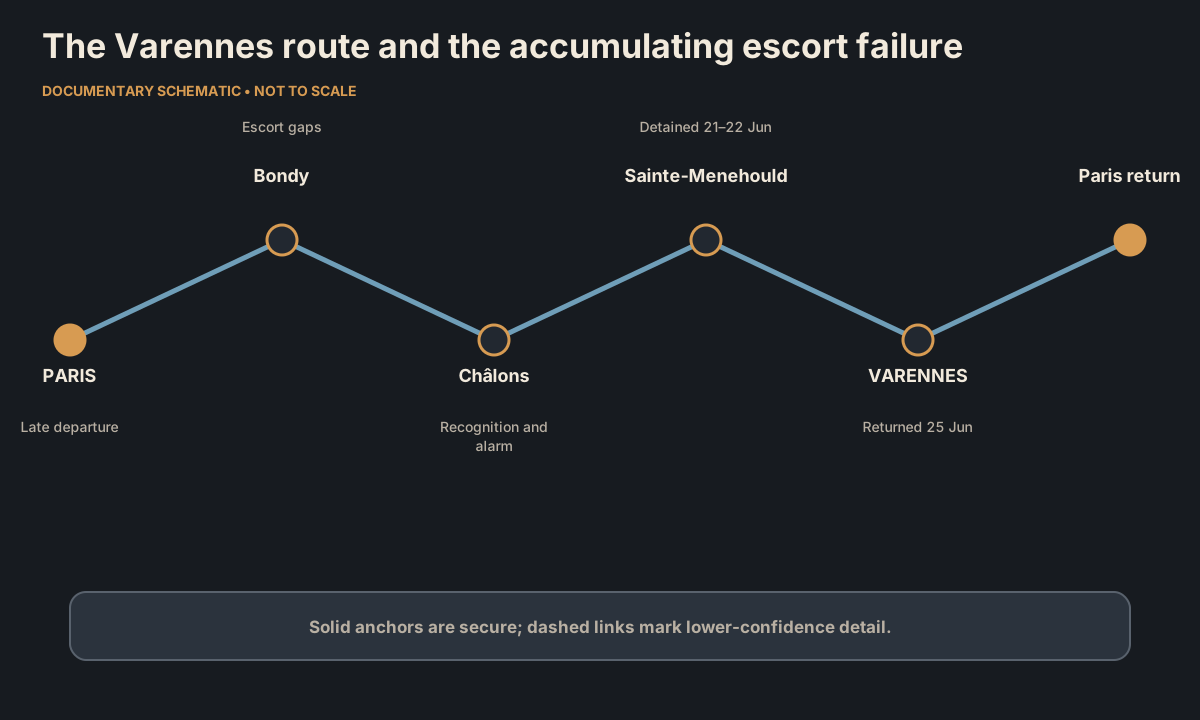
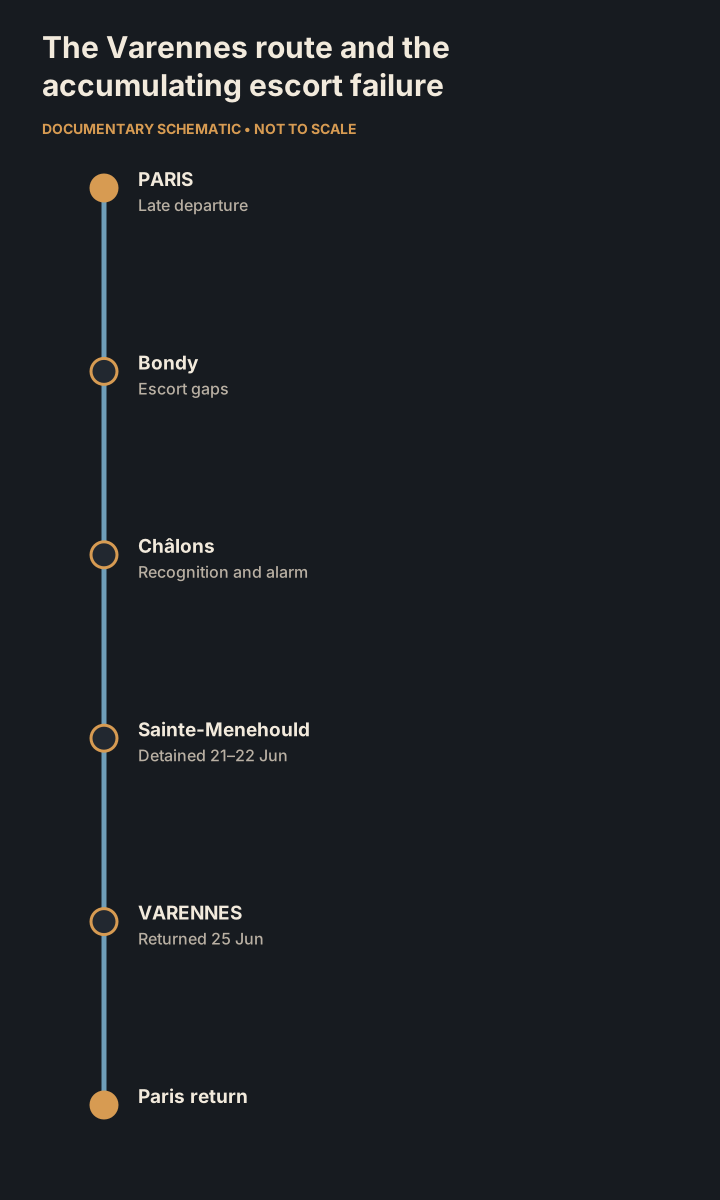
Simplified documentary reconstruction; not to scale. Evidence qualifications are written directly into the visual and explained in the adjacent text.
Evidence discipline
What the record supports
Status labels distinguish secure conclusions from uncertainty and rejected claims. Color is never the only signal.
MYTH
The immediate objective was to leave France entirely.
The first strategic destination was Montmédy, inside France near the frontier, where Bouillé had loyal troops.
Sources: SRC-005, SRC-013DOCUMENTED
Louis XVI left a signed political declaration explaining his departure.
The BnF catalogue dates the printed declaration to 1791 and records the June 20 signature; the Archives Parlementaires records its reading on June 21.
Sources: SRC-001DISPUTED
Marie Antoinette definitely lost approximately one hour wandering near the Tuileries.
Eyewitness and participant narratives conflict. The published Madame Royale tradition treats the famous long delay as potentially exaggerated.
Sources: SRC-004DOCUMENTED
Axel von Fersen was a principal organizer of the flight.
Versailles and French archival institutional records identify Fersen's central logistical role.
Sources: SRC-006, SRC-007WELL-SUPPORTED
The royal party travelled under a Madame de Korff household identity.
The passport and participant tradition consistently place Madame de Tourzel in the role of a Russian aristocratic traveller and the royal family in subordinate household roles.
Sources: SRC-003, SRC-004, SRC-005MYTH
The large berline alone caused the failure.
The carriage contributed to delay and visibility, but military desynchronization, recognition, pursuit, and the Varennes interception were also essential.
Sources: SRC-005, SRC-013DISPUTED
Drouet recognized Louis solely by comparing his face with an assignat.
The assignat comparison is a strong later tradition, but accounts also state that Drouet had prior familiarity with the royal couple's appearance. Recognition should not be reduced to one object.
Sources: SRC-002, SRC-004, SRC-011, SRC-013MYTH
Drouet arrested Louis at Sainte-Menehould.
Drouet became suspicious at Sainte-Menehould and rode ahead; local officials and National Guardsmen stopped and detained the party at Varennes.
Sources: SRC-002, SRC-008, SRC-009MYTH
Jean-Baptiste Sauce was mayor of Varennes.
Museum records and local-history reconstruction identify Sauce as procureur-syndic, not mayor.
Sources: SRC-008, SRC-009MYTH
Louis XVI was involuntarily kidnapped from Paris.
The abduction theory served a constitutional political purpose after the event, but Louis's signed declaration and the coordinated travel plan demonstrate deliberate departure.
Sources: SRC-001, SRC-014MYTH
The monarchy ended immediately after Varennes.
Louis later accepted the Constitution of 1791 and the monarchy continued until the revolutionary crisis of 1792.
Sources: SRC-014