
At a Glance
- Escape: Night of 27–28 November 1989
- Starting country: Socialist Republic of Romania
- First destination: Hungary
- Escapee: Nadia Comăneci
- Border group: Six escapees plus guide Gheorghe “Ghiță” Talpoș
- Organizer/Western contact: Constantin Panait
- Method: Guided nighttime foot crossing of the Romanian-Hungarian border
- Onward route: Hungary → Austria → United States
- U.S. arrival: 1 December 1989, John F. Kennedy International Airport
- Outcome: Successful closed-border escape and celebrity defection
Nadia Comăneci left Romania less than a month before the communist state that had controlled her movements began to collapse. During the night of 27–28 November 1989, the former Olympic champion joined a small group guided on foot across Romania’s western border into Hungary.
The crossing immediately became international news because Comăneci was not an obscure political dissident. Since scoring the first Olympic gymnastics perfect 10 in Montreal in 1976, she had been one of Romania’s most recognizable public figures. Her departure therefore exposed a striking contradiction: a person celebrated for years as an international symbol of Romanian achievement had decided that leaving the country illegally was preferable to remaining under the restrictions imposed on her.
Later retellings added rumors, disputed relationships, and increasingly dramatic descriptions of the border. The archival record supports a clearer story if those layers are kept separate.
A national symbol under surveillance
Comăneci’s international status never placed her outside the surveillance system of Nicolae Ceaușescu’s Romania. Historian Stejărel Olaru’s research, built from approximately 25,000 pages of Securitate material and other intelligence records, shows that the secret police monitored her from adolescence.
Phones were tapped. Correspondence and conversations were collected. Informants operated around the gymnastics establishment. The state’s interest increased as Comăneci’s fame made her both a propaganda asset and a potential embarrassment if she chose not to return from a trip abroad.
The danger appeared especially real after Béla and Márta Károlyi, the coaches most closely associated with her early career, remained in the United States in 1981. Comăneci did not leave with them. She had opportunities to remain abroad earlier in her career and returned to Romania.
By the later 1980s, however, her circumstances were different. Her competitive career had ended, Western travel had become far more restricted, and the opportunities available to an internationally famous former athlete were controlled by a state that feared another high-profile defection.
Why she decided to leave
Comăneci later summarized her motive in simple terms: she wanted a free life.
That statement fits the documented restrictions without requiring every private motive to be known. Contemporary reports after the crossing quoted her complaints that she had been prevented from traveling and working abroad. Olaru’s archival research confirms that senior political decisions increasingly limited her access to Western travel.
The precise trigger came in November 1989 through Constantin Panait, a Romanian émigré living in the United States who had returned to Romania. Panait offered a connection to people who could help Comăneci get out.
The plan developed quickly. Radio Free Europe/Radio Liberty’s account of Olaru’s research says the actual escape plan was only about two weeks old when she left. Romanian archival reconstruction records exploratory movement toward the western border before the final attempt.
Comăneci’s family was not treated as one uniform circle of prior knowledge. The post-escape Securitate investigation indicates that her brother Adrian and sister-in-law Liliana had some advance knowledge and encouraged the decision, while the evidence for what her mother knew before the international news broke is weaker.
The border party
One recurring source of confusion is the size of the group.
The strongest reconciliation is seven people in the border party: guide Gheorghe “Ghiță” Talpoș and six people who intended to leave Romania, including Comăneci. That explains why one institutional account says Talpoș “led six people” while Romanian reconstructions describe a seven-person party.
Talpoș was a local guide familiar with the western border region. According to Olaru’s reconstruction, he did not learn that the famous gymnast was joining the group until the night they set out.
Panait should not be substituted for Talpoș in this part of the story. Panait helped arrange the larger escape and later accompanied Comăneci toward the United States, but the guide responsible for the Romanian-Hungarian crossing was Talpoș.
Night of 27–28 November
Archive-based Romanian reporting places the final departure during the night of 27–28 November 1989.
The party moved through the western border area around Cenad and Sânnicolau Mare, then crossed toward Hungary on foot. The journey took several hours. The political frontier was heavily controlled, and people attempting unauthorized departures from Romania could face arrest or gunfire from border forces.
Comăneci’s later descriptions make the crossing vivid. She recalled mud and water, barbed wire, cold conditions, darkness, and fear that guards would shoot. Those details belong to her participant testimony. They should not be confused with the archival record, which is stronger on the date, participants, security response, and broad route than on every obstacle encountered in the fields.
That distinction also helps explain why contemporary reporting was initially inconsistent. One early account said the party had entered Hungary by car. Later archival reconstruction instead establishes the foot crossing as the core event.
Hungary
By the morning of 28 November, Comăneci was in Hungarian custody.
The timing placed Hungary in an awkward position. The country was itself rapidly moving away from communist rule and had dismantled important parts of its border regime with Austria earlier that year, but Romanian citizens crossing illegally still presented a legal and diplomatic problem.
Contemporary reports initially described Comăneci as seeking political asylum in Hungary. Hungarian authorities instead issued temporary permission while officials determined what would happen next.
Her celebrity affected the handling. According to the archive-based RFE/RL account, Hungarian officials considered returning some members of the group while treating Comăneci differently. She objected that the others should receive equal treatment. The episode is significant because it shows that the escape was not complete the instant the party crossed the frontier: the fugitives still needed a state willing not to send them back.
From Hungary to Vienna
The next stage is less cleanly documented than the Romanian-Hungarian crossing.
Contemporary reporting shows Comăneci and the others leaving the Szeged area in vehicles associated with Austria and then appearing in Vienna. Later reconstructions supply a more detailed border story, but the exact mechanics of leaving Hungary do not need to be fixed into one authoritative sequence.
By 30 November, Comăneci and Panait were in Vienna. U.S. diplomatic involvement then became decisive in arranging her onward movement.
The broad sequence is secure: Hungary had become the first place of safety, Vienna became the Western diplomatic transit point, and the United States became the intended destination. The precise roads, checkpoints, identities, and vehicle arrangements between those stages remain less important and less secure.
The Securitate discovers the defection
Romanian authorities had been monitoring Comăneci for years, but they did not stop the crossing.
Once her disappearance became clear, the Securitate opened an investigation to determine how she had left and who had assisted her. Romanian reporting based on the files identifies the post-escape operation under the name “Corina.”
Her family became an immediate focus. Security officers monitored her mother’s apartment, recorded telephone calls, and questioned or watched relatives. Olaru’s archival research shows Comăneci’s mother, brother, and sister-in-law discussing how they would respond to interrogation while aware that microphones could be present.
This is verified Securitate activity.
It is different from the more sensational claims that circulated outside Romania suggesting covert teams were already pursuing Comăneci across Western Europe or that an intelligence faction had secretly arranged the entire escape. Olaru found no evidence in the files that the CIA or a dissident Securitate faction engineered her departure.
The Nicu Ceaușescu story
No part of Comăneci’s biography attracted more gossip than the claim that she had a romantic relationship with Nicu Ceaușescu, the dictator’s son.
The story cannot simply be presented as documented fact.
Olaru told El País that he found testimony from people close to Comăneci but no confirming trace in the Securitate archive. Comăneci denied that there had been a personal relationship and said her connection to Nicu was work-related. Olaru also cautioned that silence in the files is not conclusive because the secret police were restricted in what they could record about the ruling family.
The appropriate conclusion is therefore limited: the alleged romance remains disputed, and it cannot serve as a verified explanation for the escape. Restrictions placed on Comăneci’s travel are much better documented than claims about her private relationship with Nicu.
Vienna to New York
On 1 December 1989, Comăneci flew from Vienna to New York.
Contemporary Associated Press reporting published by the Los Angeles Times says U.S. authorities had granted her refugee status. The Washington Post recorded her arrival at John F. Kennedy International Airport that afternoon after a flight from Vienna.
At the airport, the story shifted from a Romanian security crisis to a global celebrity event. Cameras, officials, and journalists surrounded one of the most famous athletes of the 1970s as she entered the United States.
Comăneci said she wanted to have a free life. Within days she moved to Florida with Panait, and press attention increasingly focused on their personal relationship rather than on the political system she had just left.
What happened with Constantin Panait afterward
Later accounts of Panait are difficult to separate from the intense tabloid attention that followed the defection.
Comăneci later alleged that after reaching the United States Panait controlled her finances and behavior and isolated her from other people. Those allegations belong to her later account of their post-escape relationship.
They do not erase the better-supported fact that Panait played an important role in arranging her departure and onward movement in November 1989. Nor should contemporary photographs of the two together be treated as proof that every later allegation was false.
The historical categories are different: Panait’s role as an escape facilitator is well supported; the more serious allegations about his conduct after arrival are later claims.
A defection three weeks before revolution
Comăneci’s disappearance was politically damaging precisely because the Romanian regime had used elite athletes as evidence of national achievement.
If someone with her international fame and relative material privilege still chose an illegal border crossing, the departure challenged the state’s claim that restriction and isolation were necessary or acceptable. Romanians who learned of the defection could read it as another sign of the regime’s failure.
The timing intensified that meaning. In December, protests beginning in Timișoara escalated into a revolution. Nicolae Ceaușescu lost power, and he and Elena Ceaușescu were executed on 25 December.
Comăneci could not have known on the night of 27 November that the regime had only weeks left. Her decision was made under the assumption that the border system and political restrictions she had known for years would continue.
That makes the escape more historically revealing than a simple story of a celebrity arriving in America just before communism fell.
What the sources actually establish
The strongest evidence supports a concise core sequence.
Comăneci had been subjected to long-running state surveillance and increasingly restrictive travel control. In November 1989 she accepted an escape opportunity connected to Constantin Panait. During the night of 27–28 November she joined five other escapees and guide Gheorghe Talpoș and crossed the Romanian-Hungarian border on foot. Hungarian authorities processed the group. Comăneci moved onward through Vienna and reached New York on 1 December with U.S. refugee status.
Beyond that core, the evidence changes character. Mud, wire, specific patrol encounters, and some route details come from later participant recollection. Stories about Nicu Ceaușescu are disputed. Claims of CIA or internal-Securitate orchestration are unsupported by the archival investigation reviewed by Olaru. Allegations against Panait concern what happened after the escape and belong to a later evidentiary category.
Separating those layers does not make the story less dramatic. It shows what was most consequential: Romania’s most famous gymnast reached a point where a clandestine walk across a guarded frontier offered more freedom than remaining one of the country’s favored public symbols.
Evidence discipline
What the record supports
Status labels distinguish secure conclusions from uncertainty and rejected claims. Color is never the only signal.
DISPUTED
The CIA secretly organized Nadia Comăneci's 1989 escape.
Later theories have alleged intelligence orchestration, but Olaru's review of Securitate records found no evidence that the CIA or an internal Securitate faction planned the escape.
Sources: SRC-002, SRC-010MYTH
Constantin Panait personally guided Comăneci across the Romanian-Hungarian border.
Panait helped arrange the wider escape, but the archive-based reconstruction identifies Gheorghe Talpoș as the local guide who led the six intended escapees across the border.
Sources: SRC-002, SRC-004DISPUTED
Comăneci's romantic relationship with Nicu Ceaușescu is established by Securitate files.
Comăneci denied a personal relationship, and Olaru found no confirming archival record. He also notes that the absence is not definitive because Securitate documentation concerning the ruling family was constrained.
Sources: SRC-003MYTH
Every dramatic physical detail of the border crossing is verified in Securitate records.
The date, broad route, participants and post-escape investigation are archive-backed. Mud, barbed wire, water and specific fear-of-gunfire scenes are principally Comăneci's later participant recollections.
Sources: SRC-004, SRC-005MYTH
Later allegations about Constantin Panait prove that his role in arranging the escape was invented.
His facilitation role is well supported by contemporary and later sources. Comăneci's allegations about control and money concern their relationship after reaching the West and belong to a separate evidentiary category.
Sources: SRC-002, SRC-007UNKNOWN
Comăneci knew the Ceaușescu regime would collapse within weeks when she crossed the border.
The revolution followed soon afterward, but no source used here establishes that she possessed foreknowledge of the regime's imminent fall.
Sources: SRC-002, SRC-003Documentary reconstruction
The route and its source limits
A case-local editorial visual separates the documented sequence from uncertainty without implying exact modern geography or operational detail.
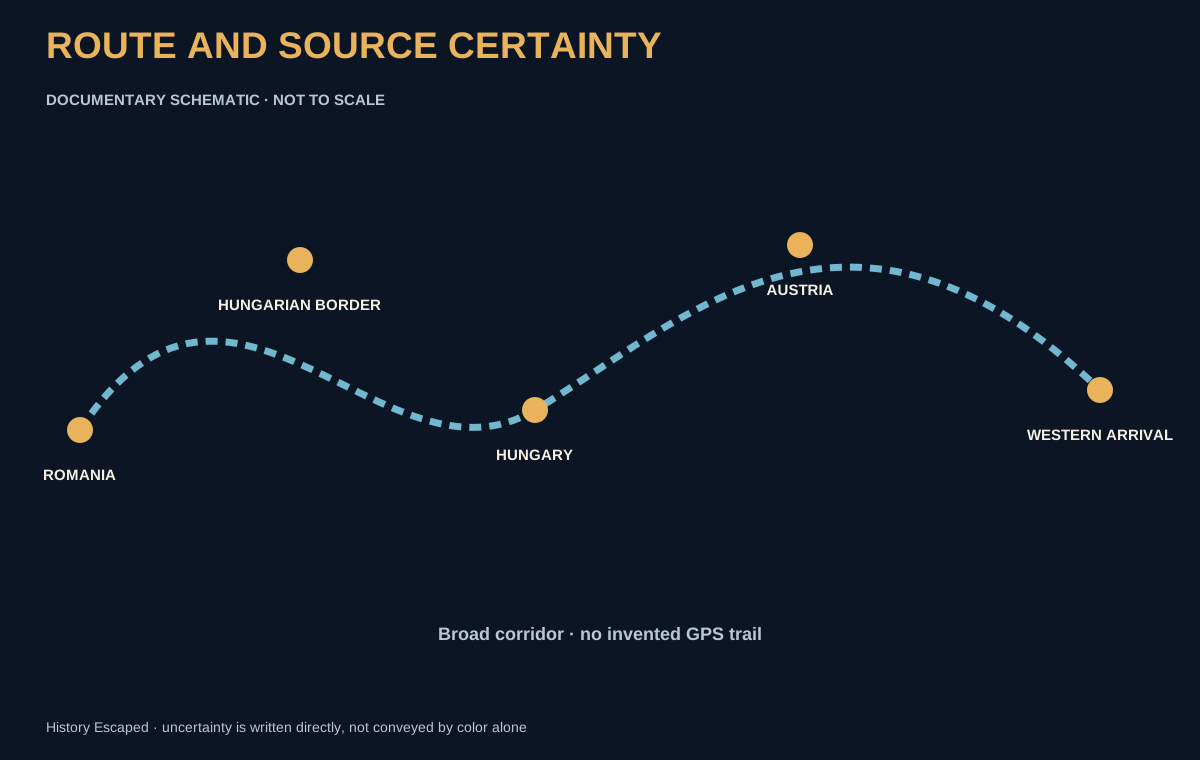
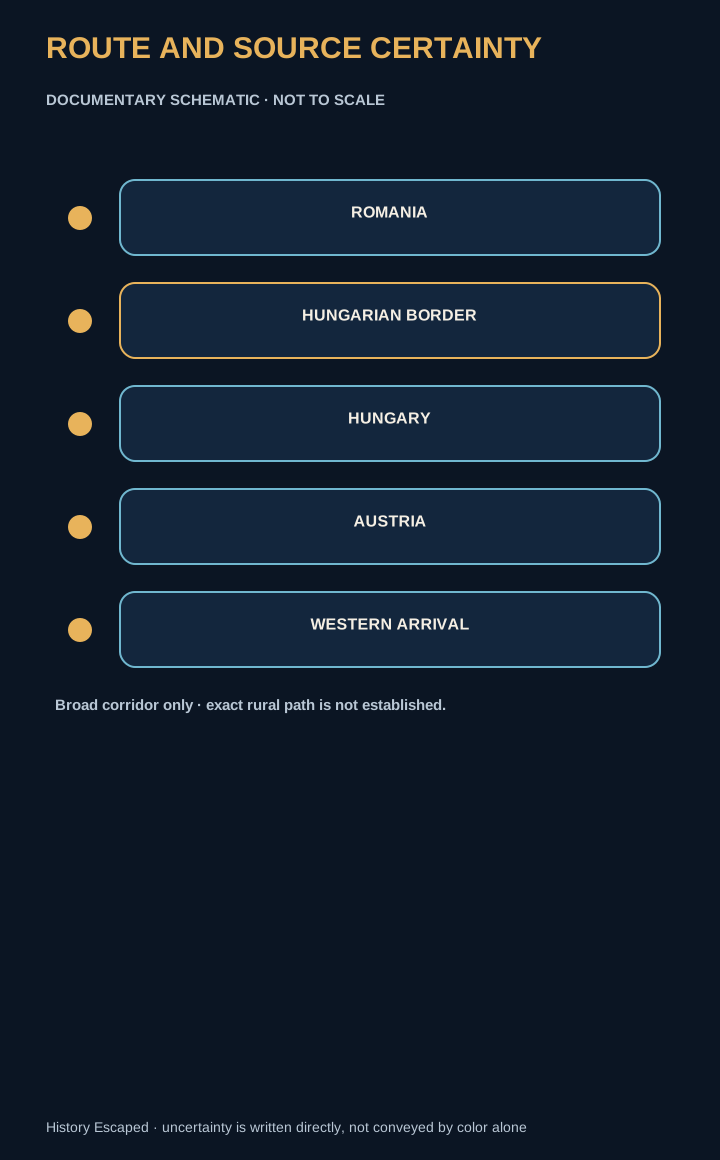
Simplified editorial reconstruction based on the cited historical record; not to scale. Uncertainty is stated directly in the visual and adjacent text.