
By late November 1960, Patrice Lumumba was living in a political contradiction. He remained a central figure in the struggle over who legitimately governed the newly independent Republic of the Congo, yet his movements were constrained at the prime ministerial residence in Léopoldville. United Nations troops guarded the residence against an attempted seizure, while Congolese National Army soldiers watched from outside with orders to arrest him if he emerged. When Lumumba left on the night of 27 November and headed east toward Stanleyville, he escaped that confinement—but not the expanding military search that followed.
At a Glance
- Escape: Lumumba secretly left his guarded residence in Léopoldville on the night of 27 November 1960.
- Objective: He traveled toward Stanleyville, where Deputy Prime Minister Antoine Gizenga and other supporters were regrouping.
- Pursuit: Congolese authorities mobilized troops and roadblocks. Declassified U.S. records show the CIA station was assisting the Congolese government with efforts to block possible routes.
- Recapture: Congolese troops caught Lumumba during the eastward journey around 1 December. Early United Nations records place the arrest at or near Mweka or Bulongo; later scholarship reconstructs it at Lodi on the Sankuru River.
- Immediate outcome: Lumumba was returned to Léopoldville on 2 December and transferred to military detention at Thysville the next day.
A prime minister isolated in his own residence
The Congo became independent from Belgium on 30 June 1960 with Joseph Kasa-Vubu as president and Lumumba as prime minister. The new state almost immediately entered a severe political and military crisis: the army mutinied, Belgian forces intervened, Katanga seceded, and the United Nations deployed a large operation. The Cold War intensified the struggle, but the crisis was also profoundly Congolese, involving rival leaders, constitutional claims, regional interests, and an army whose loyalties were unstable.
In September, Kasa-Vubu announced Lumumba's dismissal. Lumumba rejected the action and in turn claimed to dismiss Kasa-Vubu, while Parliament resisted the effort to remove the prime minister. On 14 September, army chief of staff Joseph-Désiré Mobutu announced that the politicians were being “neutralized” and installed a College of Commissioners-General. The result was not a clean constitutional transfer of power but a fractured political order in which competing actors claimed authority.
Lumumba's residence became one physical expression of that struggle. A United Nations commission later reported that Congolese soldiers surrounded the house after an unsuccessful attempt to arrest him on 11 October and strictly watched people entering or leaving. ONUC, the United Nations Operation in the Congo, maintained its own guard and reinforced it in mid-November after reports of further arrest attempts. The U.N. considered at least one attempted arrest irregular and refused to alter its guard orders merely to facilitate it.
“House arrest” is therefore useful shorthand, but it can imply more legal clarity than the situation possessed. Lumumba was effectively confined: leaving exposed him to arrest by Congolese troops, while the U.N. guard helped prevent those troops from simply entering and seizing him. He was simultaneously protected and trapped by two armed cordons serving different purposes.
His political room for maneuver was narrowing as well. On 22 November, the U.N. General Assembly voted 53–24, with 19 abstentions, to accept the credentials of the delegation associated with Kasa-Vubu. That decision did not settle the Congo's internal constitutional dispute, but it strengthened Kasa-Vubu's position internationally. In Stanleyville, meanwhile, Antoine Gizenga and other Lumumba allies were consolidating an alternative center of political power.
Why Lumumba left
The broad destination is well supported: Stanleyville. U.S. records written after the event describe Lumumba as setting out to reach Gizenga, while contemporary intelligence reporting assumed he was moving toward the eastern stronghold. Later histories likewise treat the journey as an attempt to reconnect with supporters and restore political initiative outside Léopoldville.
The immediate motive is less simple. A close friend told the later U.N. commission that Lumumba was deeply concerned with the burial of his young child, who had died in Geneva, and that the child's body had been sent to Stanleyville. Contemporary reporting also referred to a message in which Lumumba linked his departure to the funeral and suggested he would return for a political conference. That evidence should not be discarded merely because the journey also had obvious political implications.
Nor does it prove that the trip was only a family journey. Lumumba left a position of enforced isolation and headed toward the main territory controlled by his supporters at a moment when his political position in the capital had sharply deteriorated. The U.N. commission could report what a friend said about the funeral; it could not establish Lumumba's entire purpose. The most defensible reconstruction is that the burial of his child formed part of the immediate context while the move toward Stanleyville also carried unmistakable political significance.
Leaving Léopoldville
The escape from the residence took place on the night of 27 November, continuing into the early hours of the 28th. That much is secure across U.N., U.S., Congolese institutional, and later scholarly accounts. The precise mechanics come mainly from later reconstructions and deserve a lower level of certainty.
The present-day Congolese prime minister's office reproduces a detailed account from a 1966 study by Georges Heinz and Hugues Donnay. In that version, heavy rain and a storm reduced attention around the residence; an MNC station wagon left with Lumumba concealed low inside the vehicle, and the car passed the outer security cordon before he collected family members. The account is plausible and has become influential, but it is not a contemporary guard log or an eyewitness record independently corroborated in every detail.
The more important historical fact is simpler: a man who had spent weeks hemmed in by rival armed guards succeeded in leaving without being detained. Once outside Léopoldville, the problem changed from escaping a residence to crossing a vast country before the forces opposing him could close the route.
A pursuit with Congolese and foreign involvement
The pursuit was led by Congolese forces loyal to the authorities in Léopoldville. Early U.N. investigators identified Major Gilbert Pongo as directing the search and said he requested a U.N. helicopter, which ONUC refused to supply. The commission stressed that it knew very little about the actual pursuit and had heard no eyewitness to the arrest, an important limitation in a record that was already confused within a year of the event.
Other governments and intelligence services were not detached observers. A declassified U.S. State Department editorial note records a CIA station cable of 28 November saying the station was working with the Congolese government to get roads blocked and troops alerted along possible escape routes. The same official history notes that CIA officers later denied responsibility for causing Lumumba's escape or directly effecting his recapture. Those propositions can coexist: documented assistance to the search does not by itself prove that CIA personnel physically arrested him or engineered every stage of the operation.
Belgian involvement also needs to be stated precisely. Belgium had worked to remove Lumumba from power and supported efforts to arrest him. A Belgian parliamentary inquiry decades later documented extensive Belgian intervention against Lumumba and found Belgian officials involved in efforts directed at his arrest. The inquiry's wider conclusions make clear that foreign involvement formed part of the political machinery surrounding his downfall, while also emphasizing the indispensable role of Congolese opponents and authorities.
Later scholarship reconstructs an increasingly visible eastward journey. Emmanuel Gerard and Bruce Kuklick describe Lumumba traveling in a small convoy, making stops and speaking publicly, while Congolese search forces used reports from the route, checkpoints, and aerial observation to narrow the pursuit. Such details help explain how an initially successful departure became harder to conceal, but they should not be treated as a minute-by-minute contemporary record.
By 1 December the travelers had passed through the Port-Francqui and Mweka area and were still far from Stanleyville. The route then turned toward the Sankuru River. This is where the sources become especially difficult.
Where the escape ended
The first major U.N. investigation titled its section “Mr. Lumumba's departure from his residence and his arrest at Mweka.” It said Pongo had directed the search, acknowledged that the commission had heard no eyewitness to the arrest, and reported that Lumumba had been arrested at Mweka on either 30 November or 1 December. The U.N.'s 1960 yearbook instead summarized the place as Bulongo and the date as 1 December.
U.S. official history is less geographically specific. It places the capture in Kasai Province around midnight on 1 December and the flight back to Léopoldville on 2 December. That chronology is compatible with a later reconstruction but does not resolve the place-name conflict.
Gerard and Kuklick, drawing on a larger body of later evidence, place the final interception farther along the journey, at Lodi on the Sankuru River late on 1 December. In their reconstruction, Lumumba's group had turned north after Mweka and reached the river crossing before Congolese soldiers caught up with them. Other later histories similarly identify Lodi as the place of capture.
The Lodi reconstruction is persuasive enough to carry substantial weight, but the early documentary conflict remains important. “Captured at Lodi on 1 December” is a common modern formulation; “the exact place and timing are uncontested” is not. The strongest conclusion is that Congolese troops recaptured Lumumba around 1 December after he had moved through the Port-Francqui–Mweka region, before he could reach Stanleyville.
On 2 December, Lumumba was flown back to Léopoldville under guard. United Nations observers reported mistreatment and injuries during his arrest and transfer. He was transferred on 3 December to Camp Hardy at Thysville, ending the escape episode and beginning a new period of imprisonment.
After recapture
Lumumba's later death should not be folded into the escape as though it were simply the final beat of a chase. Six weeks separated his recapture from his killing, and during that period decisions were made about where to hold him and eventually where to transfer him.
On 17 January 1961, Lumumba and his political associates Maurice Mpolo and Joseph Okito were transferred to Katanga and killed that night. A later U.N. investigation concluded that the three were killed after their arrival in the Elisabethville area. The Belgian parliamentary inquiry, after examining Belgian political and operational involvement, found it highly probable that Lumumba was executed on 17 January and concluded that certain members of the Belgian government and other Belgian participants bore moral responsibility for the circumstances leading to his death. It also found no document showing that the Belgian government or one of its members issued the order to kill him.
That distinction matters. Lumumba's killing was not an automatic or inevitable consequence of the failed escape, and responsibility for it should be discussed through the evidence concerning the later transfer and execution rather than compressed into a heroic or conspiratorial ending.
What the escape reveals
Lumumba's November journey was both a real escape and a failed attempt to alter a political crisis. He overcame the immediate confinement around his Léopoldville residence and remained at large for several days, but he never reached the political base forming around Gizenga in Stanleyville. His opponents could draw on Congolese military forces, local officials, intelligence networks, and foreign assistance in the search.
The episode also resists a simple morality play about guards being fooled and a fugitive being chased. Lumumba's confinement existed inside a constitutional breakdown; the U.N. guard that helped prevent his immediate arrest was distinct from the Congolese cordon waiting outside; the purpose of his departure combined a documented family circumstance with an evident political destination; and the precise site of his recapture remains inconsistent across early official records and later historical reconstruction.
What is certain is the larger arc. On the night of 27 November 1960, Lumumba got out of the residence that had become his de facto prison and headed toward Stanleyville. Around 1 December, Congolese troops stopped that journey. The escape succeeded at the house and failed on the road, at a moment when the Congo's internal struggle and the Cold War interests surrounding it had become almost impossible to separate.
Evidence discipline
What the record supports
Status labels distinguish secure conclusions from uncertainty and rejected claims. Color is never the only signal.
DOCUMENTED
Lumumba left his guarded Léopoldville residence on the night of 27 November 1960 and headed toward Stanleyville.
U.N. reporting, U.S. official history, Congolese institutional history, and later scholarship agree on the departure and intended direction.
Sources: SRC-002, SRC-003, SRC-008DISPUTED
“House arrest” fully describes a single, legally settled custodial arrangement.
Lumumba was effectively confined, but the physical arrangement involved a U.N. protective guard and a separate Congolese cordon seeking to arrest him amid a contested constitutional crisis.
Sources: SRC-001, SRC-006, SRC-008DISPUTED
Lumumba's only reason for leaving was to attend his child's burial.
A close friend gave the U.N. commission a family-burial explanation, but Lumumba also traveled toward the main political base of his supporters at a moment of severe political isolation. The evidence does not justify reducing the journey to only one motive.
Sources: SRC-001, SRC-003, SRC-007LATER CLAIM
The detailed concealment-and-storm escape mechanism is established by contemporary eyewitness evidence.
The modern Congolese prime minister's office reproduces a detailed narrative from Heinz and Donnay's 1966 study. The broad clandestine departure is secure, but each mechanical detail does not have equivalent contemporary corroboration.
Sources: SRC-008DISPUTED
Lumumba was definitively arrested at one uncontested place on 1 December.
The 1961 U.N. commission reported Mweka and admitted it had no eyewitness to the arrest; the U.N. yearbook used Bulongo; later scholarship reconstructs Lodi on the Sankuru River late on 1 December.
Sources: SRC-001, SRC-002, SRC-007DISPUTED
The CIA directly carried out Lumumba's physical recapture.
Declassified records document CIA station assistance to the Congolese government's search through roadblocks and alerts, while officers later denied responsibility for the escape or physical recapture. The record supports involvement in the pursuit but not a simple claim that CIA personnel made the arrest.
Sources: SRC-003MYTH
ONUC supplied Major Pongo a helicopter to hunt Lumumba.
The U.N. commission reported that Pongo requested a helicopter and that ONUC refused the request, saying the search was the Congolese authorities' responsibility.
Sources: SRC-001Documentary reconstruction
The house-arrest escape and disputed route
A case-local editorial visual separates the documented sequence from uncertainty without implying exact modern geography or operational detail.
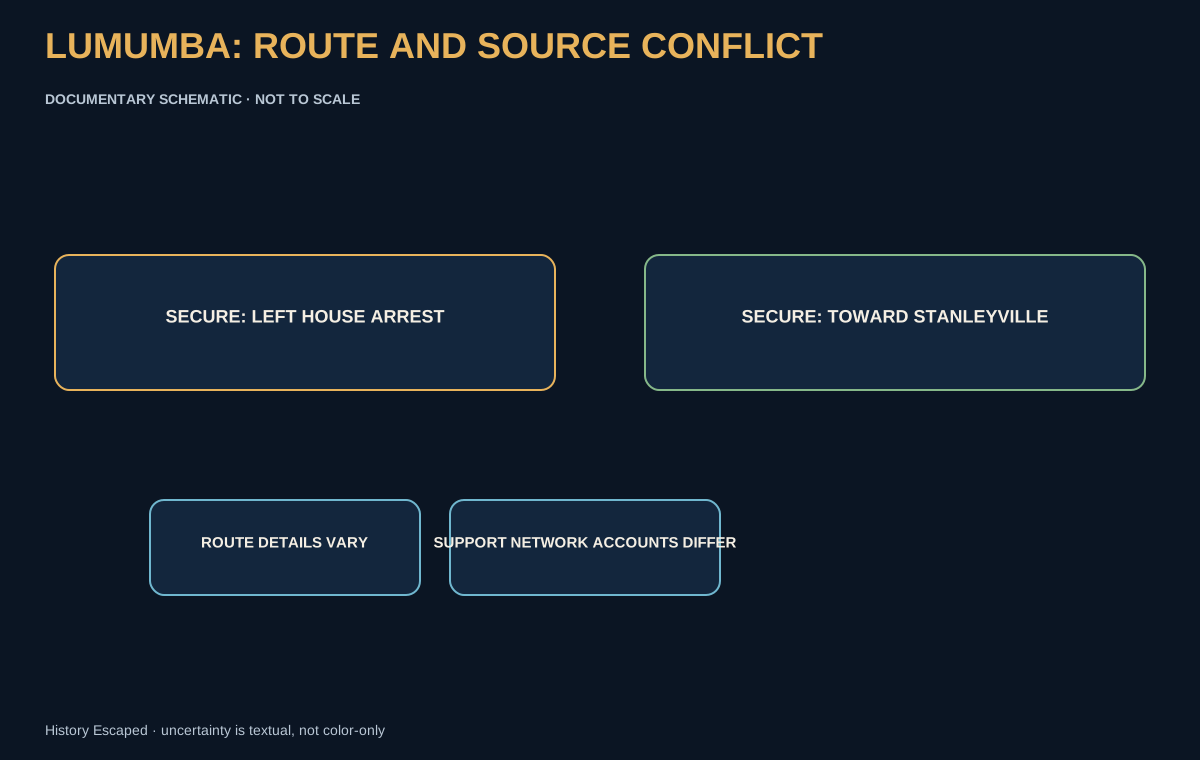
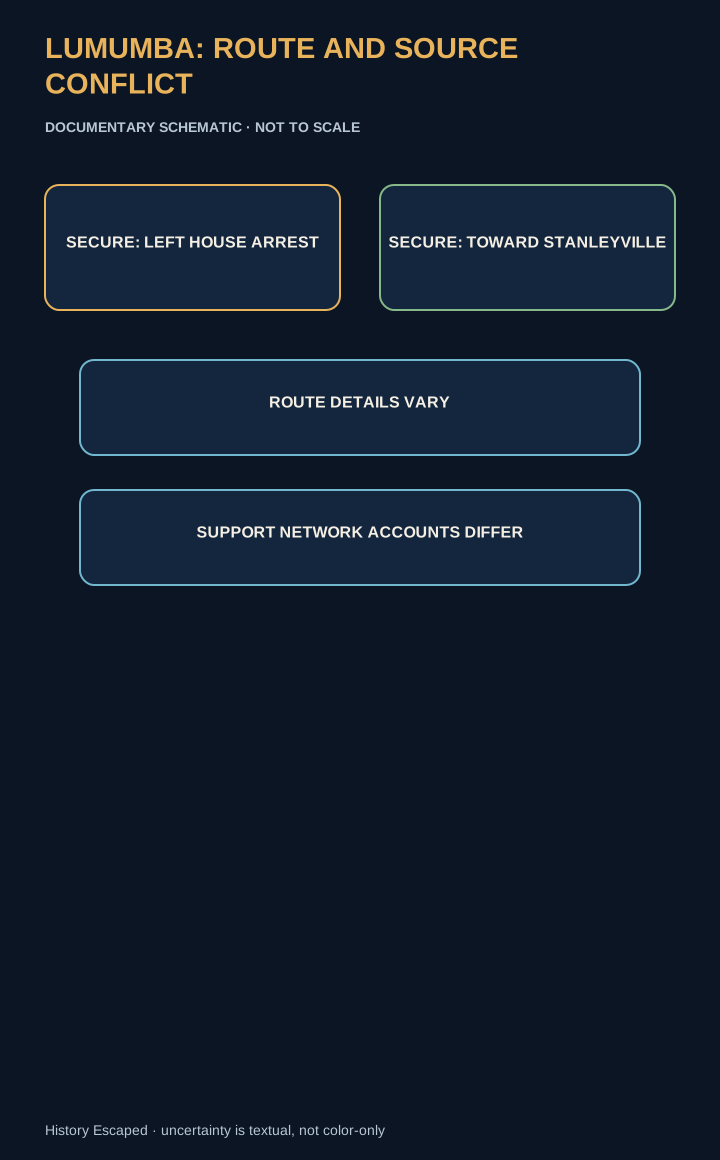
Simplified editorial reconstruction based on the cited historical record; not to scale. Uncertainty is stated directly in the visual and adjacent text.
