
The escape from Clinton Correctional Facility in Dannemora, New York, became public on the morning of 6 June 2015, when officers discovered that Richard Matt and David Sweat were missing from their cells. By then the two convicted murderers had already passed beyond the prison walls and disappeared into the rural country of northern New York.
The breakout immediately looked extraordinary. Clinton was a maximum-security prison, and the men had spent months preparing a way from their cells into restricted service areas and eventually outside the perimeter. What the official investigation later found was more important than the exact path: the escape depended on employee misconduct and on routine security safeguards that had stopped functioning reliably.
For more than three weeks, the breakout became a regional crisis. A massive manhunt spread through communities near the Canadian border. Matt was killed by law enforcement on 26 June. Sweat was shot and captured two days later.
At a Glance
Who: Richard Matt and David Sweat, both imprisoned for murder.
Prison: Clinton Correctional Facility, a maximum-security New York State prison in Dannemora.
Escape: They left their cells after 11 p.m. on 5 June 2015 and reached the outside around midnight, entering 6 June.
Assistance: Joyce Mitchell knowingly supplied tools and joined getaway planning. Gene Palmer’s unauthorized contraband and assistance also facilitated the breakout, though the available official record does not establish that he knowingly joined the escape plan.
Manhunt: Matt was killed on 26 June; Sweat was captured on 28 June.
Official conclusion: Chronic complacency, employee misconduct, and systemic failures in basic security helped make the escape possible.
Two Prisoners in Clinton’s Honor Block
Matt and Sweat were serving long sentences for separate murder convictions. Matt was serving 25 years to life. Sweat was serving life without parole for the killing of a Broome County sheriff’s deputy.
Both eventually lived in Clinton’s Honor Block, where they occupied adjacent cells. They also had experience in the prison’s industrial programs. Matt worked for years in prison tailor shops. Sweat had worked under civilian supervisor Joyce Mitchell before security concerns about their relationship caused his removal; he later returned to prison industry in another shop.
The jobs themselves did not cause the escape. The deeper problem was that relationships between inmates and employees crossed professional boundaries while systems designed to detect contraband, unauthorized movement, and physical damage repeatedly failed.
Joyce Mitchell and Gene Palmer
The Inspector General found that Matt and Sweat began seriously plotting their escape in early 2015 and drew Joyce Mitchell into the plan. Mitchell worked as a civilian supervisor in the prison tailor shops. She purchased and smuggled cutting tools into Clinton, where they reached the inmates.
Her involvement eventually extended to the planned getaway. Mitchell agreed to meet Matt and Sweat after they emerged from the prison, creating an expectation that transportation would be waiting outside.
She did not appear. On the night of the escape, Mitchell went to a hospital after what the Inspector General described as a panic attack. Matt and Sweat reached the street expecting help and instead had to flee on foot.
Correction officer Eugene Palmer played a different role. Palmer had developed improper patterns of favors and contraband exchanges with inmates, including Matt. His actions provided items and unauthorized assistance that materially helped the escape, and he later pleaded guilty to criminal charges.
That distinction matters. Mitchell knowingly joined the escape project. Palmer’s misconduct facilitated it, but the available sources do not establish that he knowingly agreed to help Matt and Sweat break out.
Months of Work Hidden by Routine Failure
Matt and Sweat prepared access from their cells into restricted areas of the prison and spent months developing a route toward the exterior.
Modern prison escapes can easily become stories about measurements, tools, and exact passageways. Those details are less important historically than the Inspector General’s finding that the work repeatedly escaped detection when ordinary security practices should have revealed it.
The investigation identified failures at several levels. Employee bags were not screened as policy required. Night counts were so poor that unauthorized absences went unnoticed. Cell searches and physical inspections failed to detect evidence of tampering. Contraband control broke down. Supervision in the prison industries blurred professional boundaries. Management and central oversight failed to recognize how many safeguards had become unreliable.
The escape therefore was not one clever trick. It was a long project operating inside a system where enough routine controls had eroded at the same time.
The Night of 5–6 June
The official chronology crosses midnight.
According to the Inspector General, Matt and Sweat left their cells shortly after the final count at about 11 p.m. on Friday, 5 June. They moved through the route they had prepared beneath the prison.
Around midnight they reached the outside. This explains why the Inspector General report refers to a “June 5” escape while public accounts commonly call it the June 6 breakout.
The planned pickup failed when Joyce Mitchell did not arrive. Matt and Sweat left Dannemora on foot.
Their empty cells were discovered at 5:17 a.m. during the morning count. After the facility was searched and the absence confirmed, the escape became a major law-enforcement emergency.
The North Country Manhunt
New York State Police became the lead agency. Local, state, federal, and Canadian authorities participated as investigators searched a heavily wooded region and worked through thousands of leads.
Official manpower figures vary by source. The Inspector General says more than 1,300 officers were involved at times. A later State Police summary says more than 1,500 were used. The difference may reflect peak deployment versus broader participation, so one figure should not silently replace the other.
The search affected daily life across Clinton and Franklin counties. Residents encountered checkpoints, armed search teams, helicopters, property searches, and repeated warnings while authorities tried to determine where the escapees had gone.
The financial cost was substantial. The Inspector General calculated approximately $22.8 million in New York State law-enforcement overtime alone, excluding federal, local, Canadian, and other outside costs. New York spent an additional $573,000 on prison repairs and security measures.
Forensic evidence helped narrow the search as it moved west and north. Matt and Sweat also eventually separated.
Richard Matt, 26 June
On 26 June, law enforcement encountered Richard Matt near Malone.
New York State Police and the Inspector General state that Matt was armed when U.S. Customs and Border Protection personnel confronted him. He was fatally shot.
Matt’s death ended his time outside Clinton but not the manhunt. David Sweat remained missing and was moving through country close to the Canadian border.
David Sweat, 28 June
Two days later, New York State Police Sergeant Jay Cook saw a man near Constable and identified him as Sweat.
According to the State Police account, Cook ordered Sweat to stop. Sweat ran toward wooded cover. Cook fired, wounding him, and took him into custody.
Sweat survived and was returned to prison. He later pleaded guilty to two counts of first-degree escape and one count of first-degree promoting prison contraband. New York’s Appellate Division affirmed the judgment in 2018.
What the Inspector General Found
The most important post-escape document was a study of why the prison had failed, not simply a reconstruction of the route.
The New York State Inspector General interviewed more than 170 witnesses and reviewed tens of thousands of pages. Its conclusion was that the breakout could not have happened without longstanding breakdowns in basic security and failures of management and oversight.
The report found deficient employee screening, ineffective counts, inadequate searches and physical inspections, weak contraband control, poor prison-industry supervision, and ineffective management oversight. It also identified employees whose conduct violated law or policy.
Joyce Mitchell pleaded guilty to promoting prison contraband and criminal facilitation and was sentenced to 2⅓ to 7 years. Gene Palmer pleaded guilty to charges arising from his contraband and misconduct and received a six-month jail sentence.
The state responded with recommendations and reforms involving screening, counting, searches, inspections, camera coverage, training, industrial supervision, internal controls, and oversight. The lesson was institutional: strong walls do not guarantee security when the procedures that support them are repeatedly ignored.
The Story After Dannemora
The breakout quickly entered American true-crime culture. In 2018 Showtime released Escape at Dannemora, directed by Ben Stiller and starring Benicio del Toro as Matt, Paul Dano as Sweat, and Patricia Arquette as Joyce Mitchell.
The dramatization helped fix the escape in popular memory as a story about personality, manipulation, and ingenuity. The official record is more complicated. Some fine-grained details came from Sweat after his capture, some from Mitchell or Palmer, and many of the broader conclusions came from an investigation designed to identify institutional responsibility.
The central sequence is secure. Matt and Sweat prepared for months. Mitchell knowingly supplied critical assistance. Palmer’s misconduct also helped them. Clinton’s security systems repeatedly failed to detect what was happening. The men reached the street around midnight on 6 June 2015 and then spent weeks outside custody.
The escape did not end in lasting freedom. Matt was killed. Sweat was returned to prison. Its historical significance lies as much in what it exposed as in how the men physically got out: a maximum-security institution whose barriers were undermined by human misconduct and systemic neglect.
Evidence discipline
What the record supports
Status labels distinguish secure conclusions from uncertainty and rejected claims. Color is never the only signal.
DISPUTED
The escape should be dated only to 6 June 2015.
They left their cells after 11 p.m. on 5 June and emerged outside around midnight on 6 June. The most precise formulation is the night of 5–6 June.
Sources: SRC-001MYTH
Matt and Sweat escaped solely through their own ingenuity.
The Inspector General found that employee misconduct and longstanding failures in basic security were necessary enabling conditions.
Sources: SRC-001, SRC-002UNKNOWN
Gene Palmer knowingly joined the escape conspiracy.
Palmer’s misconduct facilitated the escape and led to criminal convictions, but the available official record does not establish that he knew Matt and Sweat intended to escape.
Sources: SRC-001, SRC-007WELL-SUPPORTED
Joyce Mitchell was supposed to provide transportation after the escape.
The Inspector General documented Mitchell’s participation in the getaway plan and the prisoners’ expectation that she would meet them outside.
Sources: SRC-001, SRC-006MYTH
A single security failure caused the breakout.
The Inspector General identified multiple failures across screening, counts, searches, inspections, contraband control, supervision, training, and oversight.
Sources: SRC-001, SRC-002DISPUTED
Exactly 1,500 officers participated in the manhunt at peak.
The Inspector General gives more than 1,300 at times; a later State Police summary says more than 1,500 were used. The counting conventions are not identical.
Sources: SRC-001, SRC-003Documentary reconstruction
Institutional failures and divergent outcomes
A case-local editorial visual clarifies the evidence structure without adding false precision or reusable operational detail.
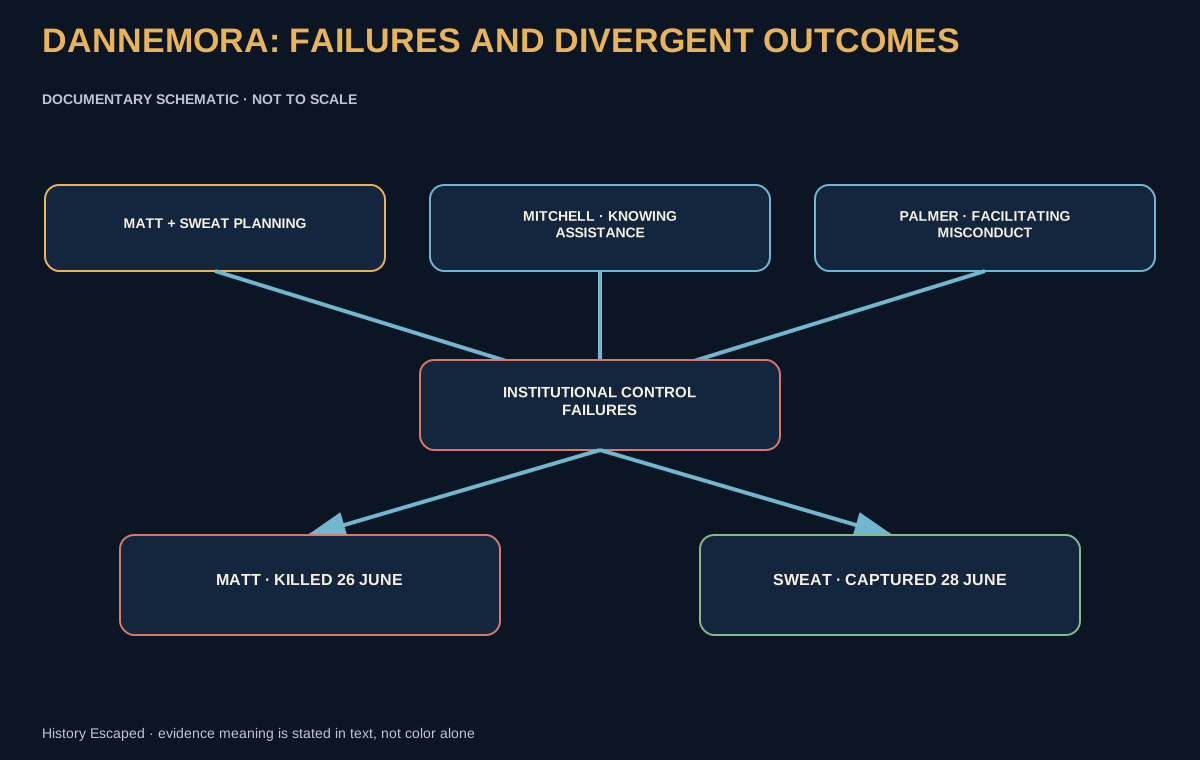
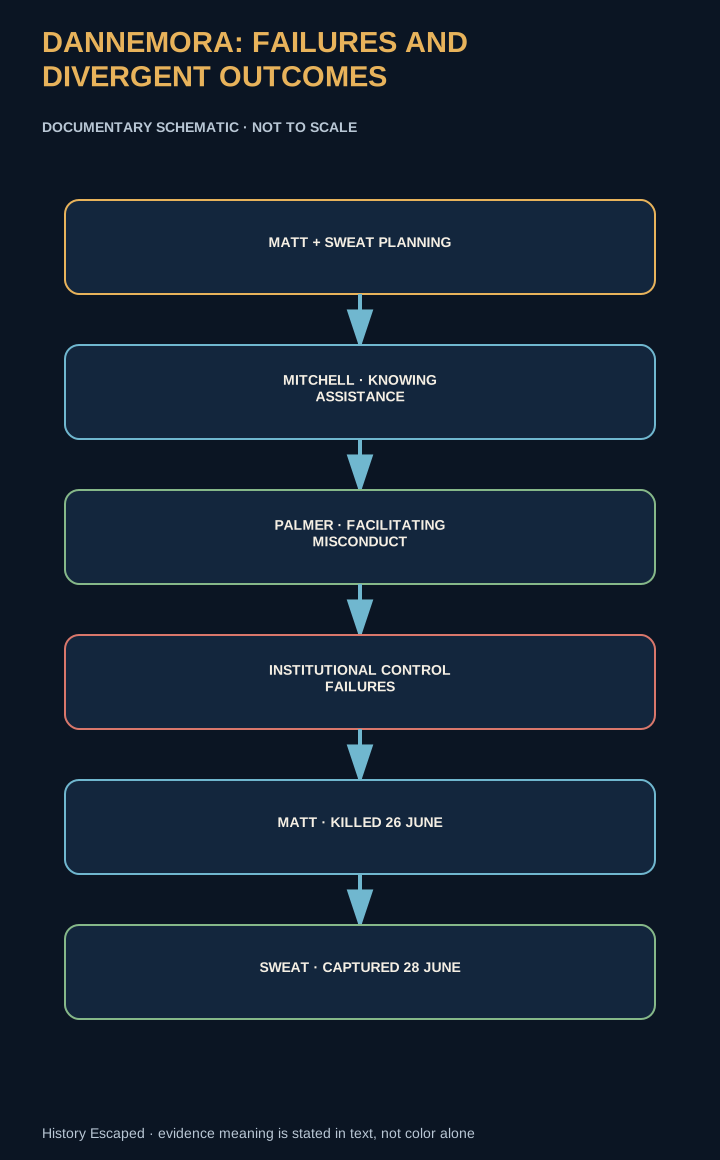
Simplified evidence-led editorial reconstruction based on the cited record; not to scale. Uncertainty is stated directly in the visual and adjacent text.
