
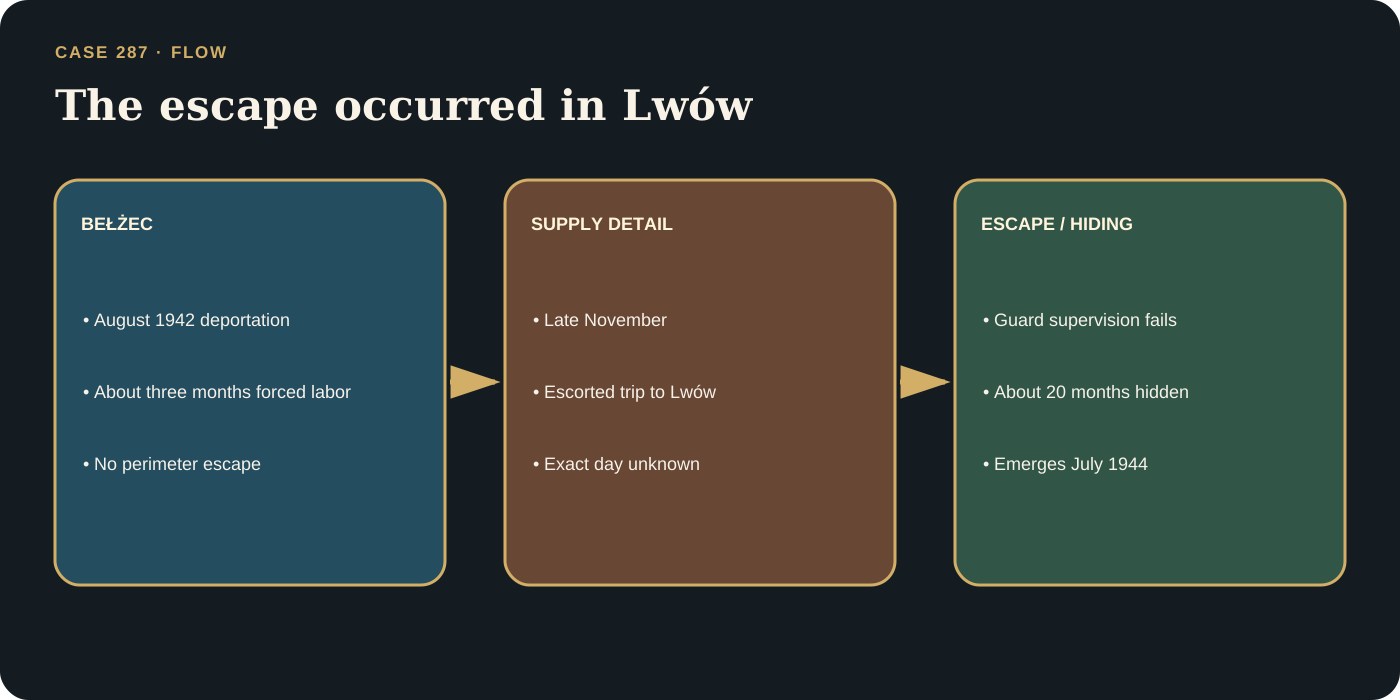
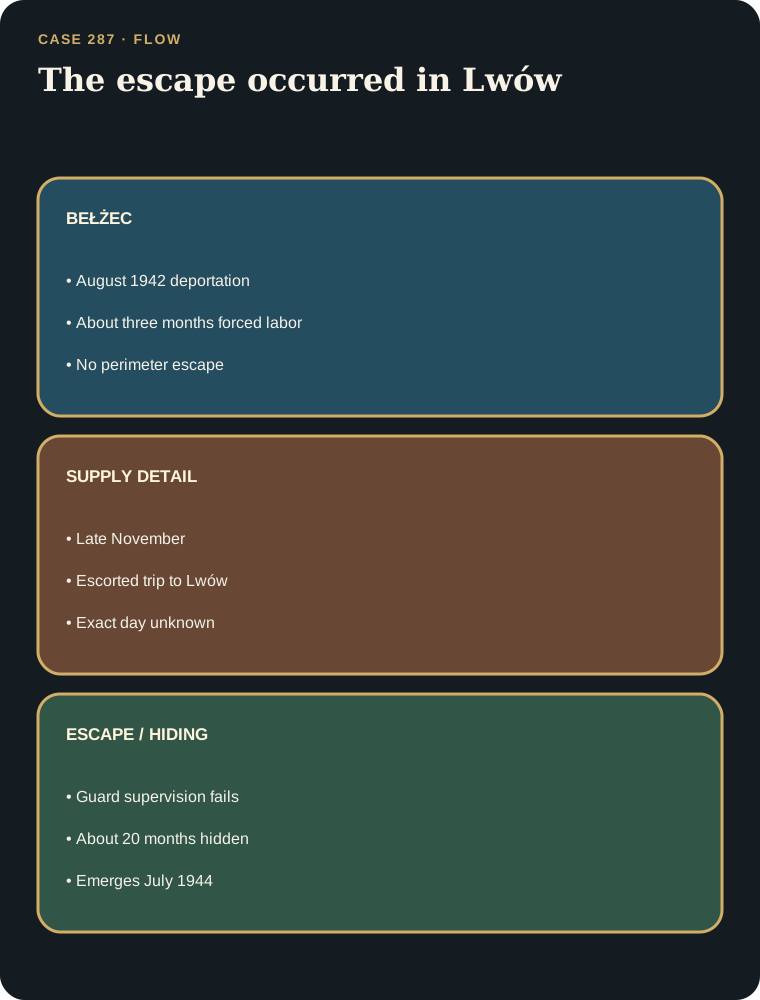
Rudolf Reder's escape from Bełżec in late November 1942 did not take place by crossing the killing center's perimeter. The decisive opportunity came when German personnel removed him from Bełżec under guard and drove him to Lwów to obtain sheet metal and other supplies. Once there, Reder later testified, four escorts left the truck and the remaining guard fell asleep. Reder stepped down, behaved as though he were examining the materials, and then walked away.
That distinction changes the shape of the case. Reder survived Bełżec because the SS temporarily kept him alive as a forced laborer with useful technical skills. He escaped because those same skills caused his captors to take him outside the killing center.
He then faced a second problem: remaining alive in German-occupied Lwów. Reder found clandestine shelter and stayed hidden until the Red Army entered the city in July 1944. After the war, his testimony became one of the indispensable survivor sources for reconstructing Bełżec.
At a Glance
- Deported to Bełżec: August 1942 from Lwów
- Escape: Late November 1942; exact day unknown
- Escape site: Lwów, during an escorted supply trip from Bełżec
- Reason for trip: Acquisition of sheet metal / metal building materials for the camp
- Immediate opportunity: Most escorts left the vehicle and the remaining guard fell asleep
- Immediate method: Reder stepped down, appeared to inspect the materials, and walked away into the city
- After escape: Entered hiding in Lwów and remained concealed until July 1944
- Historical importance: Author of the only extensive written testimony left by a Jewish prisoner who survived Bełżec
- Critical source issue: Reder's accounts differ over the identity of the person who hid him after the escape
A killing center intended to leave almost no witnesses
Bełżec was one of the three principal killing centers created for Operation Reinhard, the German program to murder the Jews of the General Government. Mass killing there began in March 1942. The Museum and Memorial in Bełżec and the United States Holocaust Memorial Museum both give a minimum figure of 434,508 people murdered, overwhelmingly Jews deported from occupied Poland and other parts of Europe.
Most deportees were killed shortly after arrival. A much smaller number were temporarily selected for forced labor needed to operate the site: handling belongings, maintaining equipment, working in workshops, and performing other tasks imposed by the SS.
Those work assignments were not reprieves in any meaningful sense. The camp was organized around mass murder, and Jewish laborers themselves lived under constant threat of being killed and replaced.
Only a tiny number of people escaped Bełżec, and still fewer survived the war. The Museum and Memorial identifies Rudolf Reder and Chaim Hirszman as the two former prisoners who survived long enough to leave substantial written testimony about the camp.
That rarity makes Reder's escape important for two reasons at once. It saved his life, and it preserved an eyewitness account from a place where the perpetrators intended almost every Jewish witness to disappear.
Reder enters Bełżec
Reder was a Jewish chemist and soap manufacturer from Lwów, born in 1881. He was in his early sixties when he was deported during the great deportation action against the city's Jewish population in August 1942.
Sources differ slightly over the exact August date, so no exact day can be stated securely. The Bełżec memorial's historical materials place him in the August deportations from Lwów.
Upon arrival, Reder avoided immediate murder because he was selected for forced labor after presenting himself as someone with mechanical or technical skills. His 1946 testimony describes work that brought him into direct contact with the functioning of the killing center.
The details of that forced work are among the most important parts of his testimony, but an escape reconstruction does not need to reproduce its most graphic passages. What matters for the escape is that the SS came to regard Reder as technically useful. He survived at Bełżec for roughly three months.
The opportunity comes from forced labor
Near the end of November 1942, Reder was told that the camp needed metal building materials. In his postwar account, he identified an SS or Gestapo man he called Irrmann as the person who told him he would travel under guard to Lwów because he knew the relevant materials and where they might be obtained. The official Bełżec memorial independently confirms the broad event: Reder was taken under escort to Lviv to collect sheet metal for the camp.
This was not a planned outside rescue. No resistance team was waiting to overpower the guards, and Reder did not leave Bełżec with an established escape route.
The trip simply moved him from an extermination center designed for near-total control into a city he knew. That geographic change created the opportunity.
The truck in Lwów
Reder's 1946 testimony gives the most detailed account of what happened after the party found the required materials. He said four guards left the truck to drink, leaving him with one guard. The remaining man fell asleep.
Reder did not describe a violent confrontation. He stepped from the vehicle and acted as though he were examining the metal.
When the guard remained asleep, Reder began walking slowly away. His testimony places the episode in the evening and describes mist in the city. He pulled his cap down and moved toward the area where he knew someone who might shelter him.
These details come from Reder himself and were recorded after the war. They are highly plausible and form the only detailed first-person reconstruction of the escape, but they are not a minute-by-minute German security record. The secure external facts are broader: Reder was taken from Bełżec to Lwów under escort for supplies and escaped there in late November.
What "escape from Bełżec" actually means
The familiar title can sound as though Reder climbed a fence or broke directly out of the camp. He did not.
The escape was from Bełżec custody, but the physical break occurred in Lwów while he was outside the camp on a forced procurement detail. That distinction should remain visible everywhere the case appears. It is historically more interesting than the simplified version because it explains why a prisoner from an almost witnessless killing center suddenly had an opening.
His forced labor assignment had extended his life. His technical usefulness then brought him into a less controlled environment. Finally, the guards' temporary lapse turned that movement into an escape.
None of those stages made survival likely. Together they created one narrow opportunity.
The problem of where he hid
Walking away from the truck did not make Reder safe. Lwów was under German occupation, and a Jewish fugitive from Bełżec faced the danger of discovery, denunciation, arrest, and murder. Reder needed shelter immediately.
His accounts are not completely consistent about who provided it. The 1946 narrative describes reaching a Polish woman or landlady he knew and says she hid and fed him until liberation. In another early investigative statement, later editors identify that woman as Anastazja Hawryluch.
In later testimony, however, Reder credited Joanna Borkowska, a Polish acquaintance from before the escape. Borkowska herself later stated that she had hidden him, and she and Reder eventually married.
Modern editors Robert Kuwałek and Dariusz Libionka explicitly flag the discrepancy. The surviving evidence does not allow a confident dismissal of either account, and it is possible that both women assisted him at different points.
The correct historical treatment is therefore not to turn one name into an unquestioned fact. Reder obtained Polish civilian help in Lwów and survived in hiding until July 1944; the exact division of responsibility between Hawryluch and Borkowska remains uncertain.
Twenty months in hiding
Reder's testimony says that his hiding period lasted about twenty months. He had escaped in late November 1942. The Red Army retook Lwów in July 1944.
In his account, Reder emphasized both his physical condition after Bełżec and the psychological burden of what he had witnessed. The period in hiding was not simply the quiet aftermath of a successful escape. He remained a hunted Jewish survivor in an occupied city while the Holocaust continued around him.
The escape sequence is best understood as ending with concealment, not at the moment he stepped away from the truck. Physical separation from the guard made flight possible. Protected hiding made survival possible. That distinction is particularly important in Holocaust escape history, where leaving immediate German custody often created only the first stage of a much longer struggle to remain alive.
Reder becomes a witness
After Soviet forces entered Lwów, Reder began giving testimony. Modern source editors trace several accounts between 1944 and 1960. He spoke to Soviet investigators after liberation and later gave statements to Jewish historical and Polish investigative bodies.
In Kraków, Nella Rost recorded the extensive testimony that became Bełżec, published in 1946 by the Jewish historical commission. The text was later republished and translated, and it became a foundational source for historians of the killing center.
Reder’s testimony is indispensable but not exhaustive. He was an eyewitness, not an omniscient observer. Some figures, names, chronology, and information he learned secondhand have been refined or corrected by later scholarship.
That does not diminish the exceptional evidentiary value of what he personally saw and experienced. For the escape itself, the convergence is unusually strong. His first-person account, the modern source edition, and the official Bełżec memorial agree on the central sequence: late November, escorted journey to Lwów for metal supplies, lapse in guard supervision, escape, and prolonged hiding.
Why the escape matters
Bełżec was created as a place from which almost no Jewish witness would emerge. Reder's survival therefore altered the surviving historical record.
His account gave postwar investigators and later historians evidence from inside a killing center where German authorities destroyed much of the physical infrastructure and attempted to erase traces of mass murder. The testimony is not valuable because Reder was the only person ever to get away; other escapees are known. It is valuable because so few survived the war and because Reder left the most extensive surviving prisoner account.
The escape itself was strikingly untheatrical. There was no revolt, tunnel, or assault on the perimeter. A forced laborer was taken back to the city from which he had been deported. Most of his guards stepped away. One fell asleep. Reder recognized that the normal system of custody had briefly broken down and walked out of it. He then found someone willing to risk death by hiding him.
What can be reconstructed securely
The chronology is strong at month level and weak at day level. Reder was deported from Lwów to Bełżec in August 1942, survived there through the autumn, and escaped in late November 1942. No exact day should be invented.
The geography is stronger than the usual title suggests. The successful physical escape occurred in Lwów, not inside Bełżec.
The mechanism is also strong because Reder described it directly and the modern memorial confirms the supply trip. He was taken to obtain sheet metal or related building material; several escorts temporarily left; the remaining guard failed to maintain control; Reder walked away.
The largest meaningful uncertainty comes after that moment. Early and later accounts do not identify his shelter provider in the same way, so the names of Anastazja Hawryluch and Joanna Borkowska should remain part of a documented source conflict.
The broader conclusion does not depend on resolving it. Rudolf Reder escaped Bełżec's custody in Lwów at the end of November 1942 and survived in hiding until liberation. Because he did, one of Nazi Germany's most deliberately witnessless killing centers left behind the testimony of a man who had been forced to see it from inside.
Evidence discipline
What the record supports
Status labels distinguish secure conclusions from uncertainty and rejected claims. Color is never the only signal.
MYTH
Reder physically broke through the perimeter of the Bełżec extermination camp.
He escaped in Lwów after being taken out of Bełżec under guard to obtain sheet metal and other materials.
Sources: SRC-001, SRC-003, SRC-005UNKNOWN
The exact calendar day of Reder's escape is known.
High-quality modern sources and Reder's own published account place the escape in late November 1942 but do not securely establish an exact day.
Sources: SRC-001, SRC-003, SRC-005MYTH
Reder escaped by overpowering or attacking his guard.
His account says the remaining guard fell asleep; Reder stepped down under the pretense of checking materials and walked away.
Sources: SRC-003DISPUTED
Joanna Borkowska can be identified without qualification as the sole person who hid Reder from the night of his escape until liberation.
Reder's early accounts refer to a Polish landlady and identify Anastazja Hawryluch in one investigative statement, while later testimony and Borkowska's own statement credit Joanna Borkowska. Modern editors suggest both may have helped.
Sources: SRC-004MYTH
Reder was the only person ever to escape from Bełżec.
Other escapees are known. Reder's importance lies in surviving the war and leaving the most extensive surviving Jewish prisoner testimony about Bełżec.
Sources: SRC-001, SRC-007MYTH
Jewish prisoners assigned to Bełżec work details were voluntary collaborators in the killing process.
They were prisoners under lethal coercion, temporarily kept alive and forced to perform labor within an extermination center.
Sources: SRC-001, SRC-006Evidence diagram
The escape occurred in Lwów
Reder survived Bełżec custody and escaped during an escorted supply trip in Lwów, then remained in hiding.
Reder survived Bełżec custody and escaped during an escorted supply trip in Lwów, then remained in hiding.