At a Glance
- Exfiltration: Night of 7–8 November 1981
- Starting point: Warsaw, Polish People’s Republic
- Escapees: Ryszard Kukliński, his wife Joanna, and their two sons
- Captivity/control type: Intelligence-source extraction from a communist state under counterintelligence pressure
- Main method: CIA-organized clandestine family exfiltration
- Intermediate stage: Western-controlled territory in Germany
- U.S. arrival: 11 November 1981
- Outcome: Kukliński and his family reached the United States; he was later condemned in absentia in Poland and remained politically controversial after communism fell
Ryszard Kukliński did not wait to be arrested before he fled Poland. By November 1981, the Polish Army colonel had spent nearly a decade secretly supplying the United States with Warsaw Pact and Polish military information. He was still serving inside the General Staff when evidence emerged that someone at the highest level was leaking sensitive material.
The danger was no longer abstract. On 2 November, Kukliński attended a meeting at which senior officers were told that the compromise involved information available to only a narrow circle. He was inside that circle. That evening he finally told his wife that he had been secretly working with the Americans and asked the CIA to remove the entire family.
Five days later they disappeared from Poland.
An officer inside the Warsaw Pact system
Kukliński’s importance to American intelligence came from access rather than rank alone. After military education and staff assignments, he worked in the Polish General Staff and participated in Warsaw Pact planning. CIA histories describe him as a senior officer positioned to see operational exercises, command arrangements and strategic planning that reflected Soviet doctrine.
He initiated contact with the Americans in 1972 while traveling in Western Europe. The CIA account says that he volunteered his services rather than being recruited in Poland. Over the following years, meetings abroad gave way to increasingly difficult clandestine exchanges in Warsaw.
The volume of material attributed to him varies by source. CIA and Polish institutional accounts commonly describe tens of thousands of pages. More important than the exact page count was the range: Warsaw Pact military planning, command-and-control arrangements, weapons information and, during the Polish crisis of 1980–81, increasingly detailed reporting on preparations for martial law.
The relationship created an obvious contradiction in how Kukliński would later be remembered. To the Polish communist state, he was an officer who passed protected military secrets to a foreign intelligence service. To his defenders, the Polish armed forces of the period were subordinated to Soviet strategic interests, and his intelligence work was an attempt to protect Poland from becoming a battlefield in a Soviet–NATO war.
That dispute over loyalty is inseparable from the escape.
Why the danger increased in 1981
The emergence of Solidarity in 1980 produced the most serious political crisis in communist Poland since the postwar system had been established. Kukliński remained inside military planning circles while reporting to the CIA on the regime’s preparations.
A CIA history based on his reporting says he was informed on 7 September 1981 that martial law was approaching. Soon afterward he learned that the Interior Ministry was investigating a leak because sensitive details had reached Solidarity and the West.
The crisis sharpened dramatically on 2 November 1981. According to both CIA and Polish institutional accounts, senior General Staff officers were told that highly restricted material had leaked. Kukliński knew that only a very small group had access to the relevant documents.
He had survived years of clandestine work partly because no investigation had narrowed so directly toward his level. Now that protection was disappearing.
The same day, he told his wife Joanna about his secret relationship with the CIA. The Polish Institute of National Remembrance says that, with her agreement, he sent an urgent message requesting immediate evacuation for himself and his family.
Selected chronology
Selected chronology
Kukliński initiates contact with the United States
While traveling in Western Europe, he approached the Americans and began the clandestine relationship that would last until 1981.
Leak investigation becomes visible
Kukliński learned that Polish security organs were pursuing a leak related to martial-law planning.
Exposure risk becomes acute
A General Staff meeting revealed that compromised information came from a narrow group with access that included Kukliński.
CIA exfiltration from Poland
Kukliński, his wife and two sons were clandestinely removed from the country.
Arrival near Washington
The family arrived at Andrews Air Force Base aboard a U.S. military aircraft.
Death sentence in absentia
A Polish military court convicted Kukliński of treason and desertion and sentenced him to death.
Polish prosecution discontinued
Military prosecutors closed the renewed case, concluding that Kukliński had acted under conditions of higher necessity.
Posthumous promotion
President Andrzej Duda promoted Kukliński to brigadier general.
The extraction problem
Removing one intelligence source would already have been difficult. Kukliński wanted his wife and two sons taken with him.
The CIA station in Warsaw faced intensified surveillance. American diplomats and intelligence officers operated in an environment where Polish counterintelligence routinely watched their movements. A sudden visible contact with Kukliński or an obvious family departure could expose both the source and the extraction attempt.
Public accounts agree that several days of preparation followed. Polish reporting describes American personnel conducting movements and false appointments intended to confuse surveillance while the Kukliński family also maintained ordinary appearances and misleading explanations for their weekend plans.
The exact mechanics remain one of the most contested parts of the story. Later books, articles and recollections describe particular vehicles, hiding arrangements, border checkpoints and cover identities. Some versions conflict with others. Kukliński himself and American officials were deliberately guarded about operational details for years.
For a historical reconstruction, those disagreements matter more than cinematic specificity. The secure conclusion is that the CIA station coordinated a clandestine family extraction under heavy counterintelligence pressure and succeeded during the night of 7–8 November 1981.
Leaving Poland
Kukliński was still behaving like an officer expected to return to work shortly before the extraction. That normality was part of what made his disappearance initially difficult to interpret.
Polish institutional reporting places the family’s departure late on 7 November. The CIA’s public historical accounts confirm that Kukliński and his family were successfully exfiltrated once Polish security began focusing on the leak.
A later Polish anniversary reconstruction says the family reached territory controlled by the U.S. mission in Warsaw late that night and then traveled west, reaching an American facility in West Berlin after a long overnight journey. Other public accounts describe the route less precisely, saying only that Kukliński reached West Germany or Western-controlled territory before onward movement.
That difference should remain visible. West Berlin, West Germany and the precise land route should not be collapsed into a single perfectly documented itinerary. The Cold War geography itself was complicated: West Berlin was politically separate from the Federal Republic even though it was tied to the Western alliance system.
The historical point is simpler. By 8 November, Kukliński and his family had passed beyond the immediate reach of the Polish security apparatus.
From Europe to the United States
The family did not appear publicly as newly arrived defectors. They remained under American control and protection.
A CIA review of Benjamin Weiser’s A Secret Life, which was produced with unusually extensive access to CIA case material, states that on 11 November 1981 Kukliński and his family arrived aboard a U.S. military aircraft at Andrews Air Force Base outside Washington, D.C. The CIA station’s long relationship with its source had ended as an agent-in-place operation and became a resettlement and protection problem.
Public accounts differ on the exact sequence of facilities used between the escape from Poland and the flight to the United States. Some later reconstructions insert West Berlin and then additional U.S. installations in the Federal Republic. The broad sequence—Poland, Western-controlled Germany, U.S. military flight, Washington area—is secure enough. A precise hour-by-hour itinerary is not necessary and remains entangled with intentionally protected operational history.
That distinction is especially important for an intelligence escape case. The purpose of reconstruction is to explain why the extraction became necessary and how its stages fit together, not to reverse-engineer a clandestine service’s detailed procedure.
Problem → response
Escape was a sequence of problems
Each response solved a practical obstacle while often creating the next one.
- 01→
Obstacle
Counterintelligence investigation
Polish authorities were narrowing the source of highly sensitive leaks inside the General Staff.
Response
Kukliński requested emergency removal before the investigation became an arrest.
- 02→
Obstacle
Surveillance of U.S. personnel
American diplomats and intelligence officers in Warsaw operated under intensified Polish surveillance.
Response
The CIA used counter-surveillance and deception while keeping the exact extraction procedure compartmented.
- 03→
Obstacle
Need to remove four people, not one
Kukliński refused to treat escape as an individual defection and wanted his wife and two sons taken with him.
Response
The CIA planned a family exfiltration, increasing operational complexity but removing immediate leverage over his closest relatives.
Martial law came a month later
Kukliński arrived in the United States just over a month before martial law was imposed in Poland on 13 December 1981.
His reporting gave Washington substantial insight into the Polish government’s preparations. It did not answer every strategic question. Even later declassified records left disputes about Soviet intentions: whether Moscow was preparing to invade, pressuring Polish leaders to act themselves, or keeping intervention options open.
Kukliński’s position in that debate became politically explosive after his identity was publicly known. Supporters argued that he had provided intelligence essential to understanding both Warsaw Pact war planning and the approaching crackdown on Solidarity. Critics asked why an officer who regarded himself as a Polish patriot had supplied a foreign intelligence service with Polish military secrets.
The fact that the CIA valued the reporting highly does not settle the Polish moral argument.
Documentary reconstruction
Exposure risk and broad exfiltration
A case-local editorial visual separates the documented sequence from uncertainty without implying exact modern geography or operational detail.
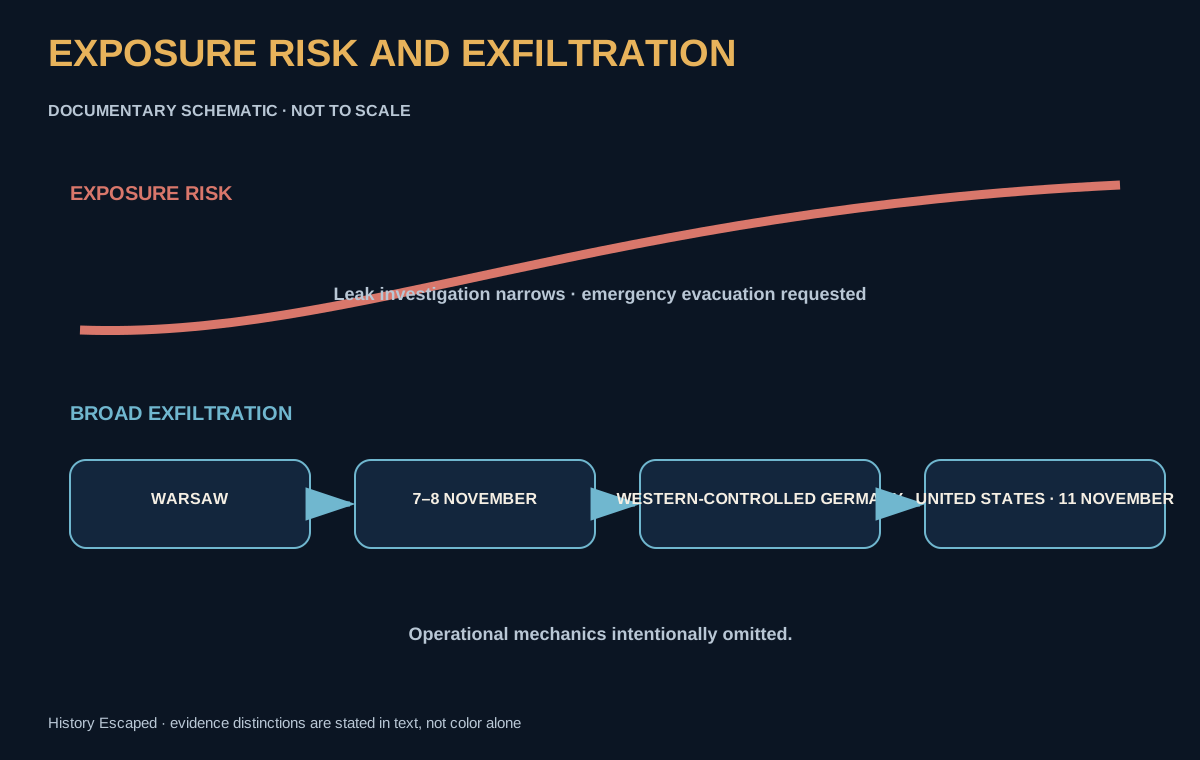
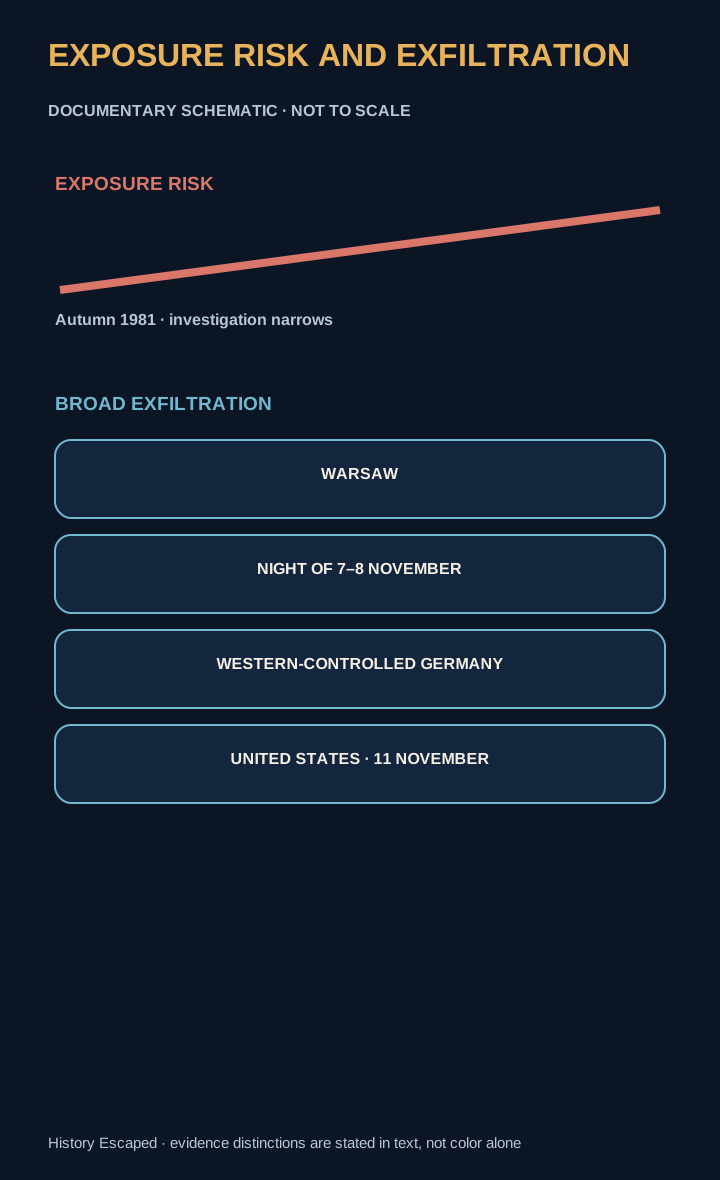
Simplified editorial reconstruction based on the cited historical record; not to scale. Uncertainty is stated directly in the visual and adjacent text.
Motive: patriot, spy, or both?
Kukliński consistently portrayed his cooperation with the United States as an act directed against Soviet domination rather than against Poland.
CIA historical writing emphasizes his belief that Warsaw Pact war plans would make Poland a principal corridor for Soviet forces and therefore a major target for NATO nuclear strikes. He later described cooperation with the West as a form of resistance and said that the events of 1968 in Czechoslovakia and the killing of Polish workers during the 1970 Baltic protests deepened his opposition to the system.
That is his explanation, supported by sympathetic American intelligence histories and many later Polish accounts.
The competing interpretation starts from a different principle: Kukliński was a serving officer who had sworn obligations to the Polish state and disclosed highly classified material to the CIA. The communist military court therefore treated him as a spy and deserter. Some post-communist politicians, military officers and commentators continued to call him a traitor even after the political system that convicted him had disappeared.
A third line of criticism questions not merely his loyalty but later claims about the scale or strategic meaning of what he knew. Some former Polish officers argued that accounts of his access became exaggerated. More speculative claims that he functioned as a Soviet-controlled double agent have circulated, but the sources available for this case do not establish that interpretation.
The safest historical conclusion is not to award a moral title. Kukliński knowingly worked for the CIA while serving in the Polish General Staff, said he did so to resist Soviet domination and protect Poland, and remained the subject of a genuine national dispute over whether that constituted patriotism or treason.
Poland’s response to the disappearance
Polish authorities quickly opened an investigation after Kukliński and his family vanished. The operation became known as “Renegat.”
The investigation established that the officer was no longer in the country and eventually shifted toward prosecution. In 1984, a military court convicted Kukliński in absentia and sentenced him to death for treason and desertion. His rank and civil rights were stripped and his property was subject to confiscation.
The sentence survived the collapse of communist rule only temporarily.
In 1990 the death penalty was reduced. In 1995, the Supreme Court’s Military Chamber overturned the 1984 judgment and returned the case for renewed investigation. In 1997, military prosecutors discontinued the proceedings, concluding that Kukliński had acted under a state of higher necessity because he perceived a serious danger to Poland.
That legal resolution did not end the political controversy.
From condemned officer to posthumous general
Kukliński returned to Poland publicly in 1998 after roughly seventeen years away. He was celebrated by supporters and still denounced by critics.
The disagreement reflected more than one man’s intelligence career. It touched larger questions about the legal and moral status of the communist Polish state, the Polish Army’s relationship to Moscow, the legitimacy of resistance from inside state institutions and the meaning of military oaths under a Soviet-dominated alliance.
Those questions did not produce a single national verdict. Even prominent figures associated with the anti-communist opposition differed over Kukliński.
Official Poland nevertheless moved steadily toward rehabilitation. The criminal case had been closed in 1997. In 2016, President Andrzej Duda posthumously promoted Kukliński to brigadier general, presenting the gesture as recognition of service to Polish independence.
Evidence discipline
What the record supports
Status labels distinguish secure conclusions from uncertainty and rejected claims. Color is never the only signal.
DISPUTED
The precise vehicle, hiding arrangement and checkpoint sequence of Kukliński’s escape are completely settled.
Public sources agree on the family exfiltration and broad route but later accounts conflict over detailed mechanics. CIA public histories remain intentionally general.
Sources: SRC-002, SRC-003, SRC-005, SRC-006MYTH
Kukliński’s wife had long known about his CIA work before the 1981 escape.
IPN and Weiser-derived accounts place his disclosure to Joanna on 2 November 1981, only days before the extraction.
Sources: SRC-003, SRC-005MYTH
Kukliński’s motives are historically uncontested.
He described his actions as resistance to Soviet domination and a defense of Poland, while critics treated his disclosure of military secrets to the CIA as treason. The controversy continued after communism.
Sources: SRC-004, SRC-008MYTH
The CIA’s documented post-exfiltration handling proves that the United States controlled every political consequence of Kukliński’s case in Poland.
American support for Kukliński and later diplomatic pressure are documented, but Polish legal and political responses developed through domestic institutions and remained contested.
Sources: SRC-004, SRC-008DISPUTED
Kukliński was definitively proven to be a Soviet double agent.
Double-agent theories have been advanced by critics, but the available sources do not establish them as demonstrated fact.
Sources: SRC-008What can be reconstructed
The evidence supports a clear escape chronology:
- CIA cooperation began in the early 1970s.
- By autumn 1981, counterintelligence was pursuing a damaging leak.
- On 2 November, Kukliński learned how close the investigation had come and requested extraction.
- The CIA station in Warsaw organized removal of his wife and two sons with him.
- During the night of 7–8 November, the family was clandestinely removed from Poland.
- They passed through Western-controlled territory in Germany.
- On 11 November, they arrived near Washington aboard a U.S. military aircraft.
The evidence does not require a definitive account of the exact Warsaw pickup point, vehicle configuration, concealment method, passport identities, checkpoint sequence, or every intermediate facility.
Those details are precisely where later narratives conflict and where intelligence services had reasons to preserve ambiguity.
Why the escape succeeded
Kukliński’s exfiltration succeeded because the CIA acted before the Polish investigation became an arrest.
That timing mattered more than any single escape device. He still possessed enough freedom of movement to leave his home, meet the extraction plan and avoid immediate detention. His family had not yet been placed under permanent control. The CIA still had diplomatic infrastructure and personnel inside Warsaw capable of supporting an emergency operation.
The decision to remove all four family members also prevented the regime from using his closest relatives as leverage after his disappearance.
Once they crossed into Western-controlled territory, the balance changed completely. The Polish state could prosecute him in absentia and pursue political campaigns against him, but it could no longer simply arrest him.
The escape and the argument that followed
The November 1981 extraction ended one of the CIA’s most productive Cold War human-intelligence relationships inside the Warsaw Pact. It did not end Kukliński’s historical role.
Within weeks, martial law was imposed. Within years, he had been condemned to death by the state he had served. After communism fell, that conviction was dismantled. Later governments honored him.
Yet the ambiguity at the center of the story remained.
Kukliński’s escape can be reconstructed without resolving whether he was a hero or a traitor. Those labels depend on how one judges the sovereignty of communist Poland, its military obligations to the Warsaw Pact, an officer’s duty to his state, and resistance to Soviet power.
What is not disputed is that by early November 1981 his clandestine life was approaching discovery. He chose not to face arrest alone. He asked the CIA to remove his family with him, and within days all four were beyond Poland.
For an intelligence officer who had survived nearly a decade inside the system he was secretly exposing, the final escape was brief. The controversy lasted far longer.