
Xuanzang’s journey to India began not with an imperial commission but with a problem of permission.
The monk had become dissatisfied with contradictions among Buddhist texts available in China and wanted to study in India, where he could consult Sanskrit traditions closer to their source. According to the late-seventh-century biography written by Huili and completed by Yancong, Xuanzang and companions petitioned the Tang court for permission to travel west. Permission was refused. The others abandoned the plan. Xuanzang did not.
What followed in 629 is one of the most important border-crossing episodes in medieval Eurasian travel history: a scholar-monk moving west through the Hexi Corridor, repeatedly obstructed by officials, helped by Buddhist sympathizers inside the frontier system, and eventually passing beyond Tang-controlled watchtowers into the desert toward Yiwu.
The broad event is well supported. Its legal framing and some of its most dramatic details require more caution.
Why Xuanzang Wanted Out
Xuanzang had spent years studying Buddhist doctrine in different parts of China. By the late 620s he had encountered conflicting translations and interpretations, especially in Yogācāra-related texts. His solution was unusually ambitious: travel to India, study with learned masters, obtain texts unavailable in China, and return with better materials for translation.
His later fame can make the departure look inevitable. It was not.
The biography says Xuanzang and others submitted a formal request to the court and were denied permission. Max Deeg’s source-critical study notes that the same biography describes a prohibition on common people traveling beyond the western frontier and portrays officials as acting under strict imperial orders.
Xuanzang’s own later apology, preserved in the biography when he prepared to return to China, is especially important. It says that in the third Zhenguan year he had taken the risk of transgressing regulations and had privately gone to India. Whatever the exact legal mechanism, Xuanzang himself was remembered as having left without authorization.
How “Closed” Was the Tang Border?
The phrase “closed border” is useful only if it is handled carefully.
Recent scholarship on Tang mobility emphasizes that movement inside and outside the empire was heavily regulated through passes, checkpoints, and official permission. One modern study of Tang “cosmopolitanism” explicitly cites Xuanzang as a famous example of unauthorized departure and argues that Tang openness did not mean unrestricted private movement.
Deeg, however, raises a significant source problem. He notes that no surviving Tang administrative regulation has been found that exactly matches the biography’s sweeping statement that ordinary people were generally forbidden to leave for the western regions. He also points to tension between Xuanzang’s individual denied petition and the biography’s description of a general prohibition.
The safest conclusion is therefore narrower than either extreme. Xuanzang faced real official obstruction, lacked authorized travel permission, and encountered a controlled military frontier. Whether the biography’s prohibition should be read as a precise empire-wide statute in the form it presents is disputed.
Liangzhou: Ordered Back
Xuanzang traveled west from the capital through the Hexi Corridor and reached Liangzhou, modern Wuwei.
There he stayed long enough to lecture and attract attention. The biography names Li Daliang, the governor of Liangzhou, as the official who questioned Xuanzang about his intentions. Xuanzang answered that he wanted to go west in search of the Dharma.
Li ordered him to return toward the capital.
That order did not end the journey because Xuanzang had already built support among Buddhist clerics. A senior monk named Huiwei arranged for two disciples, Huilin and Daozheng, to escort him secretly westward. The biography’s dramatic formulation is that they traveled at night and concealed themselves by day.
This is the first unmistakable escape phase: not yet the outer border, but flight from an administrative order intended to turn him back.
Guazhou and the Arrest Order
Xuanzang eventually reached Guazhou, farther west along the corridor.
The biography places him there for an extended stay while he tried to understand how to cross the frontier. His situation worsened when an official communication arrived seeking his apprehension. Later retellings often describe this simply as an “arrest warrant,” though the surviving narrative comes through the biography rather than an extant administrative document.
An official named Li Chang learned of Xuanzang’s intention. In the biographical tradition, Li was sympathetic to Buddhism and chose not to enforce the order against the monk. Instead, he warned Xuanzang and urged him to leave quickly.
This episode is important because Xuanzang’s success depended repeatedly on selective non-enforcement by people inside the Tang system. He did not defeat the frontier bureaucracy as a lone fugitive. Officials, monks, and frontier soldiers repeatedly decided that his religious mission mattered more than strict compliance.
The Problem of the Jade Gate
From Guazhou, the western route was blocked by a frontier system associated with Yumen Pass, the Jade Gate.
The exact archaeological location of the Tang-period Yumen through which Xuanzang traveled is not as simple as modern tourist maps imply. The famous Han-era Yumen site near Dunhuang is not automatically the same gate used in the seventh century. Modern Gansu heritage material places the Tang Yumen farther east in the Guazhou region near the Hulu River and Suoyang/Kuyu area, while acknowledging that the frontier shifted over time.
The biography describes the Hulu River as a major obstacle and the Yumen crossing as a choke point. Beyond it stood a chain of watchtowers spaced across an arid zone toward Yiwu.
For the case record, this means the broad geography is secure—Guazhou, a Tang frontier crossing, watchtowers, desert, then Yiwu—but a precise modern pin for “Xuanzang’s Yumen Gate” would imply more certainty than the archaeology permits.
Shi Pantuo and the Night Crossing
Xuanzang still needed someone who knew how to get through the frontier.
At Guazhou he encountered a man usually called Shi Pantuo in modern transliteration. The biography identifies him as a Hu man from the western regions who offered himself as a disciple and agreed to guide Xuanzang.
An older traveler also advised Xuanzang and provided an old red horse said to know the western road. Later storytelling has made that horse almost providential. The historical point is more modest: Xuanzang obtained a mount associated with people experienced on the route.
Xuanzang and Shi Pantuo moved out at night and crossed the river near the frontier rather than presenting themselves openly for authorized passage.
Their partnership did not last.
The biography says Shi Pantuo became afraid of the danger and consequences of helping an unauthorized traveler. In the most dramatic version, Xuanzang suspected that the guide considered killing him to prevent later implication. The exact threat belongs to the hagiographic biography and should not be treated as independently documented. What can be said more securely is that Shi Pantuo abandoned the journey and Xuanzang continued without him.
The Watchtowers
Beyond the frontier crossing, the biography describes five military watchtowers separated by long waterless distances.
Xuanzang could not simply avoid every tower because the garrisons controlled scarce water. At the first, he approached the water source and was discovered by guards after arrows were fired in his direction.
He identified himself as a monk from Chang’an seeking Buddhist teachings in the West.
The officer at the first tower, Wang Xiang, is presented as sympathetic to Buddhism. Rather than detaining Xuanzang, he gave him water and advice. The biography then describes another helpful officer, Wang Bolong, at a later tower, who warned Xuanzang away from a less sympathetic position farther ahead and directed him toward a safer route and water source.
The pattern repeats what had already happened at Guazhou. Xuanzang crossed the controlled frontier not because the state apparatus vanished, but because individuals within it chose not to stop him.
The Desert Beyond Tang Control
Passing the watchtower line did not mean immediate safety.
Xuanzang now faced the Moheyan desert on the approach to Yiwu, in the region of modern Hami. The biography turns this crossing into another major test of faith: he loses or spills water, becomes dangerously dehydrated, experiences visions or apparitions, and refuses to return east.
Some modern accounts repeat precise numbers of days without water and present supernatural elements as direct travel reportage. The biography itself is openly devotional in tone. Its author uses dreams, divine protection, prayer, and ordeals as part of a literary program demonstrating Xuanzang’s spiritual stature.
That does not mean the desert crossing was invented. It means the physical ordeal and the devotional interpretation should not be collapsed into the same evidentiary category.
Xuanzang eventually reached Yiwu. At that point the specific problem of escaping the Tang frontier had been solved.
629 or 627?
The conventional chronology places the departure in 629, the third year of Zhenguan.
This date is strongly embedded in Xuanzang’s later biographical tradition, including the apology that dates his unauthorized journey to the third Zhenguan year. Modern institutional accounts commonly use 629.
Yet the chronology is not entirely settled. Some East Asian traditions and modern references give 627, and scholars have noted chronological tensions involving figures Xuanzang supposedly met in Central Asia.
The site should therefore retain 629 as the canonical case year but mark it WELL-SUPPORTED rather than absolutely DOCUMENTED. The border crossing belongs to the biographical chronology of 629; 627 remains an acknowledged alternative in the scholarship.
What the Biography Is Doing
Huili was not writing neutral administrative history.
Modern literary analysis of the biography shows how dreams, miraculous protection, moral tests, and providential encounters are used to establish Xuanzang as an extraordinary religious figure. The illicit departure itself becomes part of that pattern: worldly officials obstruct him, spiritually sympathetic people help him, and repeated dangers validate his determination.
Deeg goes further and argues that the dramatic illegality of the departure serves an important narrative function. The later return reverses the opening situation. Xuanzang comes back not as a fugitive slipping across a frontier but as a celebrated master welcomed by the emperor.
That literary architecture matters.
The names of officials, places, frontier stations, and the unauthorized character of the journey give the story substantial historical texture. But the biography’s precision should not automatically be mistaken for contemporary bureaucratic documentation.
Return and Imperial Pardon
Xuanzang’s unauthorized departure did not prevent a dramatically different return.
After years in Central Asia and India, he approached Tang territory in 645 carrying Buddhist texts, images, and relics. Before reentering, he wrote to Emperor Taizong acknowledging that he had left privately in violation of regulations and explaining why.
The emperor welcomed him back.
Xuanzang then spent much of the remainder of his life translating the materials he had brought from India. His Great Tang Dynasty Record of the Western Regions, compiled with Bianji, became one of the most important geographical and historical records of seventh-century Central and South Asia.
The success of the later mission can obscure the precarious beginning.
In 629, the future imperial translator did not possess an open passport to the West. He moved through a regulated frontier despite orders to turn back, aided by people who repeatedly chose not to enforce those orders against him.
That is the historical core of his escape across the Tang border.
Evidence discipline
What the record supports
Status labels distinguish secure conclusions from uncertainty and rejected claims. Color is never the only signal.
DISPUTED
Tang China had a single clearly documented empire-wide statute categorically closing the border to all private foreign travel in exactly the terms given by Xuanzang’s biography.
The biography describes such a prohibition and modern Tang mobility scholarship supports strong controls, but Max Deeg notes that no surviving Tang administrative regulation has been found that exactly matches the biography’s sweeping wording.
Sources: SRC-002, SRC-003MYTH
Xuanzang left with normal official permission.
The biography says his petition was refused, and the later apology preserved there describes his departure as privately transgressing regulations.
Sources: SRC-001, SRC-002MYTH
The famous Han-era Yumen tourist fortress near Dunhuang is securely the exact gate Xuanzang crossed in 629.
Tang-period Yumen shifted over time; modern Gansu heritage material associates Xuanzang’s Tang frontier with the Guazhou/Hulu River/Suoyang area rather than simply equating it with the famous Han monument.
Sources: SRC-005MYTH
Every miraculous or providential episode in the Huili biography is equivalent to contemporary travel documentation.
Modern literary scholarship identifies dreams, divine protection, and ordeal scenes as deliberate narrative strategies in the biography.
Sources: SRC-006DISPUTED
Xuanzang’s departure year is beyond dispute.
629 is the dominant biographical chronology and is retained as canonical here, but 627 appears in other traditions and modern references.
Sources: SRC-001, SRC-002, SRC-007MYTH
Xuanzang simply bypassed all frontier officials without being seen.
The biography instead describes repeated encounters with officials and guards, several of whom knowingly chose to help or not detain him.
Sources: SRC-001Evidence diagram
Denied permission and passage across the Tang frontier
A source-aware view of state obstruction and unauthorized frontier passage without a tactical checkpoint map.
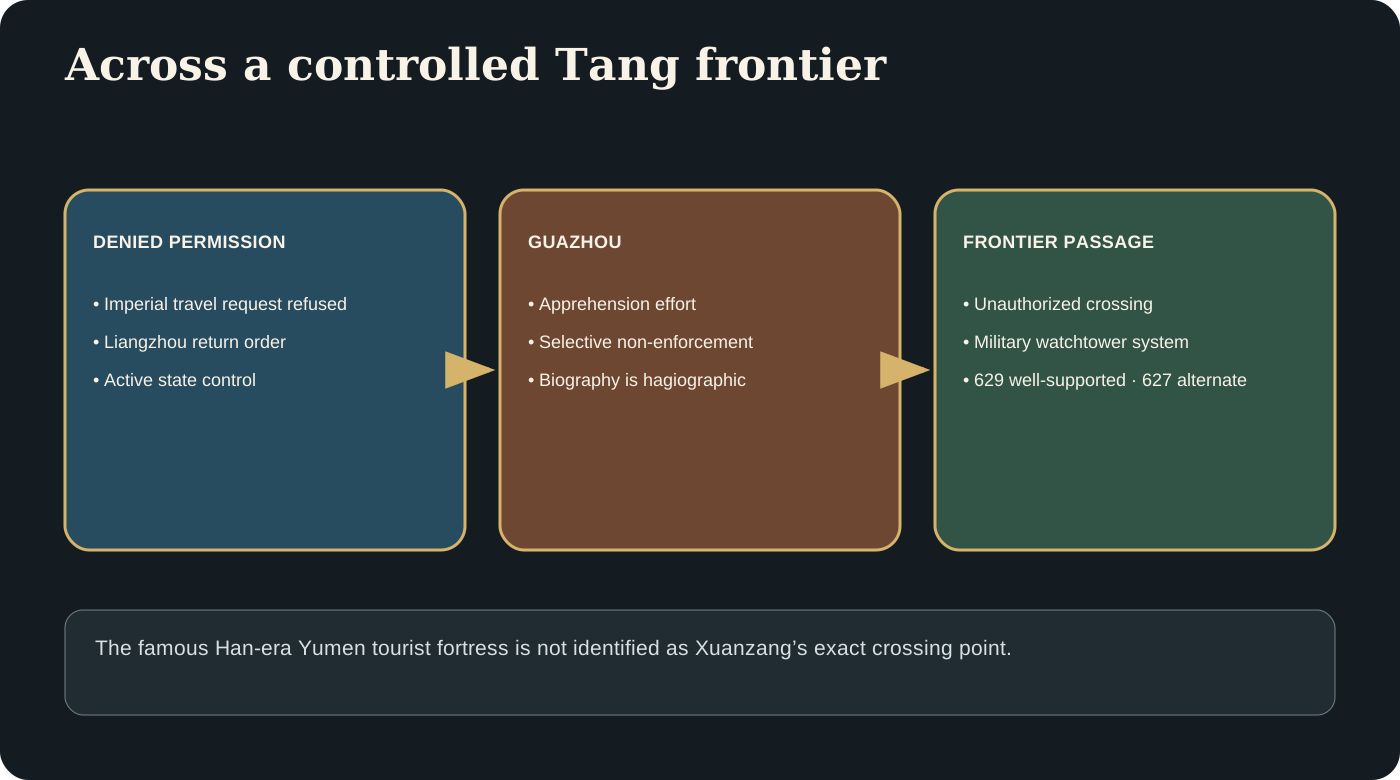
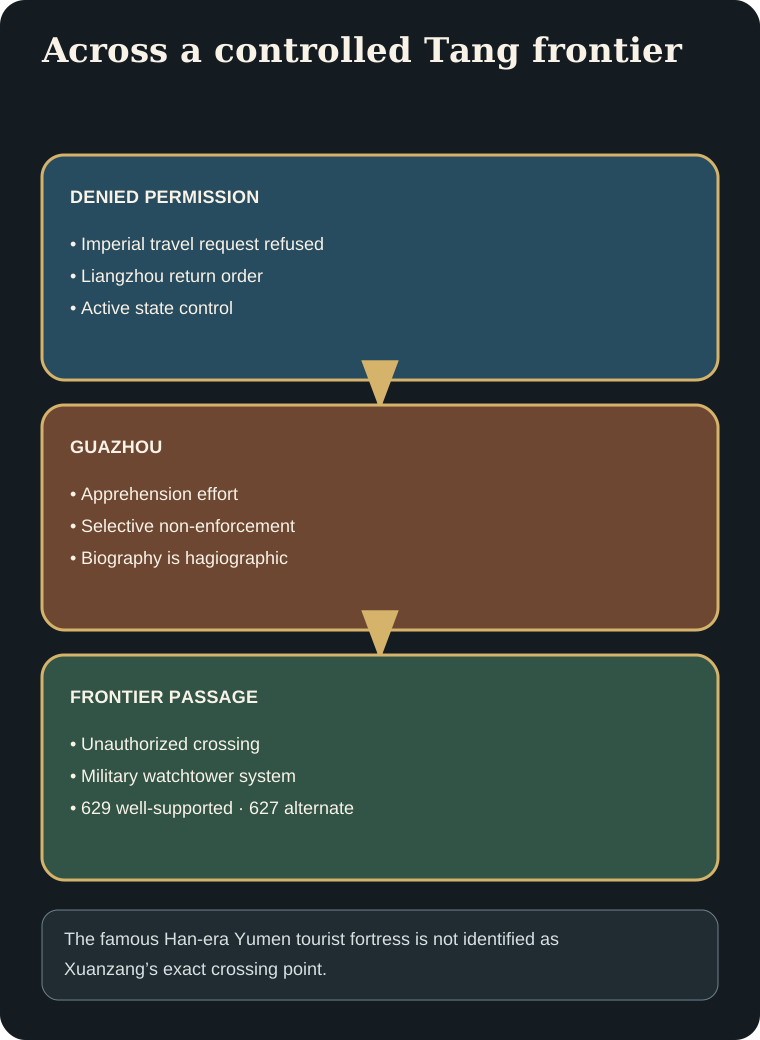
A source-aware view of state obstruction and unauthorized frontier passage without a tactical checkpoint map.