
Alfie Hinds became famous for getting out of prisons, but the more unusual part of his story was what he did with the attention those escapes created. Between 1955 and 1958 he escaped custody three times—first from Nottingham Prison, then from the London Law Courts, and finally from Chelmsford Prison—before his last long fugitive period ended in 1960.
Throughout those years Hinds insisted that the 1953 conviction behind his twelve-year sentence was wrong. He contacted newspapers and television while on the run, petitioned politicians, brought civil actions, studied law, and became a surprisingly capable litigant in person. His career therefore sits at an unusual intersection of prison escape and legal history.
At a Glance
- Original sentence: Twelve years' preventive detention
- First escape: Nottingham Prison, 26 November 1955
- Second escape: London Law Courts, 24 June 1957
- Third escape: Chelmsford Prison, 1 June 1958
- Final long fugitive period ended: 1960
- Recurring theme: Escape, publicity, and litigation all fed Hinds's challenge to his conviction
- Legal caution: His later civil libel victory did not itself erase the 1953 criminal conviction
The Maples Conviction
Hinds's postwar notoriety began with the 1953 Maples case. He was prosecuted in connection with a major burglary at the Tottenham Court Road store and was convicted at the Central Criminal Court of breaking and entering. Hansard later recorded the sentence as twelve years' preventive detention.
Hinds maintained that he had been wrongly convicted. That assertion became the central theme of almost everything he did afterward, but it should not be confused with a judicial finding that the conviction had been false.
Even before trial, his complaints had begun to collide with the prison system. While on remand at Brixton he attempted to communicate concerns about his case to his Member of Parliament. The letter was stopped by the prison governor because of the way Hinds had tried to route it through his wife.
The episode reached Parliament in November 1955. The MP who raised it argued that a remand prisoner should have meaningful access to an elected representative, especially when the complaint concerned the fairness of an impending trial. By then, Hinds had already escaped Nottingham Prison.
Nottingham — 26 November 1955
The first famous escape has a small date problem that later retellings often miss. On 8 December 1955, the Home Secretary told the House of Commons that Hinds had escaped Nottingham Prison on the evening of 26 November, apparently with another prisoner named Fleming, and that both were still at large.
A parliamentary question the following February referred instead to 28 November. The earlier official answer was given closer to the event and directly states the date, so 26 November is the stronger chronology.
Later accounts add more color to the mechanism. They describe Hinds and Patrick Fleming getting access to a prison work area and using timber or wooden frames to help cross the perimeter. Those details are plausible, but they are not as firmly established as the date, the prison, and Fleming's presence.
The crucial result was that Hinds got out and stayed out for months.
A Fugitive Who Wanted to Be Heard
Hinds's behavior after Nottingham was unusual because publicity was not merely an accidental by-product of the escape. In February 1956, Parliament discussed the fact that he remained at large while in touch with the press and television. An MP pointedly asked how the police could fail to catch a wanted prisoner whose recorded voice had been broadcast on commercial television.
Hinds was using his freedom to amplify his claim that the 1953 case had been unjust. That strategy made capture more likely, but it also ensured that his name remained connected to the grievance he wanted reviewed.
He was eventually recaptured in 1956. The next escape would come not from a prison wing but from the legal proceedings he had pursued against the prison authorities.
The Law Courts Escape — 24 June 1957
Hinds had brought litigation against the Prison Commissioners arising from his earlier escape and recapture. That litigation required him to appear at the Law Courts in London.
On Monday 24 June 1957, two prison officers escorted him to a lavatory near the Bear Garden. A Reuters report printed the next day described the escape as having happened on Monday, while a later Law Gazette reconstruction explains how the setting had been prepared.
Hinds's brother Albert and his associate Tony Maffia had helped arrange a padlock and fittings that could secure the lavatory door. Once Hinds's handcuffs had been removed, the two warders ended up locked inside, and Hinds escaped into Fleet Street.
The episode is frequently summarized as a brilliantly successful escape. In one sense it was: he left custody from inside the central machinery of British justice. In another sense it lasted only a few hours.
Five Hours of Freedom
Hinds traveled west and reached Bristol Airport, apparently intending to fly to Dublin. He was recognized before departure and arrested roughly five hours after escaping the Law Courts.
That short interval is important because Hinds's three escapes had very different outcomes. The Nottingham breakout produced months at large. The Law Courts episode ended almost immediately. Chelmsford would lead to another long fugitive period.
Albert Hinds and Tony Maffia were later imprisoned for assisting the Law Courts escape. The incident also illustrates how tightly Hinds's legal and escape histories had become entangled: a lawsuit gave him a reason to be transported into a different custody environment, and that environment became the setting for the next breakout.
Chelmsford — 1 June 1958
Less than a year later, Hinds escaped again. A contemporary press photograph dated 1 June 1958 identifies the two men as Alfred George Hinds and George Walkington and states that they had escaped Chelmsford Prison that Sunday.
This was not Hinds acting alone. Walkington was serving a substantial sentence and had previous escape experience of his own.
The broad fact of the breakout is secure, while the exact mechanics are less tidy. Later accounts describe duplicate keys prepared for prison doors, one key failing, a forced change of plan, a wall crossing, and a waiting car. The complete key-and-wall sequence is more dependent on retrospective retellings than the date and identities.
For that reason, the third escape is best reconstructed around what is certain: Hinds and Walkington left Chelmsford on 1 June 1958, and Hinds once again remained free long enough to build another life outside custody.
William Herbert Bishop
A 1962 TIME profile says Hinds returned to Ireland and lived under the name William Herbert Bishop. He worked as a used-car dealer and remained outside British custody for almost two years before a vehicle-related encounter with police led to his capture.
The exact arrest sequence is less important than the documented end state. On 19 November 1960, a contemporary news-photo caption recorded Hinds's wife traveling from Belfast after unsuccessfully seeking habeas corpus to prevent his return to Chelmsford Prison.
By then the serial escape phase was effectively over. The legal campaign was not.
Hinds the Litigant in Person
Serial escape brought Hinds celebrity, but contemporary lawyers noticed something else. In May 1961, the New Zealand Law Journal reproduced British legal commentary on what it called “The Astonishing Hinds.” The significance was not that judges agreed with him; it was that an untrained prisoner appeared to understand the practical craft of advocacy unusually well.
The commentary described a litigant who kept his statutes and cases organized, listened to judicial interventions, and answered the issue the court was actually raising instead of simply reading a prepared speech. That is a very different skill from learning a few legal phrases.
TIME's 1962 profile gives the same broader picture. It described Hinds continuing to work through appeals and legal arguments after his 1960 recapture, with Lila Stuckley helping research authorities in the British Museum. The magazine also reported that Hinds personally argued before the House of Lords for roughly three hours.
Whatever the merits of his claims, he had become more than a prisoner filing repetitive petitions.
Escape as Public Advocacy
The legal campaign and the escapes reinforced one another. When Hinds was in prison, he petitioned and litigated; when he was outside, he contacted journalists, sent memoranda, and continued telling the public that the Maples conviction was wrong.
That did not make escape a legal appeal. It remained an unlawful departure from custody, but it explains why Hinds's story became larger than a sequence of security failures. He used the notoriety created by each escape to keep forcing the original conviction back into public discussion.
That strategy reached its strangest result in 1964.
Hinds v Sparks
Former senior detective Herbert Sparks had publicly asserted Hinds's guilt, and Hinds sued him for libel. Under the law then operating, the earlier criminal conviction did not automatically settle the truth issue in the new civil case.
Sparks relied on truth as a defence, but he failed to persuade the jury, and Hinds won the action. This result is sometimes described too loosely as Hinds proving that he was innocent.
It did not do that.
The civil jury's verdict did not itself quash the 1953 conviction. Instead, the case exposed a legal problem: a man already convicted in a criminal court could use a defamation action to put essentially the same question of guilt before a civil jury under different procedural conditions.
Later law-reform discussion cited Hinds v Sparks precisely because of that problem.
The Civil Verdict and the Criminal Conviction Were Different Things
The New South Wales Law Reform Commission later summarized the English debate. It noted that Hinds had been convicted, that Sparks subsequently published the accusation, that Hinds sued, and that Sparks failed on the truth issue.
The concern was institutional rather than personal: should a civil defamation suit effectively become a retrial of a criminal conviction when the Crown was not even a party? English legislation later changed the evidentiary position of criminal convictions in civil proceedings.
Hinds's own criminal case followed a separate route. Hansard in July 1964 records that he petitioned the Home Office for a review and indicated an intention to apply for a free pardon, and parliamentary material the following year continued to treat pardon and criminal review as distinct questions.
The safe historical conclusion is narrow: Hinds won an important civil libel case; that victory was not, by itself, a judicial erasure of his 1953 conviction.
Why Alfie Hinds Belongs in Escape History
The usual nickname, “Houdini Hinds,” encourages a simple story about a man who was unusually good at getting through doors and over walls. That is only half of it.
His three famous escapes were structurally different. Nottingham was a prison breakout with another prisoner and a long fugitive aftermath. The Law Courts escape exploited a temporary custody setting and lasted about five hours. Chelmsford produced another extended period under an alias in Ireland.
None became permanent freedom.
What made Hinds historically unusual was the second campaign running beside them: correspondence, press appearances, civil litigation, legal research, petitions, and self-representation. He repeatedly escaped prisons, but he also repeatedly returned to the same question in court—whether the conviction that put him there could be challenged again.
That combination is what separates Alfie Hinds from an ordinary serial jailbreaker.
Evidence discipline
What the record supports
Status labels distinguish secure conclusions from uncertainty and rejected claims. Color is never the only signal.
MYTH
Hinds's first Nottingham escape occurred on 28 November 1955.
A February 1956 question used 28 November, but the Home Secretary's direct December 1955 statement gives 26 November. The earlier official answer is preferred.
Sources: SRC-001, SRC-002MYTH
Hinds escaped Nottingham alone.
The Home Secretary said he escaped apparently with another prisoner, Fleming.
Sources: SRC-001MYTH
Hinds escaped the Law Courts on 25 June 1957.
A Reuters report printed on Tuesday 25 June says the escape happened Monday, fixing the event to 24 June.
Sources: SRC-003MYTH
The Law Courts escape kept Hinds free for days.
He was recaptured at Bristol Airport about five hours later.
Sources: SRC-003, SRC-004DISPUTED
The exact Chelmsford escape mechanism is fully documented.
The date and Walkington's participation are contemporary facts; duplicate-key and exact wall details rely more heavily on later retellings.
Sources: SRC-005, SRC-008MYTH
Hinds was merely a publicity-seeking escapee with no serious legal ability.
Contemporary legal commentary described him as an unusually effective litigant in person.
Sources: SRC-009MYTH
Winning Hinds v Sparks in 1964 automatically quashed Hinds's 1953 conviction.
The libel verdict was civil. Criminal review and any pardon process remained separate.
Sources: SRC-011, SRC-012, SRC-013, SRC-014Documentary reconstruction
Serial escapes and a legal campaign
A case-local editorial visual separates the documented sequence from uncertainty without implying exact modern geography or operational detail.
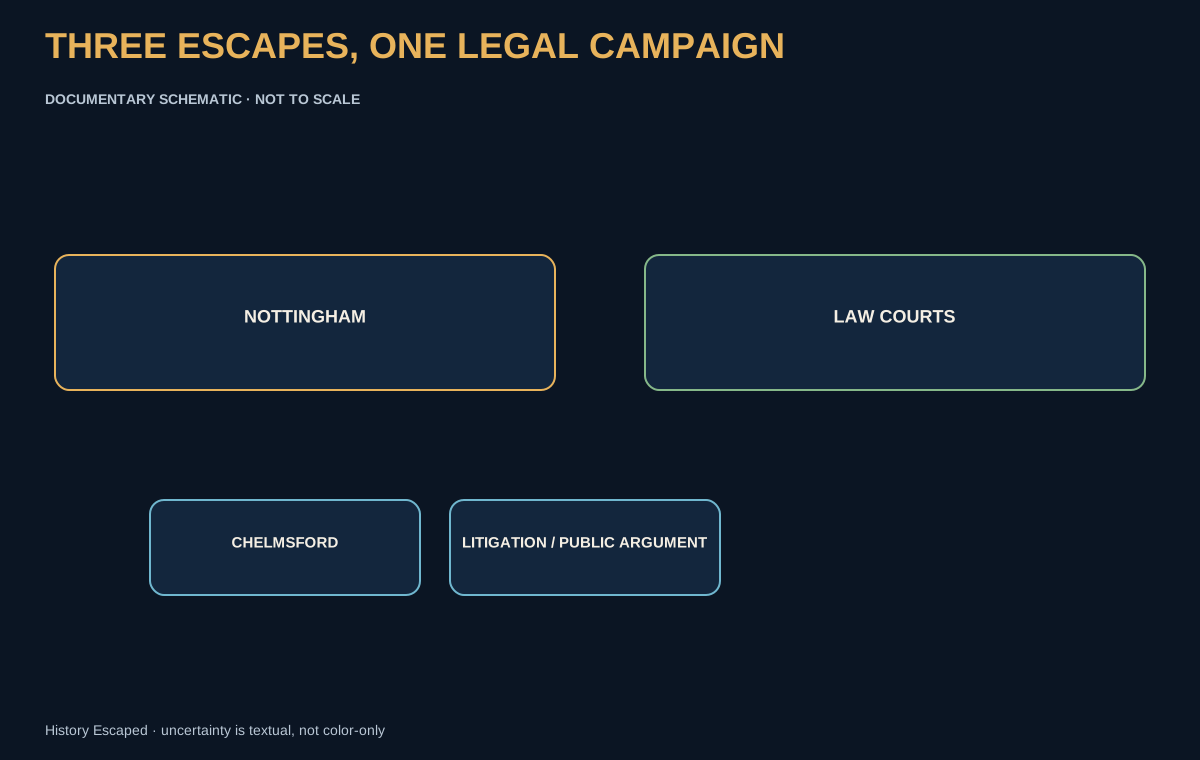
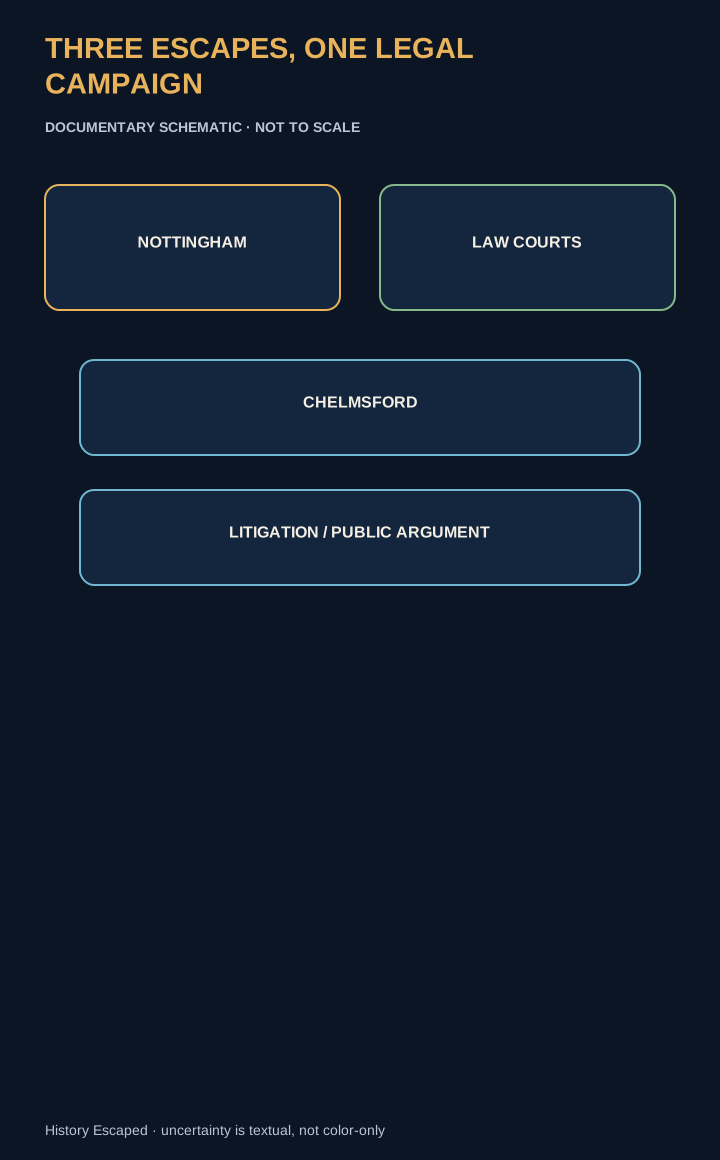
Simplified editorial reconstruction based on the cited historical record; not to scale. Uncertainty is stated directly in the visual and adjacent text.