
On the evening of 3 February 1919, Éamon de Valera, Seán McGarry and Seán Milroy walked out of Lincoln Prison through doors opened with a forged master key. The famous fruit cakes were real, but the escape was more complicated than the familiar story of one perfect key baked into one cake: several copies failed, tools were smuggled in, an imprisoned metalworker fashioned the working key, and an outside network arranged the fugitives’ journey across England.
At a Glance
- Date: Evening of 3 February 1919
- Place: Lincoln Prison, Lincoln, England
- Escapees: Éamon de Valera, Seán McGarry and Seán Milroy
- Captivity type: Wartime internment under the Defence of the Realm framework
- Main method: Forged master key with coordinated outside assistance
- Key obstacle: Turning an imperfect impression and drawing into a key that would actually work inside the prison
- Outcome: All three men escaped Lincoln and reached underground safe accommodation in Manchester
A political prisoner inside a changing revolution
Éamon de Valera entered Lincoln Prison because of the British government’s May 1918 crackdown on Sinn Féin. Dublin Castle accused republican leaders of taking part in what became known as the “German Plot,” an alleged scheme involving treasonable communication with Germany. De Valera and other prominent nationalists were arrested and interned in English prisons without the ordinary criminal trial process that readers might associate with a conventional prison sentence.
His political importance increased while he was locked up. Sinn Féin won a sweeping victory in Ireland in the December 1918 general election, and its elected representatives refused to take their seats at Westminster. On 21 January 1919 they assembled in Dublin as Dáil Éireann, declaring an independent Irish legislature; many elected members were absent because they remained imprisoned in Britain.
De Valera was among those absentees. The National Museum of Ireland records that the First Dáil selected him, Arthur Griffith and Count Plunkett as envoys intended to press Ireland’s claim at the Paris Peace Conference, even though all three were imprisoned. That made freeing senior prisoners a political objective as well as a personal one.
Michael Collins and Harry Boland became central to the work outside Lincoln. Inside, de Valera, McGarry, Milroy and other prisoners had a different problem: before any car, safe house or political plan mattered, they needed a way through the prison doors.
The key problem
The escape route depended on a door leading from the exercise area toward the outside. De Valera’s access to Catholic services gave him an opportunity to study a key used by the prison chaplain. UCD Archives, drawing on de Valera’s papers, states that he copied the chaplain’s key in wax during Mass.
That impression could not simply be mailed out. Prison correspondence was inspected, and the prisoners needed to communicate the dimensions without writing an obvious request for a master key. Seán Milroy, who was skilled at drawing, helped turn the information into apparently harmless artwork.
One surviving Christmas card in de Valera’s papers shows Seán McGarry with an oversized key as part of a joke about imprisonment. More important than the joke were the concealed instructions that accompanied the drawing. UCD preserves correspondence telling contacts outside that the pictured key was the only thing separating “D” from freedom and asking for a matching key, files, a motor car, a place to stay and even a rope as a fallback if the gate could not be opened.
The archival letters make one point especially clear: the cake was not folklore added decades later. The prisoners explicitly asked for keys and files to be sent inside cakes.
Why the first keys failed
The popular version often compresses the mechanism into a single exchange: de Valera makes an impression, Collins receives the design, a duplicate goes into a cake, and the prison door opens.
The surviving material shows trial and error instead. Keys made outside the prison and smuggled in with food did not fit properly. The National Museum of Ireland describes failed attempts using smuggled keys before blanks, files and key-cutting tools were sent into Lincoln.
That changed who could solve the problem. Peter de Loughry, another Irish prisoner at Lincoln, had metalworking experience. The Oireachtas describes him as an iron moulder who ran a foundry business in Kilkenny and credits his metalworking skill as integral to the escape.
The National Museum says the blank keys and tools were passed to de Loughry so he could make the master key that ultimately opened the way for de Valera, McGarry and Milroy. Later reconstructions add that de Loughry examined or removed a prison lock while refining it, but the broader fact is better established than every workshop step: the successful key was finished inside after the externally manufactured copies had failed.
The escape is therefore better understood as a feedback process than as a single clever trick. The prisoners obtained a model, concealed its form in communication, tested outside-made copies, discovered the mismatch and finally brought the tools for correction inside the prison.
The cakes were part of a larger network
Food parcels made useful containers, but the operation extended well beyond whoever baked a cake. Liam McMahon, an Irish Republican Brotherhood organizer in Manchester, later gave a detailed statement about the support network in Britain. He remembered an early cake baked by Thomasina McGarry, another prepared in Manchester, and the final heavy fruit cake containing a blank key and files.
In McMahon’s account, Kathleen Talty carried that last cake into the prison. His testimony also shows how much preparation lay beyond the prison wall: Collins, Boland and their associates discussed a rope ladder in case the gate key failed, while taxis were arranged in stages from Lincoln to Worksop, Worksop to Sheffield and Sheffield to Manchester.
The surviving correspondence in UCD Archives independently supports this logistical picture. The prisoners asked not only for a key but also for transport, a place to hide and a rope alternative. They were planning a chain of escape rather than a single door-opening moment.
The evening of 3 February
Most archival and historical sources place the escape on the evening of Monday, 3 February 1919. A National Museum catalogue entry dates it to 4 February, so the discrepancy deserves notice; the stronger combined chronology from contemporary reporting, later participant testimony and multiple institutional histories supports 3 February for the actual departure.
De Valera left with Seán McGarry and Seán Milroy. The National Museum preserves an unusual object associated with his movement across the prison: a makeshift covering made from a sock and the sleeve of a jumper, worn over his boots to reduce the noise of his footsteps in the exercise yard.
The forged key opened the crucial doors. Later accounts often add a near-disaster at the final gate: Michael Collins, waiting outside with another copy, supposedly broke his key in the lock, after which de Valera pushed the broken piece through and used the key from inside. The story is repeated widely in biographies and commemorative retellings, but it is not stated in the British Home Office’s public summary of its inquiry or in the National Museum’s concise object record.
What the British government itself acknowledged is less colorful and more important. In the House of Commons on 4 March, Home Secretary Edward Shortt said that the official inquiry had found that the prisoners obtained egress with a forged key and that friends outside the prison had assisted in preparing it.
What did not happen
The escape immediately generated stories, some encouraged by republican supporters who had good reason to obscure the real method. One rumor claimed that women had distracted or enticed sentries away from their positions.
The British inquiry addressed that allegation directly. Asked in the Commons whether women had facilitated the escape by “enveigling the sentries,” Shortt answered no and said the sentries had no knowledge of the women.
That denial separates two different facts. Women were genuinely important to the wider support network: cakes, messages, transport and safe accommodation depended in part on activists such as Thomasina McGarry, Kathleen Talty and Mary Healy. But that is not the same as saying women distracted Lincoln’s guards at the moment the prisoners left.
Another simplification gives de Valera sole credit for making the final key. The evidence supports his central role in identifying and copying the key system, but the working master key is closely associated with Peter de Loughry’s skill inside the prison.
From Lincoln to Manchester
Opening the prison gate solved only the first problem. The men still had to put distance between themselves and Lincoln before their absence was discovered.
McMahon’s later statement gives the clearest account of the transport chain. The plan used separate taxis rather than one conspicuous long journey: Lincoln to Worksop, then to Sheffield, then to Manchester. Fuel restrictions and the difficulty of hiring cars for long trips made the arrangement a practical response to travel conditions in postwar Britain.
McMahon waited in Sheffield for the final leg. His statement records the escapees arriving with Paddy O’Donoghue and then traveling on to Manchester, reaching the city shortly after midnight. De Valera was hidden separately from McGarry and Milroy, and further assistance moved him when the first hiding place appeared unsafe.
The prison break had become an underground concealment operation. De Valera returned to Dublin later in February; on 1 April Dáil Éireann elected him President of the Dáil, and in June he traveled to the United States to seek political and financial support for the Irish Republic.
Why the escape mattered politically
It is easy to treat Lincoln as a colorful prelude to de Valera’s later career, especially because the key, cake and coded drawings make such memorable objects. In early 1919, however, the escape had immediate political meaning.
Britain had removed much of Sinn Féin’s leadership during the 1918 arrests. The December election then gave Sinn Féin a commanding position across most Irish constituencies outside the northeast, while the First Dáil attempted to turn electoral victory into an alternative state structure.
De Valera’s freedom placed one of the movement’s most prominent leaders back inside that rapidly changing political struggle. His subsequent election as President of the Dáil and his American mission made the consequences visible within months.
None of this means the escape itself caused the Irish War of Independence or determined the political course that followed. Armed conflict, underground government, British policy, public opinion and competing strands of Irish nationalism were already interacting in ways far larger than one prison break.
Lincoln mattered because it returned a major political actor to that contest at a moment when institutions, leadership and international recognition were all being fought over.
Legend and record
The Lincoln escape survived because it contains the ingredients of a memorable anecdote: candle wax, a coded Christmas card, keys hidden in fruit cake, a metalworker in prison, Michael Collins outside the wall and a last-minute problem at the gate.
Several of those ingredients are well documented. UCD preserves correspondence about the key drawings, cakes, files, transport and fallback rope. The National Museum preserves keys from the operation and de Valera’s improvised boot covering. The British government publicly conceded the forged-key method and outside help.
Other details come mostly through later recollection. The exact number of failed cake deliveries varies across retellings. The broken-key episode at the final gate is famous but less directly documented than the existence of the working forged key. Stories of women distracting guards were explicitly rejected by the official inquiry.
The archive makes the escape more collaborative and more technically interesting than the simplified legend. It worked because a prison key could be studied, encoded, copied, tested and corrected — and because people on both sides of the walls were ready to turn that small piece of metal into transport, shelter and political freedom.
Documentary reconstruction
Why copied keys failed—and the fitted master key worked
A case-local visual focused on the historical question that the surviving evidence can answer.
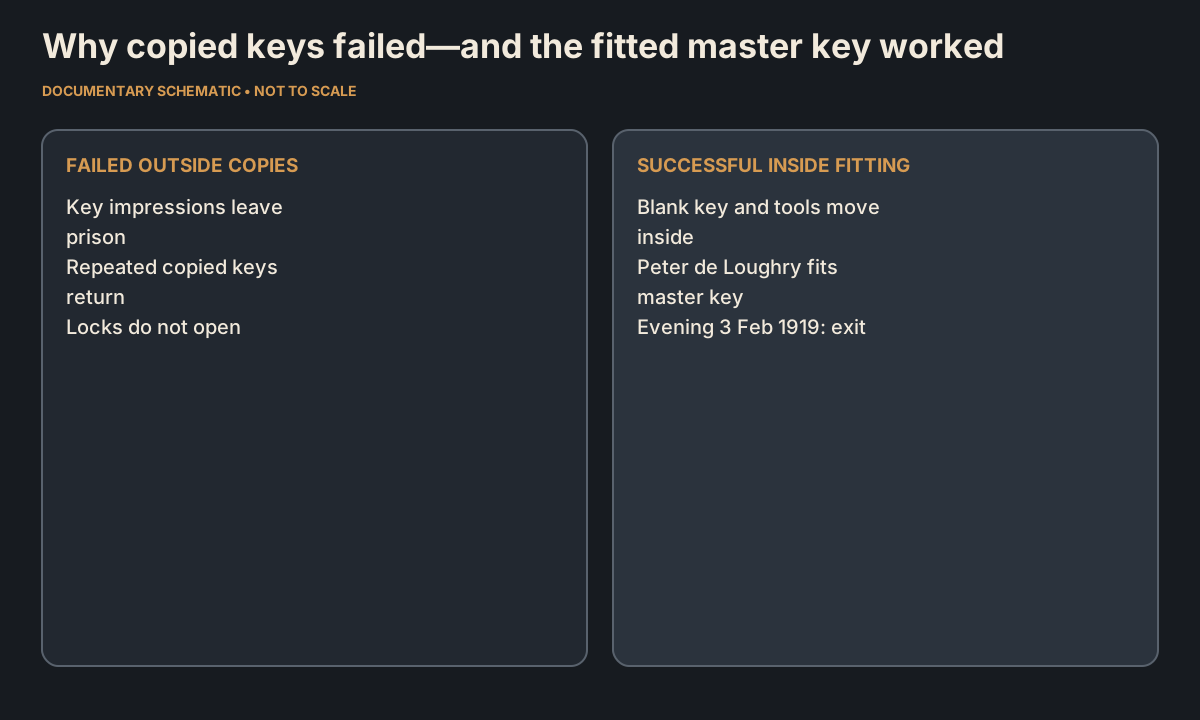
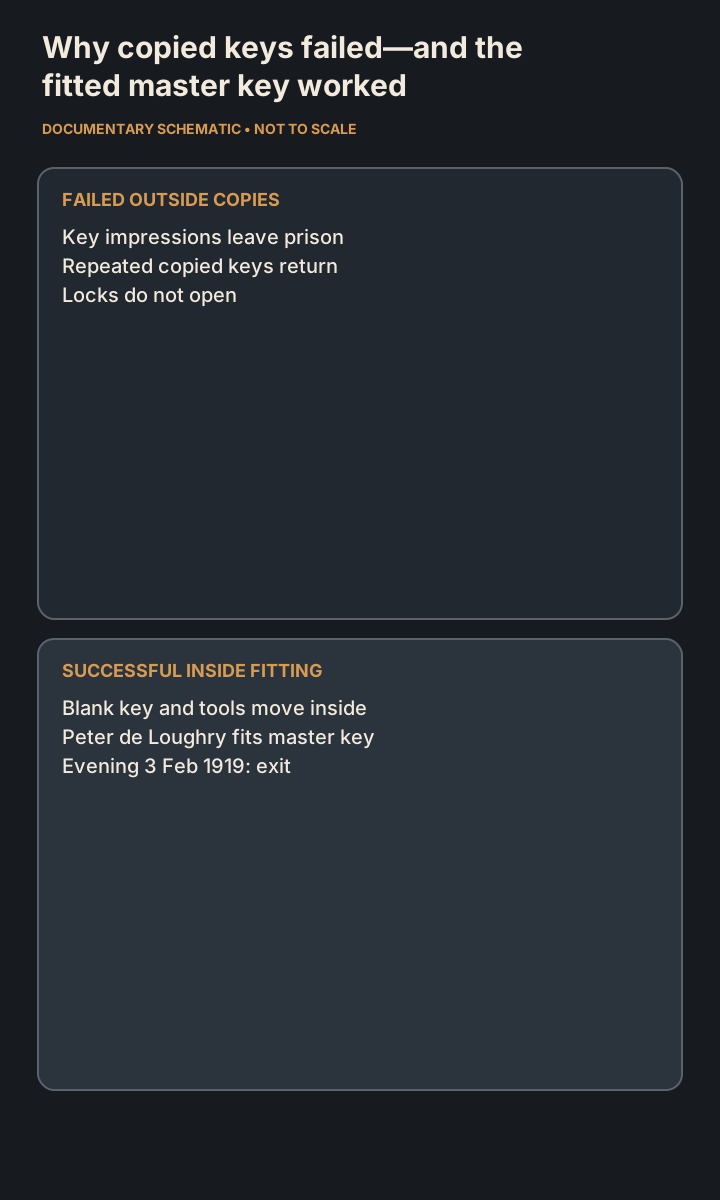
Simplified documentary reconstruction; not to scale. Evidence qualifications are written directly into the visual and explained in the adjacent text.
Evidence discipline
What the record supports
Status labels distinguish secure conclusions from uncertainty and rejected claims. Color is never the only signal.
DOCUMENTED
The Lincoln escape depended on a forged key and outside assistance.
The British Home Secretary stated after an official inquiry that egress was obtained with a forged key prepared with help from friends outside the prison; Irish archival and museum sources independently support the same mechanism.
Sources: SRC-001, SRC-002, SRC-003DOCUMENTED
A key and files were smuggled into Lincoln in fruit cake.
UCD preserves prison correspondence explicitly asking for a key and files in a cake, while the National Museum and Liam McMahon’s later witness statement describe repeated cake deliveries containing keys and tools.
Sources: SRC-001, SRC-003, SRC-006MYTH
One perfect duplicate key was baked into one cake and immediately opened the prison.
Several outside-made keys failed. The successful solution involved sending blank key material and files into the prison so the key could be fitted there.
Sources: SRC-003, SRC-006, SRC-008MYTH
Éamon de Valera personally made the final working master key.
De Valera was central to obtaining and communicating the key pattern, but institutional sources credit fellow prisoner Peter de Loughry’s metalworking skills with producing the working master key.
Sources: SRC-003, SRC-005, SRC-008MYTH
Women distracted Lincoln sentries so the prisoners could escape.
Women participated materially in the wider support network, but Home Secretary Edward Shortt told the Commons that the official inquiry found no basis for the claim that women had enticed sentries away.
Sources: SRC-002, SRC-006LATER CLAIM
Michael Collins broke an outside duplicate key in the final gate lock.
The episode appears repeatedly in later biographies and commemorative accounts, but it is not part of the concise official inquiry statement or National Museum key record.
Sources: SRC-014, SRC-015WELL-SUPPORTED
The escape occurred on 3 February 1919.
Contemporary-derived reporting, Liam McMahon’s witness statement, the CSO and numerous historical treatments use 3 February. The National Museum’s collection record gives 4 February, so the discrepancy remains visible.
Sources: SRC-003, SRC-006, SRC-007, SRC-010