
Cabanatuan Raid: The U.S.–Filipino Rescue of Allied POWs in 1945
On January 30, 1945, a combined force of U.S. Rangers, Alamo Scouts and Filipino guerrillas attacked the Japanese POW camp near Cabanatuan on Luzon. More than five hundred Allied prisoners were removed from the camp before nearby Japanese troops could reinforce it.
The assault lasted minutes. The extraction took the rest of the night and depended on hundreds of Filipino guerrillas, local guides, village food and water, a Filipino doctor and eventually seventy-one carabao carts. Cabanatuan was not simply a Ranger raid with local assistance; it was a rescue system built around U.S. assault troops and Filipino intelligence, blocking forces and civilian logistics.
At a Glance
Date: January 30–31, 1945
Location: Pangatian / Cabanatuan, Nueva Ecija, Luzon, Philippines
Mission: Rescue Allied POWs from Japanese custody
U.S. assault force: 124 Rangers and 13 Alamo Scouts in the detailed Army Special Operations task organization
Filipino guerrillas: Approximately 300–350 in the detailed task organization
Principal guerrilla commanders: Juan Pajota and Eduardo Joson
Preferred liberation count: 516
Common commemorative count: 511
Post-raid roster breakdown: 489 Americans, 23 British, 2 Norwegians, 1 Dutch, 1 Filipino
POW deaths during withdrawal: 2
Evacuation carts: 71 by the later stages of the withdrawal
Classification: Successful POW rescue / extraction
Presentation: Sensitive / Wartime
The Prisoners Had Already Survived Years of Captivity
Many of the men at Cabanatuan had fought on Bataan or Corregidor in 1942. After surrender came the Bataan Death March, overcrowded prison camps, disease, hunger, forced labor and repeated prisoner transfers. Cabanatuan became one of the largest Japanese POW camps in the Philippines.
By late 1944, many healthier prisoners had been shipped elsewhere for labor. The men left behind included large numbers who were sick, disabled or physically depleted. That fact would become one of the rescue plan’s biggest logistical problems.
Palawan Changes the Risk
On December 14, 1944, Japanese forces killed most of the American POWs held at Puerto Princesa on Palawan. A small number escaped.
Filipinos helped survivors avoid recapture and reach Allied contact. Their testimony gave American commanders direct evidence that retreating Japanese forces might murder prisoners rather than allow them to be liberated.
Cabanatuan was therefore not rescued simply because the front happened to be nearby. Commanders feared time was running out.
Lapham’s War Behind the Lines
Major Robert Lapham had spent years working with Filipino guerrilla forces in central Luzon. His network supplied intelligence on Japanese movements and prisoner locations long before the U.S. front reached the area.
Lapham also understood the practical problem that made an early guerrilla-only rescue difficult: removing five hundred sick prisoners was one task; hiding, feeding and transporting them was another. When Sixth Army returned to Luzon, the equation changed. Lapham raised the Cabanatuan problem again.
Krueger Orders a Rescue
Lieutenant General Walter Krueger directed planning for a raid before conventional American units could reach the camp. Lieutenant Colonel Henry Mucci of the 6th Ranger Battalion received command of the rescue force. Captain Robert Prince commanded the principal Ranger assault element and developed the camp plan. The Rangers were only one part of the operation.
Two Alamo Scout teams moved ahead to gather current intelligence. Filipino guerrilla units under Captains Juan Pajota and Eduardo Joson supplied local knowledge, security and blocking forces.
The Force Was Larger on the Filipino Side
A detailed U.S. Army Special Operations history gives the raid task organization as 124 Rangers and 13 Alamo Scouts.
For the Philippine guerrillas, it gives roughly 300–350 men. That comparison is important.
The operation’s popular image focuses on the Rangers entering the prison because that was the visible rescue moment. Numerically, however, the Filipino armed force around the objective was substantially larger.
Their mission was different. They were there to keep the rescuers from being overrun.
Juan Pajota Says Wait
The first planned attack date did not survive contact with local intelligence. Pajota warned Mucci that a large Japanese formation was moving through the area near the camp. Attacking immediately could place the rescue force between the prison garrison and a major reinforcement column.
Mucci postponed the operation for approximately twenty-four hours. That decision was not a minor scheduling adjustment. It shows the command relationship at its best: the arriving American commander accepted that the Filipino guerrilla leader had superior immediate knowledge of the local battlefield.
The Scouts Go Back
The delay gave the Alamo Scouts more time to observe the prison. They studied: - guard positions; - camp layout; - roads; - enemy movement. Their fresh information went back to Prince and Mucci. The plan was revised again.
Cabanatuan succeeded in part because the raiders treated intelligence as something that could change until the last hours before the attack.
Villages Were Part of the Operation
The march toward the camp crossed a populated landscape. Filipino guides knew which routes were usable and which areas were dangerous. Villagers supplied food and water. Local resistance networks reduced the chance that movement would be betrayed.
The Army’s own later analysis described support from the local population as a condition on which the mission heavily depended. This was not an empty countryside through which American commandos moved alone.
Pajota and Joson Take the Flanks
As the assault force approached the camp, Pajota’s and Joson’s guerrillas moved to blocking positions. Pajota’s men covered the Cabu River approach. Joson’s force covered another major approach and protected the withdrawal flank. These forces had a simple strategic purpose:
keep Japanese reinforcements away from the prison long enough for the POWs to get out.
The Rangers could defeat the camp guard and still lose the rescue if nearby Japanese units reached the objective before the prisoners were clear.
The Open Field
The ground around the prison gave little concealment. Rangers and Scouts moving toward the perimeter risked being seen before the attack began. A P-61 Black Widow aircraft was used as a diversion. The plane made conspicuous passes while the men below moved into final positions.
The aircraft trick is memorable. It worked because the rest of the system was already in place.
The Raid Begins
The assault began in the evening. Rangers hit Japanese positions, breached the camp and moved through the compound. The prisoners did not instantly understand what was happening. After years of captivity and threats, some feared that the gunfire meant Japanese guards were beginning a massacre.
Rangers and Scouts had to enter the prisoner area and direct men toward the gate. Some prisoners could walk. Others could not.
The Battle Outside the Fence
At the same time, Filipino guerrillas were fighting to keep Japanese troops from reaching the camp. Pajota’s force blocked reinforcements around the Cabu River. Joson’s force held another approach. The rescue is often remembered from inside the camp fence, but the prisoners could leave only because the perimeter battle outside kept the objective isolated.
The Rangers opened the prison. The guerrillas protected the time needed to empty it.
The Prisoners Were Weaker Than Expected
American planners had badly underestimated how difficult it would be to move the rescued men. Years of starvation, malaria, dysentery, wounds and disability had reduced many prisoners to a condition in which even a short march was hard. Rangers gave prisoners clothing and shoes. Men supported others physically.
Stretchers were used. Then the rescue force reached the civilian transport system that would become essential.
Twenty-Five Carts Were Not Enough
The initial evacuation plan called for a limited number of carabao carts for the weakest men. The need grew almost immediately. At one stage about 115 prisoners were moved in twenty-five carts. More carts were requested from villages.
The total reached fifty-one. Later it reached:
seventy-one.
The growing cart column is one of the clearest measures of how much the original extraction plan had underestimated POW condition.
Filipino Villagers Make the Withdrawal Possible
The carts did not appear from an American supply depot. They came from the surrounding Filipino population. Local people also supplied food and water as the exhausted column passed. Guerrillas continued to guide and protect the movement.
The withdrawal turned into a mobile partnership between: - rescued POWs; - Rangers; - Scouts; - guerrillas; - cart drivers; - villagers. The prison gate was only the midpoint of the rescue.
Doctor Layug
At Platero, a Filipino physician identified in Army histories as Doctor Layug treated sick and wounded men. The need had become urgent because Captain James Fisher, the Ranger medical officer, had been mortally wounded. Layug’s role is easy to omit from a combat-focused account. It belongs in the story because medical treatment was part of keeping the rescued alive long enough to reach friendly lines.
The Rangers Who Died
Two Rangers died as a result of the raid. Captain James C. Fisher was mortally wounded while treating casualties.
Corporal Roy F. Sweeny was killed.
Other Rangers and Alamo Scouts were wounded. These losses should be distinguished from prisoner deaths during the evacuation and from the disputed Filipino guerrilla casualty record.
Two Prisoners Die After Liberation
Two men who had been freed from Japanese control died during or immediately after the withdrawal. One account describes a prisoner dying of a heart attack before he could fully leave the camp. Another died during the movement toward safety. The distinction matters when rescue totals are discussed.
A man can be liberated from a prison and still not survive the extraction.
Why 511 Is Everywhere
The number 511 appears on official commemorative pages, in memorial events and in popular histories. It was one of the early counts that circulated after the operation. Other early figures included 512 and 513. Those counts were made in darkness, amid movement, with exhausted prisoners, scattered groups, and incomplete rosters.
One British prisoner was even missed during the initial evacuation and recovered later. A perfect real-time count was unlikely.
Why 516 Is the Preferred Roster Count
The detailed U.S. Army Special Operations history says later roster reconstruction supports 516 as the most likely accurate total. Its breakdown is:
489 Americans
23 British
2 Norwegians
1 Dutch
1 Filipino
The arithmetic is exact:
516.
That figure is therefore the preferred liberation count here. The presence of 511 in modern official commemorations remains historically important and is retained as a count tradition rather than dismissed.
Rescue Count Versus Survival Count
The 516 figure describes the people liberated or removed from the camp according to the later roster reconstruction. Two liberated men died during the immediate withdrawal. That means the number who survived through the complete extraction was lower. Subtracting the two known deaths suggests approximately 514 immediate survivors, but that figure is derived arithmetic rather than a separately verified roster.
The Guerrilla Casualty Problem
Filipino casualty figures are less stable than the prisoner roster. A 2025 U.S. Army account says twenty guerrillas were injured.
The detailed 2018 Army Special Operations article contains a summary sentence saying twenty-six guerrillas were killed. Those two statements cannot both describe the same casualty category. The 2018 claim also sits awkwardly beside the article’s own detailed narrative and the dominant later account of the raid. Without a primary guerrilla casualty roster, the exact Filipino loss total remains disputed.
That uncertainty should be visible rather than repaired by guesswork.
One Prisoner Was Still in the Camp
British prisoner Edwin Rose was missed during the main evacuation. Accounts describe him as severely ill and hard of hearing. He was recovered afterward with the help of the remaining Scout and guerrilla network. His story helps explain why early prisoner totals shifted.
A rescue conducted in darkness across a moving battlefield did not produce its final accounting at the gate.
Reaching Friendly Lines
By morning, the rescued column approached American-controlled territory. The final miles required trucks and ambulances. The men who had survived years of captivity were finally taken into military medical care. For some, the transition was physically abrupt.
They had gone from a Japanese prison, through a night battle and a long evacuation, into Allied hospitals in less than a day.
What Made Cabanatuan Work
The Rangers had the mission of entering the camp. The Alamo Scouts provided close reconnaissance. Pajota and Joson isolated the objective with guerrilla blocking forces. Lapham’s network supplied the local intelligence framework.
Villagers fed the force. Filipino cart drivers moved men who could no longer walk. Doctor Layug treated casualties. The P-61 diversion bought concealment.
No one element explains the rescue alone.
Evidence, Myth and What the Sources Support
Did U.S. Rangers rescue the prisoners without major Filipino participation?
MYTH
The operation included roughly 300–350 Filipino guerrillas in the detailed Army task organization, and local civilians provided essential transport, food, water, route knowledge and medical assistance.
Was Juan Pajota merely a guide?
MYTH
Pajota commanded a major guerrilla force, supplied critical local intelligence, influenced the decision to delay the raid and helped isolate the camp from Japanese reinforcements.
Did Eduardo Joson have a meaningful operational role?
DOCUMENTED
Joson commanded another guerrilla blocking force protecting the camp and withdrawal routes from reinforcement.
Were exactly 511 prisoners rescued?
DISPUTED
511 is a common early and commemorative count. The detailed Army Special Operations reconstruction argues that 516 is the most accurate later roster total.
Is 516 just a modern guess?
MYTH
The 2018 Army Special Operations history explicitly states that the 516 figure is likely the most accurate because it is based on later roster accounting rather than field counts made during the withdrawal.
Did all 516 survive the extraction?
MYTH
Two liberated prisoners died during or immediately after the withdrawal.
Were the POWs able to march out under their own power?
MYTH
Many could not. The rescue eventually required seventy-one locally obtained carabao carts as well as stretchers and physical assistance.
Was the P-61 flyover the single trick that made the raid succeed?
MYTH
The diversion helped conceal the final approach, but success also depended on reconnaissance, Filipino blocking forces, local intelligence and a civilian-supported evacuation system.
Did the rescue happen entirely inside the prison camp?
MYTH
Filipino guerrillas fought outside the camp to prevent Japanese reinforcement while the Rangers removed prisoners.
Were 26 Filipino guerrillas definitely killed?
DISPUTED
A 2018 Army Special Operations summary says 26 guerrillas were killed, while a 2025 Army retrospective reports twenty guerrillas injured and no comparable guerrilla death total. The exact casualty accounting remains unresolved in the available source stack.
Did local civilians matter only after the fighting ended?
MYTH
Civilian support mattered during infiltration, feeding, route movement, transport and medical care. The evacuation could not have proceeded as planned without local support.
Why the Raid Matters
Cabanatuan is often taught as a model of special-operations planning. Its deeper lesson is broader. The raid worked because a formal military rescue force entered a landscape already shaped by years of Filipino resistance. The Rangers could attack the camp because Scouts and guerrillas gave them current intelligence.
The prisoners could leave because Pajota and Joson held off reinforcements. The weakest men could reach safety because villages produced carts, food, water and medical help. The rescue was multinational in command, local in logistics and collective in execution.
Evidence discipline
What the record supports
Status labels distinguish secure conclusions from uncertainty and rejected claims. Color is never the only signal.
MYTH
The Cabanatuan rescue was essentially a U.S.-only Ranger operation.
The detailed Army task organization includes approximately 300–350 Filipino guerrillas, and the withdrawal depended on Filipino villages, guides, carts and medical support.
Sources: SRC-001, SRC-003MYTH
Juan Pajota was merely a guide attached to the Rangers.
Pajota commanded a major guerrilla blocking force, supplied critical local intelligence and influenced the decision to postpone the raid.
Sources: SRC-001, SRC-007DOCUMENTED
Eduardo Joson commanded a meaningful guerrilla blocking force during the raid.
Army histories identify Joson as commander of a separate guerrilla element protecting approaches and withdrawal routes.
Sources: SRC-001DISPUTED
Exactly 511 prisoners were rescued.
511 is a common official commemorative count, but the detailed U.S. Army Special Operations history says early 511/512/513 figures were field counts and that 516 is probably the most accurate roster-based total.
Sources: SRC-001, SRC-003WELL-SUPPORTED
516 is the strongest current roster-based liberation total.
The 2018 U.S. Army Special Operations history explicitly favors 516 and provides a nationality breakdown summing to that total.
Sources: SRC-001MYTH
All 516 liberated prisoners survived the immediate extraction.
Two liberated prisoners died during or immediately after the movement to safety.
Sources: SRC-001, SRC-002MYTH
The prisoners could simply march back to American lines.
Their physical weakness had been underestimated; local carabao-cart support eventually expanded to 71 vehicles.
Sources: SRC-001MYTH
The P-61 distraction alone explains the raid's success.
The diversion helped the final approach, but success also required reconnaissance, guerrilla blocking forces, local intelligence and civilian-supported evacuation.
Sources: SRC-001DISPUTED
Twenty-six Filipino guerrillas were definitely killed in the raid.
A 2018 Army Special Operations summary says 26 guerrillas were killed, while a 2025 Army retrospective says 20 guerrillas were injured. The available source stack does not reconcile the conflict.
Sources: SRC-001, SRC-002MYTH
Local Filipino civilians became relevant only after the shooting stopped.
Village support, food, guides and local networks mattered during infiltration, planning, evacuation and medical care.
Sources: SRC-001, SRC-002Documentary reconstruction
A four-layer rescue system
A case-local editorial visual separates the documented sequence from uncertainty without implying exact modern geography or operational detail.
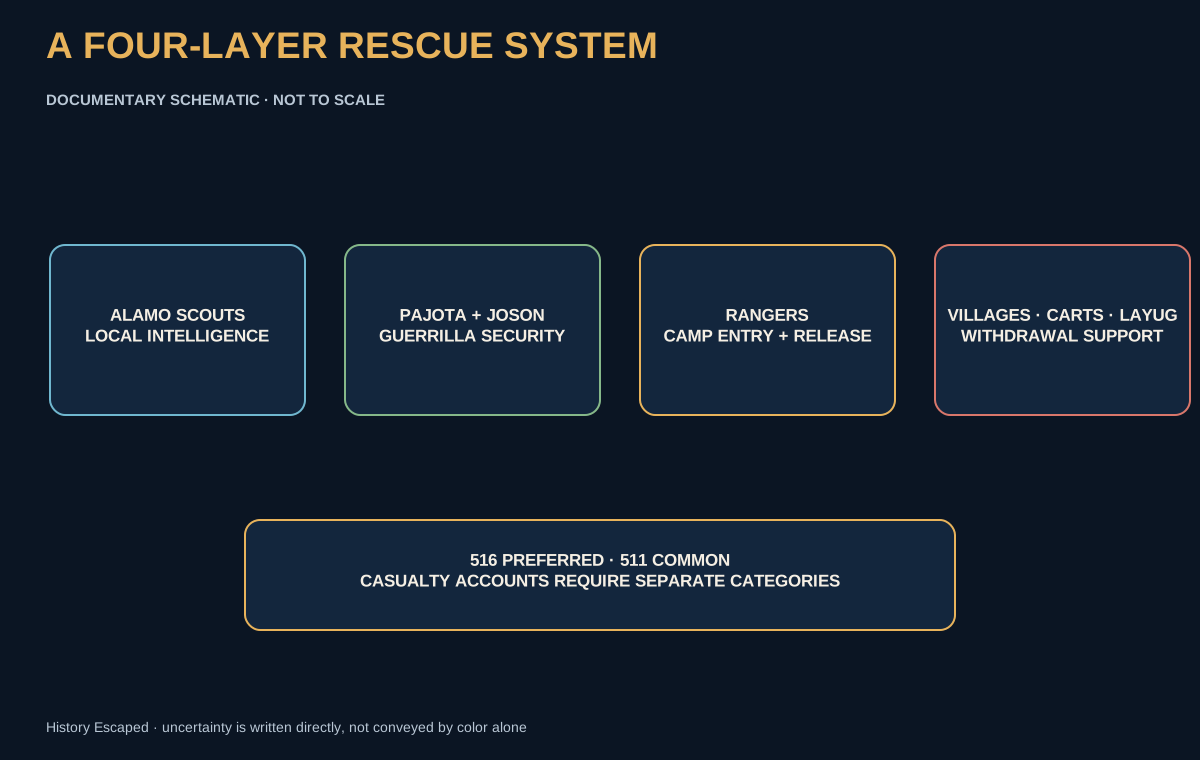
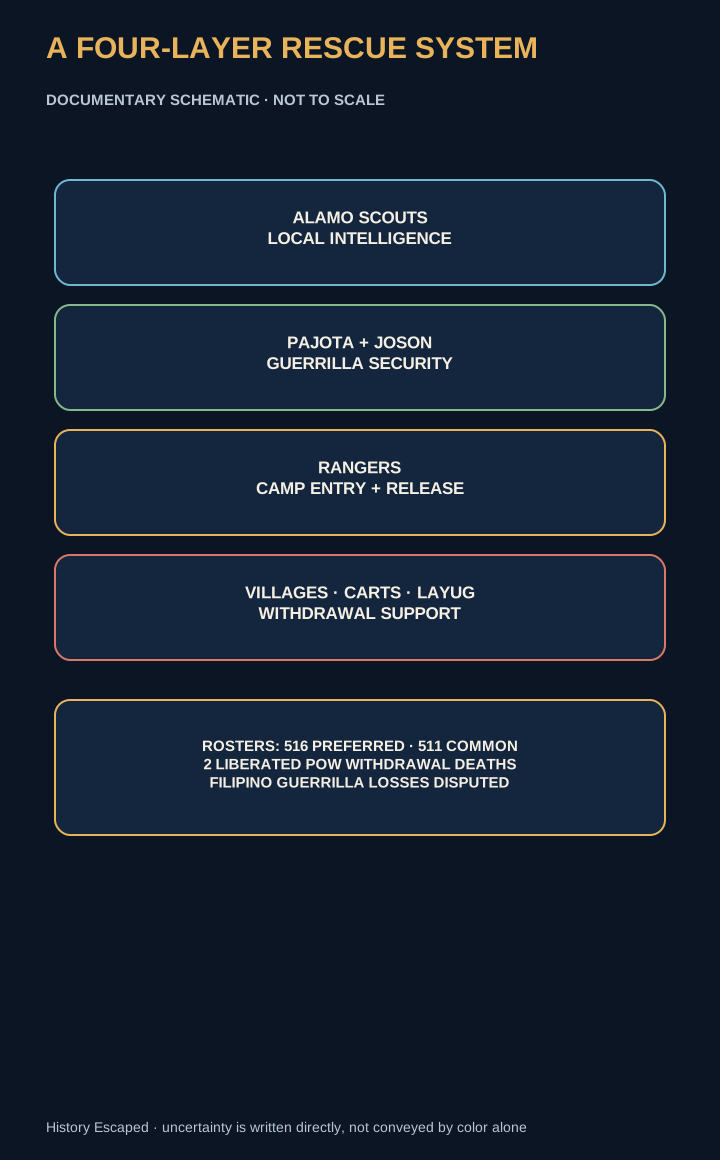
Simplified editorial reconstruction based on the cited historical record; not to scale. Uncertainty is stated directly in the visual and adjacent text.
