
Los Baños was a civilian internment camp, but by February 1945 it had become a place where starvation and the collapse of Japanese control made liberation an emergency. More than two thousand Allied civilians were confined on the former campus of the University of the Philippines College of Agriculture near Laguna de Bay. They included men, women and children from multiple Allied nationalities, as well as eleven U.S. Navy nurses who had been captured earlier in the war and were treated by the Japanese as civilian internees. Food had dwindled, illness was spreading, and the prisoners knew that other captives in the Philippines had been murdered rather than released.
The rescue that followed on 23 February 1945 is often remembered as an airborne operation by the U.S. 11th Airborne Division. That is only half the story.
Filipino guerrillas had been watching the camp, moving intelligence through Japanese-held territory, guiding U.S. reconnaissance teams, identifying landing and drop areas, and preparing to attack the guards before the paratroopers arrived. The final operation joined that resistance network to an airborne drop, an amphibious crossing of Laguna de Bay and a blocking force intended to keep larger Japanese formations away long enough to evacuate every internee.
The result was the rescue of 2,147 people in the controlling U.S. Army and Philippine historical-marker count.
At a Glance
- Date: 23 February 1945
- Place: Los Baños, Laguna, Luzon, Philippines
- Camp site: University of the Philippines College of Agriculture grounds
- Internees: mostly Allied civilians, including women, children, missionaries, clergy and 11 U.S. Navy nurses
- Controlling rescue count: 2,147
- Alternative count found in major secondary sources: 2,132
- U.S. formation: 11th Airborne Division
- Parachute assault: B Company, 511th Parachute Infantry Regiment
- Reconnaissance: 11th Airborne Division Reconnaissance Platoon
- Amphibious lift: 672nd Amphibian Tractor Battalion with LVT-4s
- Filipino guerrilla force: roughly 300 in the U.S. Army's official summary
- Selected guerrillas in reconnaissance/assault element: about 90
- Philippine groups identified by NHCP: ROTC Hunters, Wha Chi/48th Squadron, President Quezon’s Own Guerrillas, Marking’s group and other irregular forces
- Key Filipino coordinators: Lt. Col. Gustavo Inglés and Lt. Col. Honorio Guerrero
- U.S. Army casualty summary: 3 guerrillas killed, 6 wounded; 2 U.S. paratroopers killed, 4 wounded
- Internee deaths during rescue: none in the strongest rescue summaries
- Evacuation: across Laguna de Bay and toward New Bilibid/Muntinlupa
- Later aftermath: Japanese reprisals killed large numbers of Filipino civilians in the surrounding area; roughly 1,500 is often cited, but the precise total and geography remain source-sensitive
Los Baños was created because Santo Tomas was overcrowded
The Japanese occupation authorities opened the Los Baños camp in 1943 as the civilian internee population at Santo Tomas in Manila became increasingly difficult to house. The site occupied part of the University of the Philippines College of Agriculture campus near the northern slopes of Mount Makiling and the shore of Laguna de Bay. The first major transfer brought hundreds of internees from Santo Tomas. Additional groups followed as Japanese authorities concentrated Allied civilians who had previously lived under looser restrictions or in other camps. By 1945 the camp held more than two thousand people representing multiple nationalities and a wide range of ages.
U.S. Army historical material describes men, women and children from ten nationalities, including infants and elderly adults. Missionaries, priests and nuns formed a conspicuous part of the population, while the eleven Navy nurses represented a small but historically important group of captured U.S. military medical personnel whom the Japanese classified as civilians.
The camp was not a conventional prisoner-of-war compound
Los Baños is often called a POW camp in popular histories, but that label can obscure who was actually being held. Most of the prisoners were civilians: businesspeople, teachers, missionaries, clergy, families and other Allied nationals caught in the Philippines when Japan occupied the islands. The eleven Navy nurses were military personnel, and a small number of other internees had service connections, but the dominant population was civilian.
That distinction matters because the rescue problem was not simply extracting a body of soldiers who could march or fight once released. The camp contained children, elderly people, people weakened by malnutrition, patients who could not walk and families trying to remain together. Any evacuation plan had to move a civilian population, not merely open a gate.
The eleven Navy nurses had already spent years in captivity
The U.S. Navy nurses had been captured after the fall of American positions in the Philippines and first worked inside Santo Tomas. They later transferred to Los Baños to help care for the growing internee population. Navy history records how they improvised medical supplies, trained other prisoners to assist with hospital work and continued treating patients even as the camp slid toward severe malnutrition.
Their presence at Los Baños also helps explain why some official sources use the language of “civilian and military internees” while others simply call everyone civilians. The Japanese classification system had placed the nurses among civilian internees even though they were uniformed Navy personnel.
Conditions deteriorated sharply in the final year
Los Baños had never been comfortable, but its early period was less catastrophic than its final months. Internee testimony preserved by the Naval History and Heritage Command describes a camp that initially possessed gardens, limited meat, rice, beans and some ability to organize its own daily life. As Japanese military fortunes worsened, that relative stability collapsed.
The Japanese Army tightened control, food deliveries fell and the camp became increasingly crowded. By 1945 the Navy historical account describes the basic ration as roughly 500 grams of low-grade rice per day, while oral histories remember two meager meals, watery rice and severe protein deprivation. The result was visible starvation.
Sadaaki Konishi became a symbol of the camp's cruelty
Warrant Officer Sadaaki Konishi served in the camp administration and became notorious in survivor memory for enforcing harsh ration policies and abusive treatment. Later popular retellings sometimes reduce Los Baños to one sadistic individual, but the larger system matters more than his personality. The deterioration came from Japanese military control, collapsing supply, deliberate restriction and the broader wartime policy toward enemy civilians.
Konishi nevertheless became central to the camp's postwar memory because survivors associated him directly with hunger and punishment. He also survived the raid and was later implicated in atrocities against Filipino civilians in the region. His story belongs to the aftermath as much as the camp.
The prisoners feared more than starvation
By early 1945 Allied forces were returning to Luzon, but liberation did not automatically make captivity safer. The Palawan massacre had shown that Japanese forces could kill prisoners rather than allow them to be recovered. Filipino guerrilla networks and American intelligence officers were increasingly concerned that camps holding Allied prisoners might face similar orders or local decisions.
The National WWII Museum traces a direct line from knowledge of the Palawan killings to the series of prisoner-rescue operations around Manila. Cabanatuan, Santo Tomas, Bilibid and Los Baños were different military problems, but all were shaped by the fear that waiting for the front line to arrive could be fatal. At Los Baños, starvation created its own deadline even if no execution order could be proved with complete documentary certainty.
The intelligence war had been underway long before 23 February
The rescue did not begin when American aircraft appeared over the camp. Filipino guerrilla groups around Los Baños had been observing Japanese positions, guard routines, roads and the surrounding terrain while maintaining contact networks among local civilians and prisoners. The National WWII Museum explicitly states that much of the intelligence gathering came from guerrilla organizations operating south and east of Manila.
Some information moved out through women operatives and couriers who could pass Japanese checkpoints. Escaped internees also supplied details of the camp from inside the wire. The result was a body of local intelligence that American planners could combine with aerial reconnaissance and their own patrols.
Filipino guerrillas were not one organization
The word “guerrillas” can make the Philippine resistance sound like a single army under one commander. It was not. Different organizations had different political backgrounds, leadership structures and areas of operation. Around Los Baños, the Philippine National Historical Commission marker identifies a coalition that included the ROTC Hunters, the Chinese-Filipino 48th Squadron associated with Wha Chi, President Quezon’s Own Guerrillas, Marking’s group and other irregular forces.
The NHCP's separate marker for Wha Chi confirms that the Chinese-Filipino guerrilla organization took part in the liberation of Los Baños. The rescue therefore brought together groups that had not begun the occupation as one unified force.
Gustavo Inglés helped turn those groups into a rescue force
The Philippine historical marker gives Lt. Col. Gustavo Inglés a central organizing role.
It states that Inglés, a member of the Hunters, organized the combined guerrilla force while serving as the representative of the American command overseeing guerrillas in southern Luzon. Lt. Col. Honorio Guerrero and the ROTC Hunters are credited with leading the opening attack.
That record is important because many American accounts mention “Filipino guerrillas” only after describing U.S. plans in detail. The Philippine marker reverses the perspective: it makes clear that the rescue began with an organized local resistance force that already possessed men, information and access to the terrain.
The U.S. Army's own history gives the guerrillas a large role
The Army Center of Military History describes the Los Baños Task Force as including approximately two thousand U.S. airborne, amphibious and ground troops plus about three hundred Philippine guerrillas. Within the most sensitive reconnaissance and assault element, the Army says approximately ninety selected guerrillas joined thirty-two U.S. enlisted men and one officer.
The remaining guerrillas were not idle reserves. The Army credits the broader Philippine contingent with guides, reconnaissance information and marking both the parachute drop zone and the amphibious landing site. This is not a story in which local fighters merely pointed toward the camp after the Americans arrived. Their information and positioning were structural parts of the plan.
Escaped internees turned memory into a usable camp map
Several prisoners managed to make contact with guerrillas before the raid. Freddy Zervoulakos, a young Greek-Filipino internee, became one of the best-known. Benjamin Edwards also provided information after escape.
The 11th Airborne Association reconstruction describes Edwards sketching the camp layout on a schoolhouse blackboard for the reconnaissance team. Whether every line of the final plan came from that particular sketch is less important than the broader process: former prisoners could identify barracks, guard areas and internal geography that aerial photographs could not explain by themselves. Their testimony joined guerrilla observation to U.S. reconnaissance.
The rescue plan had to solve four different problems
Opening the camp was only one of them. First, someone had to reach the guards before they could organize resistance around the prisoners. Second, a substantial force had to arrive quickly enough to control the camp and surrounding ground. Third, more than two thousand weak civilians had to be physically moved away. Fourth, Japanese troops outside Los Baños had to be prevented from reaching the evacuation route.
The plan therefore separated responsibilities among an infiltrated reconnaissance/guerrilla element, an airborne company, an amphibious force and a blocking force on the roads to the west. No single unit could do all four jobs.
The lake made Los Baños both isolated and accessible
Laguna de Bay was a barrier, but it also became an evacuation route. Los Baños lay behind Japanese lines and was surrounded by road networks that larger Japanese forces could use to approach. Moving thousands of internees by road toward American lines would expose a slow civilian column to enemy intervention.
The lake allowed another option. LVT-4 amphibious tractors could cross water, approach the camp from the lakeshore and then carry large numbers of prisoners back across the same obstacle. The vehicles did not make the operation safe, but they created an evacuation corridor that Japanese road forces could not block as easily.
The 672nd Amphibian Tractor Battalion was an extraction force
The amphibious tractors are often treated as colorful supporting vehicles in photographs of the raid. Their real role was more important. They carried the bulk of 1st Battalion, 511th Parachute Infantry Regiment toward the camp and then became the principal transport for people who were sick, elderly, very young or too weak to make a long movement on foot.
The operation's objective was not to defeat a Japanese garrison and then wait. It was to remove the prisoners before larger Japanese forces could react. The LVTs turned temporary control of the camp into physical extraction.
B Company would arrive from the air
B Company of the 511th Parachute Infantry Regiment was assigned the dramatic airborne phase. The jump put an armed American force near the camp at the moment the infiltrated reconnaissance and guerrilla teams were already attacking. The airborne element could move toward the compound without waiting for a road approach from the main U.S. lines.
That synchronization is why Los Baños is remembered as an airborne operation. But the jump was one component inside a larger system. By the time the paratroopers could reach some guard positions, the Filipino guerrillas and reconnaissance teams were already engaged.
The reconnaissance platoon crossed the lake before the raid
The 11th Airborne Division's reconnaissance platoon, led by Lt. George Skau, infiltrated ahead of the main force. Small boats carried the Americans across Laguna de Bay, where they linked with Filipino guerrillas and escaped internees. The combined teams then moved through the surrounding countryside toward assigned positions.
This was a high-risk phase because discovery before the main attack could warn the garrison and endanger the prisoners. Its success depended on local crews, guerrilla guides and knowledge of Japanese patrol patterns around the lake.
Local civilians also bore risk
The guerrilla war was embedded in communities. Villagers provided information, shelter, boat crews, food and concealment while living under occupation. Helping the resistance could bring collective punishment if discovered.
Some guerrilla leaders warned civilians around Los Baños to stay inside or move away before the raid because they feared Japanese retaliation. That warning became grimly important after the rescue. The operation succeeded for the internees, but the surrounding Filipino population remained exposed when the rescue force withdrew.
The opening attack began before the paratroopers reached the camp
According to the U.S. Army Center of Military History, an alert Japanese sentry spotted a guerrilla moving into position just before the paratroopers came into sight. The first shot forced the assault to begin.
The Army account depicts a Filipino guerrilla killing the sentry at close range while other members of the combined reconnaissance force engaged additional guards. By the time the airborne company joined the action, many sentries had already been killed or driven from their positions. The sequence makes Filipino participation impossible to reduce to background support. They were part of the first combat at the camp.
The Japanese morning routine created a narrow opportunity
Intelligence from prisoners and guerrillas indicated that many guards followed a predictable morning routine. Accounts often emphasize calisthenics and the temporary separation of guards from their weapons. That detail became famous because it helps explain why a relatively small attacking force could overwhelm the camp before organized resistance developed.
The deeper point is not the routine itself. The attackers had learned the rhythm of the camp through observation, escapee testimony and repeated local intelligence collection. The surprise was produced over weeks before it appeared in seconds.
The airborne arrival amplified an attack already underway
As B Company descended, the combined reconnaissance and guerrilla force was fighting around the camp. The paratroopers then moved rapidly toward the compound and remaining defensive positions. The main amphibious force approached from Laguna de Bay while the blocking force engaged Japanese troops on the western road network.
The separate pieces converged around the same objective without all occupying the same ground. That is why Los Baños is better described as a coordinated rescue system than as one assault.
The blocking force fought away from the famous photographs
Col. Robert Soule commanded the force assigned to protect the operation from Japanese troops approaching from the west. Its mission placed soldiers away from the camp itself, which means they rarely appear in the iconic images of freed families and amphibious tractors.
Yet this force absorbed some of the operation's hardest fighting. If larger Japanese formations had reached Los Baños while thousands of weak internees were still loading, the success at the camp could have turned into a disaster. The blocking action bought the extraction time.
The prisoners initially did not understand what was happening
Survivor memories record confusion at the first sound of gunfire and aircraft. People who had spent years under Japanese control could not immediately assume that firing meant liberation. The Navy nurses moved patients under beds and tried to protect them before realizing American paratroopers were landing.
Other internees saw parachutes, smoke and armed men moving into the compound before the meaning became clear. The emotional transition from captivity to rescue happened inside an active battle.
Liberation created a new problem: two thousand people had to move
Once the guards were suppressed, rescuers had to turn a frightened and physically depleted population into an evacuation column. Some internees were reluctant to leave possessions that represented the remains of years of life in captivity. Others were too weak to walk.
The rescuers prioritized patients, children, women and people with limited mobility for the amphibious tractors. More able-bodied internees could move toward the lakeshore on foot and later board vehicles or continue with the evacuation. Speed mattered because the attackers did not intend to hold Los Baños indefinitely.
The camp was burned during the evacuation
American accounts describe barracks being set on fire as the evacuation accelerated. The immediate purpose was to force reluctant internees away from their belongings and remove structures that could be reused after the raid. The image of liberated prisoners leaving a burning camp became part of the event's memory.
The fires also meant that families were abandoning the few possessions and routines left to them. For people who had lived there for months or years, the barracks contained the few possessions and routines they still possessed. Freedom required abandoning almost everything.
The LVTs carried the weakest people first
The evacuation photographs show why amphibious transport mattered. Many internees were emaciated. Some were hospital patients. Some had to be carried on stretchers or physically assisted onto vehicles.
The LVTs could move from the camp area to the lakeshore and then continue across the water, avoiding a long march toward American lines. The extraction was humanitarian movement under military protection, a phase as historically important as the parachute drop.
New Bilibid became a place of temporary freedom
After crossing Laguna de Bay, many of the liberated internees were moved toward Muntinlupa and the former New Bilibid Prison complex. The irony was obvious: people rescued from an internment camp were taken to another prison. But Bilibid was now behind Allied lines and functioned as a reception, medical and logistical site rather than a place of captivity.
Food, medical care, registration and eventual onward movement could begin there. The meaning of a prison building depended entirely on who controlled the doors.
The 2,147 figure is the strongest rescue count
The current U.S. Army history of the 11th Airborne Division says the unit rescued 2,147 Allied civilian internees. The Army Center of Military History's Los Baños print set uses the same number. So does the Philippine National Historical Commission marker at Baker Hall, and the Osprey specialist history by Gordon Rottman uses 2,147 as the camp total.
That convergence across U.S. Army, Philippine public history and specialist military history makes 2,147 the strongest supported rescue total.
But 2,132 cannot simply be dismissed
The National WWII Museum has published a general Philippine-liberation article giving 2,132 rescued at Los Baños. Filipinas Heritage Library uses the same figure in a public history presentation, and some histories of civilian internment also list 2,132 as the camp population at liberation. Other first-person or contemporary accounts use 2,146.
The evidence available here does not securely explain the fifteen-person difference between 2,132 and 2,147. It would be worse to invent a tidy reason than to preserve the disagreement.
The difference may reflect different counting moments, but that remains an inference
Camp populations changed through births, deaths, transfers, escapes and administrative reclassification. Military rescue reports could also count categories differently from internee censuses or later civilian histories. Those possibilities make the 2,132/2,147 difference understandable in principle, but they do not prove which specific fifteen people account for it. The source record therefore supports a hierarchy rather than a forced reconciliation:
2,147 = controlling rescue total in the U.S. Army and NHCP record.
2,132 = significant alternative total in museum, heritage and internee-history sources.
No internee was killed in the main rescue account
The strongest institutional and memorial summaries treat the extraction of the prisoners as extraordinarily successful. The Los Baños Liberation Memorial Scholarship Foundation states that none of the prisoners was killed or seriously wounded during the rescue. U.S. Army accounts list casualties among the attacking forces but do not record internee deaths in their rescue summary.
That distinction matters. The mission involved gunfire around a crowded civilian compound, yet the rescued population was evacuated without the mass civilian casualties planners feared. It is one reason the operation became so famous after the war.
Rescuer casualty counts vary with the boundaries of the operation
The Army Center of Military History gives a clear task-force summary:
three Philippine guerrillas killed and six wounded; two U.S. paratroopers killed and four wounded.
Other later works give different totals, sometimes two guerrillas killed and four wounded, or additional U.S. deaths associated with the blocking force west of the camp. The discrepancy appears to reflect which elements and phases are being counted rather than a simple factual error. The Army numbers are best treated as one clearly attributed task-force accounting rather than as the only casualty total in circulation.
The Japanese garrison count is also less exact than popular summaries suggest
The Army print set says the camp was maintained by about eighty guards and a larger armed garrison, with thousands of Japanese troops several hours away. Osprey's specialist history and many later accounts use a garrison figure closer to 250. The Army summary says the entire garrison was apparently killed, while later histories often give roughly seventy to eighty Japanese deaths during the immediate camp action.
These figures are not perfectly interchangeable because “guards,” “garrison” and all Japanese troops in the surrounding area are different categories. An exact enemy body count is not necessary to explain why the rescue succeeded.
The operation was complete only when the rescuers also left
By early afternoon the camp itself had served its purpose. The internees had been moved out, the amphibious tractors were returning across the lake, and the rear guard began withdrawing. The Army Center of Military History says that by 1:30 p.m. the last internees, paratroopers and guerrillas had been evacuated from Los Baños.
Other detailed timelines place the final beach departure later in the afternoon. Again, the discrepancy is partly about which location marks the end: the camp, the beachhead or the final LVT departure. The essential fact is that the rescuers did not remain to occupy the camp area.
That withdrawal left Filipino civilians exposed
The military logic of the raid required a rapid exit. The rescuers were behind Japanese lines and could not defend every village around Los Baños after the internees were gone. Larger Japanese forces still operated in Laguna and neighboring provinces.
Filipino guerrillas understood the danger and warned civilians that retaliation was possible. The subsequent violence is therefore not an optional epilogue. It is part of the human cost of a rescue that protected foreign internees but could not protect the whole local population from Japanese reprisals.
Later reprisals killed large numbers of Filipino civilians
Many postwar accounts state that Japanese forces returned to the Los Baños area and killed roughly 1,500 Filipino civilians, often describing the killings as revenge for the rescue and suspected guerrilla collaboration. The National WWII Museum uses approximately 1,500 in its broader liberation history. The Los Baños memorial foundation repeats the same scale, and specialist accounts describe widespread burning and killing in communities around the former camp.
But war-crimes documentation and later historical compilations divide the violence into multiple incidents, places and dates. Roughly 1,500 in the surrounding Los Baños area in later reprisals is a better summary than “exactly 1,500 killed at the camp that night.”
Sadaaki Konishi reappears in the reprisal story
Konishi escaped the camp during the rescue. Later accounts and postwar proceedings implicated him in atrocities committed against Filipino civilians after the liberation of the internees. He was captured after the war, convicted of war crimes and executed.
His survival creates an important contrast with narratives claiming the entire Japanese camp staff died during the raid. Some guards and administrators did escape. That distinction reinforces why Japanese casualty totals need careful language.
The Filipino civilian dead were not a price to be balanced against the rescue
It is tempting to describe the reprisals as “the cost” of Los Baños. That framing can imply that the rescuers caused the murders in a moral sense or that the killings were an inevitable exchange for saving the internees. The responsibility for the reprisals lay with the Japanese forces and collaborators who committed them.
At the same time, the rescue changed the local military situation and appears to have intensified the danger to communities suspected of helping the operation. Both statements can be true without turning victims into an arithmetic trade.
The rescue belongs inside the Philippine resistance story
American unit histories naturally emphasize the 11th Airborne Division. Philippine public history supplies another necessary frame. The NHCP marker at Los Baños names multiple guerrilla organizations, credits Filipino commanders and describes the opening attack as a combined action before the American paratroopers joined it. The Wha Chi marker separately records Chinese-Filipino participation.
The rescue therefore belongs to the history of Philippine resistance to Japanese occupation as much as to the history of U.S. airborne warfare.
The Hunters were especially central
The ROTC Hunters had grown from young Filipino military cadets, ROTC students and other resistance members into one of the best-known guerrilla organizations in southern Luzon. Around Los Baños, their members gathered intelligence, coordinated with U.S. planners and took part directly in the attack.
Lt. Col. Honorio Guerrero appears in the Philippine marker as a leader of the initial assault. Gustavo Inglés served as a crucial bridge between the guerrilla force and the U.S. command system.
The Hunters' contribution was not created on the morning of 23 February. It rested on years of clandestine resistance.
Chinese-Filipino guerrillas also participated
The NHCP's marker for Wha Chi states that the Chinese-Filipino guerrilla force took part in the liberation of the Los Baños internment camp. That matters because broad accounts often compress the resistance into a single ethnic or political category. Wha Chi had its own history, leadership and relationship to other guerrilla formations. Its participation shows how the rescue briefly aligned organizations that did not necessarily share every postwar political goal. The common objective was the defeat of Japanese occupation forces and the liberation of the camp.
President Quezon's Own and Marking's forces belong in the same frame
The Los Baños marker also names President Quezon's Own Guerrillas and Marking's group among the combined Philippine formations involved. Those organizations operated across wider areas and supplied intelligence, fighters, guides or coordination depending on the local mission. Not every group played the same role at the same moment.
The correct emphasis is coalition rather than uniformity. Los Baños worked because a resistance network could concentrate information and people around one time-sensitive objective.
The raid also depended on Filipino geography knowledge
Modern military descriptions often praise timing, surprise and combined arms. Those were real. But an airborne map alone could not explain where boats could move safely, which roads Japanese patrols used, which fields could serve as drop zones, where local resistance cells were reliable or how American reconnaissance teams could move through occupied countryside without being detected.
Those were local knowledge problems. Filipino guerrillas and civilians helped solve them.
Intelligence and trust mattered more than any single trick
There was no one secret device that made Los Baños succeed. The plan required trust between U.S. officers and guerrilla commanders, trust between escapees and resistance contacts, trust between boat crews and reconnaissance teams, and confidence that separate assault groups would act at the expected time.
The intelligence was also redundant. Aerial reconnaissance, escaped internee sketches, guerrilla surveillance and U.S. ground observation overlapped. That redundancy reduced the danger of planning around one mistaken report.
The operation was not risk-free perfection
Later praise sometimes makes Los Baños sound inevitable once the plan was written. It was not.
A sentry detected movement before the intended signal. Amphibious vehicles crossed a large lake in darkness. The paratroopers were dropping near a camp filled with civilians. Japanese troops in the region greatly outnumbered the rescue force.
The mission succeeded because multiple risks failed to become catastrophic at the same time. That is different from saying the plan removed risk.
The famous “textbook” reputation came later
Los Baños became a case study in military coordination and rescue planning. The phrase “textbook airborne operation” is often associated with later praise by senior U.S. military leaders, especially Colin Powell.
That reputation is understandable, but it can distort the historical lens if it turns the civilians and guerrillas into props in a tactical demonstration. The operation was not conducted to prove a doctrine. It was conducted to remove starving prisoners from a camp before time ran out.
The photographs tell only part of the operation
One of the strongest surviving images shows Hal Bowie with his wife and baby daughter Lea beside 11th Airborne paratroopers after the rescue. Other photographs show emaciated internees near amphibious tractors or being moved on stretchers. Those images make the humanitarian result visible.
They do not show the intelligence couriers, guerrilla observers, boat crews, blocking forces or Filipino civilians later exposed to reprisal. The parts the camera missed remain essential to understanding how the rescue worked.
The rescue count and the casualty count answer different questions
“2,147 rescued” describes the objective achieved. “Three guerrillas killed, six wounded; two U.S. paratroopers killed, four wounded” describes one official Army accounting of the rescuing force's losses.
“Roughly 1,500 Filipino civilians killed later in reprisals” describes a separate post-raid atrocity category. Combining those numbers into one victory table would flatten very different human experiences. They describe different historical outcomes and cannot be collapsed into one victory total.
Why the 2,132 figure still matters
A source conflict matters especially when a famous operation is associated with a precise total. The difference between 2,147 and 2,132 is only fifteen people, but the U.S. Army and Philippine National Historical Commission records give 2,147 the stronger institutional support.
The persistent 2,132 tradition remains part of the evidentiary record, because omitting it would imply a certainty the surviving sources do not possess.
Why Los Baños is an escape-history case
Los Baños is a rescue-extraction case rather than an escape initiated by the prisoners. Some internees had escaped earlier and became critical intelligence sources, but the mass liberation depended on forces outside the wire.
Filipino guerrillas created the local intelligence and attack network. U.S. reconnaissance integrated that network with the division plan. Paratroopers and amphibious troops opened and stabilized the camp. The blocking force kept larger Japanese formations away. LVTs converted a temporary opening into movement across Laguna de Bay.
The escape mechanism was therefore a chain. Break any major link and the camp might have been opened without the prisoners reaching safety.
The rescue was American and Filipino
That is the central historical correction. The 11th Airborne Division supplied airborne troops, reconnaissance personnel, amphibious transport, artillery, blocking forces and command resources on a scale the guerrillas could not provide alone. The Filipino resistance supplied local intelligence, guides, marked approach areas, boats, fighters and an underground network that had operated while the country was still occupied.
The operation cannot be accurately reduced to either side. It was a combined rescue in which different capabilities met at the exact point they were needed.
What the Evidence Supports
By February 1945 more than two thousand Allied internees at Los Baños were starving inside Japanese-held territory. Filipino guerrilla groups had spent months building intelligence on the camp and its surroundings, while escaped internees supplied information from inside.
The U.S. 11th Airborne Division turned that intelligence into a coordinated rescue plan. Guerrillas and the division reconnaissance platoon infiltrated first. B Company, 511th Parachute Infantry Regiment, arrived by air. The rest of 1st Battalion approached in amphibious tractors. A blocking force held off Japanese troops west of the camp.
The camp was opened, the prisoners moved, and the evacuation crossed Laguna de Bay. The strongest official count is 2,147 rescued. The victory did not end violence around Los Baños. Japanese reprisals later killed large numbers of Filipino civilians in the surrounding area.
The lasting history is therefore not a simple story of a perfect raid. It is a story of civilian captivity, Filipino resistance, American airborne and amphibious power, local intelligence, rapid extraction and an aftermath in which liberation for one population did not immediately bring safety to another.
Evidence discipline
What the record supports
Status labels distinguish secure conclusions from uncertainty and rejected claims. Color is never the only signal.
DISPUTED
Exactly 2,147 people were at Los Baños and every reliable source agrees.
2,147 is the strongest official rescue total, used by the U.S. Army and NHCP, but 2,132 appears in significant museum and heritage sources and 2,146 in some contemporary/first-person traditions.
Sources: SRC-001, SRC-002, SRC-003, SRC-006, SRC-009, SRC-014MYTH
Los Baños was simply a POW camp full of Allied soldiers.
The great majority were civilian internees—men, women and children. Eleven U.S. Navy nurses were among the small military-associated group and were classified as civilians by the Japanese.
Sources: SRC-001, SRC-007, SRC-020MYTH
The 11th Airborne Division rescued Los Baños essentially by itself.
U.S. Army and Philippine sources place hundreds of Filipino guerrillas in intelligence, guidance, assault and marking roles. The NHCP names multiple guerrilla organizations and Filipino commanders.
Sources: SRC-001, SRC-003, SRC-004, SRC-005MYTH
Filipino guerrillas only served as guides after the Americans arrived.
Guerrillas gathered much of the intelligence, helped organize the attack, marked movement areas and fought the camp guards before the airborne company reached some positions.
Sources: SRC-001, SRC-003, SRC-005MYTH
No Allied rescuer was killed because the raid was flawless.
The U.S. Army's task-force summary records three guerrillas killed and six wounded and two U.S. paratroopers killed and four wounded. Other histories count phases differently, but zero rescuer casualties is not a safe claim.
Sources: SRC-001WELL-SUPPORTED
No internee was killed during the rescue.
The Army rescue summary records no internee deaths, and the Los Baños Liberation Memorial Scholarship Foundation states that no prisoner was killed or seriously wounded in the operation.
Sources: SRC-001, SRC-017MYTH
Exactly 1,500 Filipino civilians were massacred inside the camp on the night of 23 February.
Roughly 1,500 is a widely repeated estimate for later reprisals in the Los Baños area, but the killings occurred after the rescue across surrounding communities and the exact total, timing and geography are source-sensitive.
Sources: SRC-006, SRC-017DISPUTED
Every Japanese member of the Los Baños garrison was killed.
The U.S. Army summary says the entire garrison was apparently killed, but Sadaaki Konishi and other Japanese personnel escaped, and sources differ over guard/garrison strength and Japanese fatalities.
Sources: SRC-001, SRC-012, SRC-017LATER CLAIM
The prisoners were definitively scheduled to be massacred at 9 a.m. on 23 February.
This exact deadline appears in survivor and later narrative accounts, but it is not established strongly enough in the controlling institutional sources to present as settled fact. Starvation and the wider massacre threat were real regardless.
Sources: SRC-009, SRC-016MYTH
The rescue was personally planned by Douglas MacArthur.
MacArthur's command made rescue of prisoners a priority, but the Los Baños plan was developed and executed through the 11th Airborne Division, its staff and field commanders in cooperation with Filipino guerrilla leadership.
Sources: SRC-005, SRC-011, SRC-019Documentary reconstruction
A coequal five-system rescue
A case-local editorial visual separates the documented sequence from uncertainty without implying exact modern geography or operational detail.
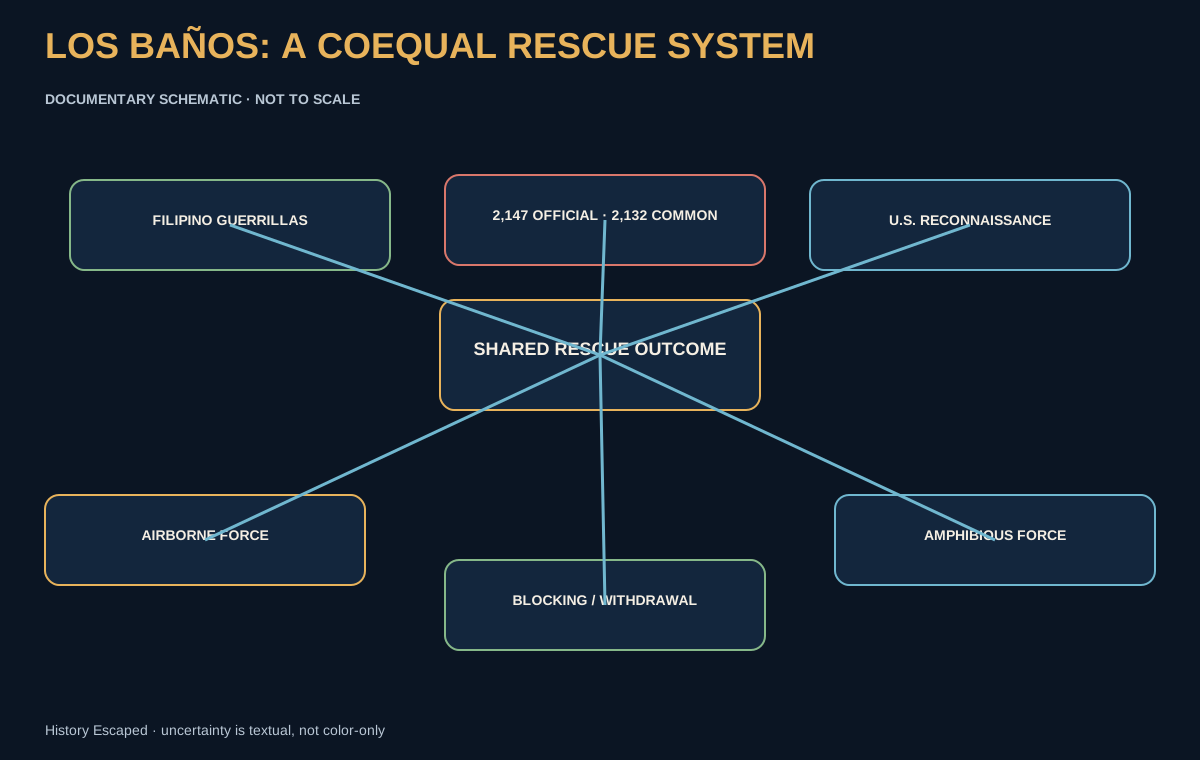
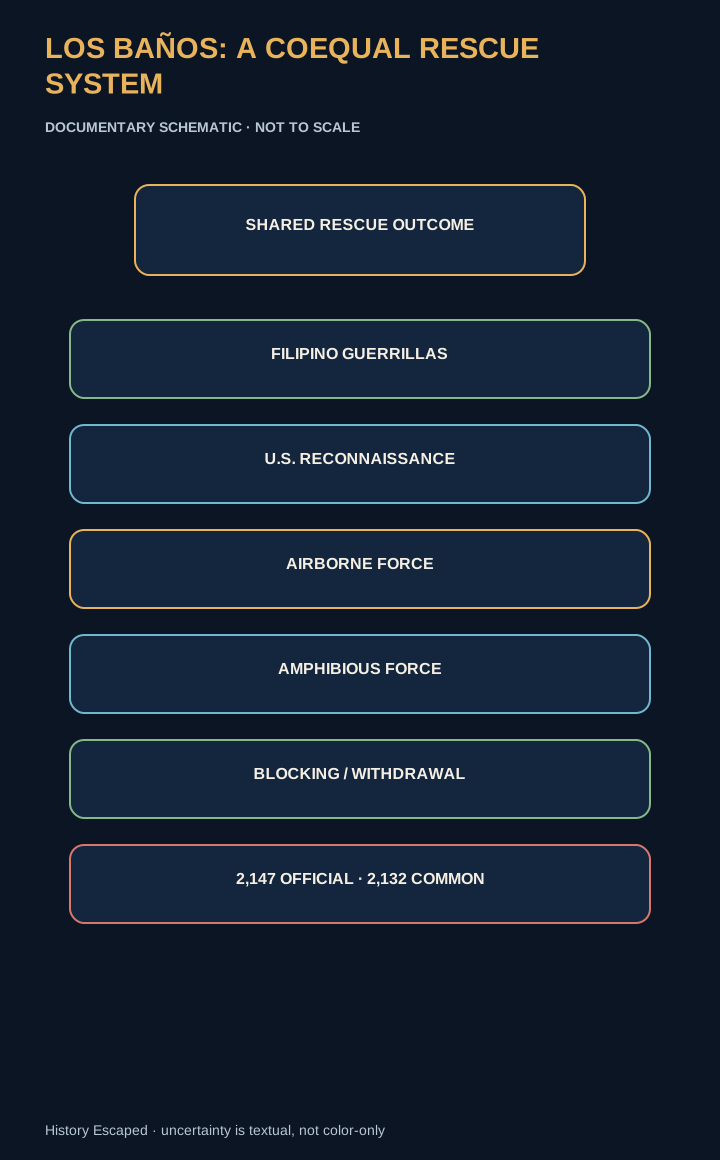
Simplified editorial reconstruction based on the cited historical record; not to scale. Uncertainty is stated directly in the visual and adjacent text.