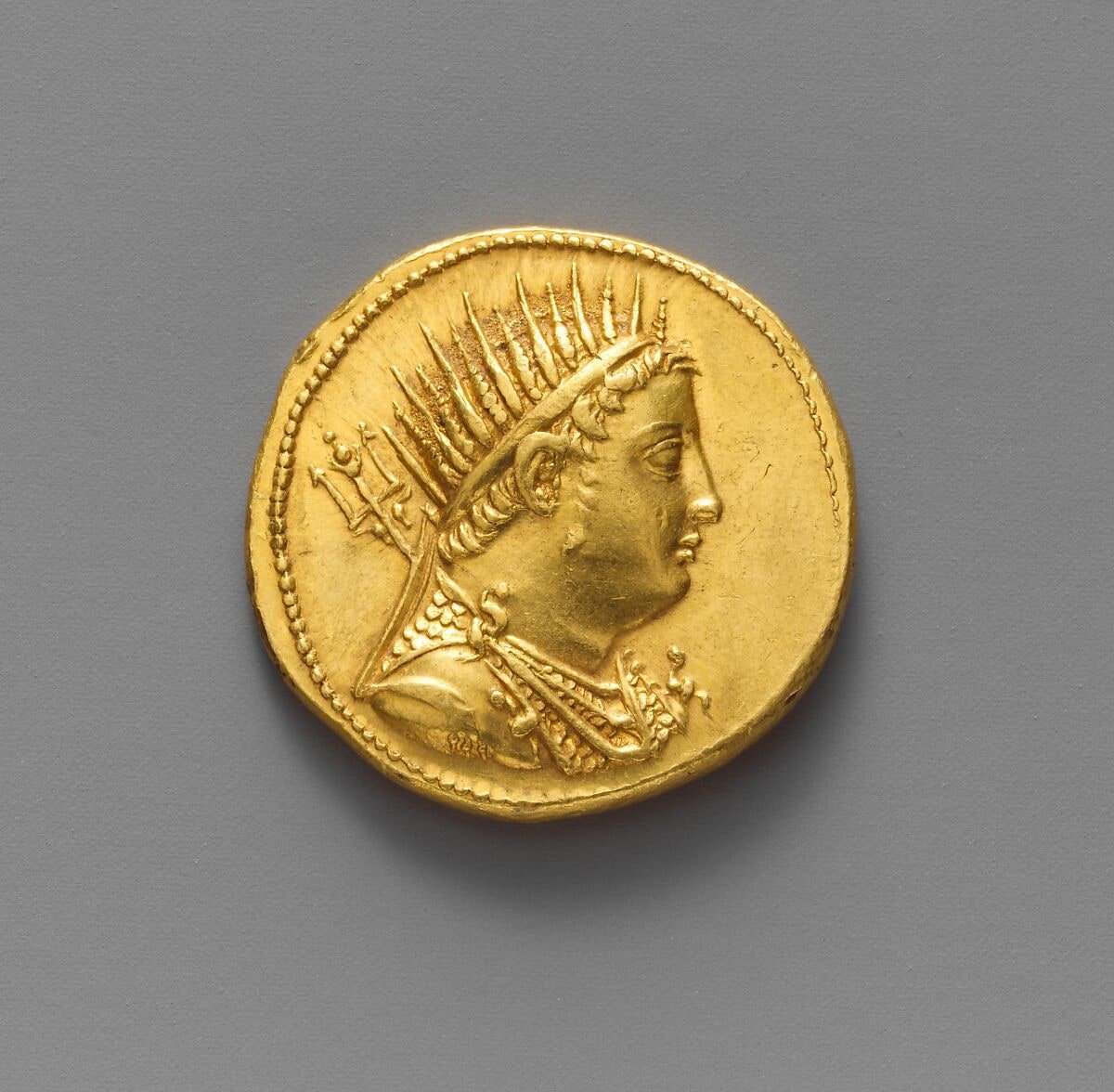
Cleomenes III did escape from Ptolemaic confinement in Alexandria. What followed, however, was not a successful flight from Egypt.
The former king of Sparta had come to Alexandria after his defeat at Sellasia in 222 BCE, hoping that Ptolemy III Euergetes would help restore him. Ptolemy III died before that could happen. Under his successor, Ptolemy IV Philopator, Cleomenes went from honored exile to political liability and finally to guarded confinement in a large residence.
In the winter of 220/219 BCE, usually dated to early 219, Cleomenes and a small group of companions deceived their guards, rushed into the streets armed, and tried to turn a breakout into an Alexandrian uprising. The public did not join them. Their attempt to release prisoners from the citadel also failed. With recapture closing in, Cleomenes and his companions killed themselves.
The escape from the house succeeded. The larger attempt to transform that freedom into political survival did not.
From Sellasia to Alexandria
Cleomenes had ruled Sparta during one of the last major attempts to rebuild Spartan military and political power. His reforms and his war against the Achaean League brought him into conflict with Antigonus III Doson of Macedon. In 222 BCE, Antigonus defeated him decisively at Sellasia.
Cleomenes returned briefly to Sparta, advised submission, and fled by sea. He ultimately reached Alexandria, where his mother and children were already in Egypt as hostages connected with his earlier alliance with Ptolemy III.
At first, exile did not look permanent. Plutarch says Ptolemy III came to respect Cleomenes, promised ships and money for a return to Greece, and granted him an annual allowance. Polybius likewise presents Cleomenes as waiting in Egypt because he believed Ptolemy would eventually supply the means to recover his ancestral throne. That expectation died with Ptolemy III late in 222 BCE.
Ptolemy IV and Sosibius
Ptolemy IV inherited the Egyptian throne while still young. Ancient writers are uniformly hostile to him, especially Polybius and Plutarch, and their portraits of a weak, pleasure-driven king need to be read as moralizing political history rather than neutral personality assessment.
The practical change for Cleomenes was clear enough. He repeatedly sought either military support or simple permission to leave Egypt with his household. Ptolemy IV refused to act. Sosibius, the minister who dominated much of the court’s political management, had additional reason to regard the Spartan as dangerous.
Cleomenes had prestige among Greek mercenaries in Alexandria, especially Peloponnesians. Plutarch even has him boast that thousands of them would follow him if he gave the signal. Whether that number represents exact military reality or rhetorical confidence, the court’s fear of his influence is present in both major narratives. A refugee king who wanted to leave was becoming a captive king whom the regime did not dare release.
The Accusation Against Cleomenes
Both Polybius and Plutarch say Sosibius used Nicagoras, a Messenian with an old grievance against Cleomenes, to create the pretext for confinement. The accounts agree on the structure but differ on the precise accusation.
Polybius says Sosibius bribed Nicagoras to leave a letter claiming that Cleomenes intended to revolt against Ptolemy unless he received an expeditionary force. Plutarch’s version says the letter accused Cleomenes of planning to seize Cyrene if he obtained ships and soldiers.
Those are not identical charges. What is common to both narratives is more important for the custody question: the letter was presented to Ptolemy as evidence of a dangerous conspiracy, and Cleomenes was then placed under guard.
Pausanias, writing much later, compresses the episode further and says Cleomenes was imprisoned after being convicted of stirring Egyptians against the king. That formulation appears to collapse accusation, confinement, and the later uprising into a single retrospective summary.
House Arrest—or a Large Jail?
“House arrest” is acceptable modern shorthand, but Polybius is more precise. He says Cleomenes was placed in a huge house under watch and ward, differing from ordinary prisoners only because his jail was larger. Plutarch similarly says Cleomenes was transferred into a large house, treated outwardly as before, but no longer permitted to leave.
This was not comfortable voluntary residence. Cleomenes had guards, restricted movement, and no realistic expectation that Ptolemy would simply let him depart for Greece. In Plutarch’s version, he overheard a courtier rebuking the guards for watching him too carelessly, which convinced him that the confinement would only become tighter. The case is therefore best described as guarded house confinement under Ptolemaic authority.
The Release Rumor
The breakout depended on making the guards believe that Cleomenes was about to be released legitimately. Both Polybius and Plutarch say Ptolemy IV happened to be away at Canopus when Cleomenes acted. Cleomenes’ circle spread a report that the king had ordered his release.
Plutarch adds an important piece of theater. At the Ptolemaic court, people about to be released supposedly received gifts and a meal from the king. Cleomenes’ friends therefore sent provisions into the house as though they were royal release gifts.
Cleomenes sacrificed, feasted, and shared the food and wine generously with the guards. Polybius gives the same basic mechanism: release rumor, entertainment, gifts, guards drinking freely. The deception worked.
Midday Breakout
By midday the guards were incapacitated enough for the group to move. Polybius says Cleomenes took the friends and servants with him and rushed out unnoticed, armed with daggers. Plutarch gives more detail: Cleomenes and thirteen friends emerged armed, implying a breakout party of fourteen men including Cleomenes.
Some older English translations render the number less clearly, but the modern Loeb translation explicitly describes thirteen friends accompanying him. Fourteen is therefore the best-supported total, while the number remains tied to Plutarch rather than Polybius.
Plutarch also says Cleomenes acted earlier than intended because a servant who knew the plot had spent the night outside the house and might reveal it. That detail does not appear in Polybius and is best treated as a later biographical addition rather than a necessary part of the core escape.
One companion, Hippitas, was lame. Plutarch says the group commandeered a passing horse for him so that he would not slow the breakout. The fugitives then entered the streets of Alexandria.
Escape Becomes Revolt
Cleomenes was not trying merely to disappear into the city. Both major sources say he called on the Alexandrians to rise for their freedom. The goal had shifted from escaping confinement to creating a political revolt large enough to protect the fugitives and overturn the situation that had trapped them.
No crowd joined. This failure is central to the case. Alexandria was a huge, politically active Hellenistic capital, but Cleomenes’ prestige among Greek mercenaries did not translate automatically into a popular revolutionary following. The breakout had been sudden, and the public had no reason to risk itself for a defeated foreign king. The group remained isolated.
What Happened to the Ptolemaic Officials?
Here Polybius and Plutarch diverge sharply. Polybius says Cleomenes’ men encountered Ptolemy, the official left in charge of the city. They intimidated his attendants, dragged him from his chariot, and confined him.
Plutarch instead describes two violent killings. He says three of the Spartans killed Ptolemy son of Chrysermus, then the group attacked another Ptolemy who was in charge of the city, scattered his attendants, dragged him from his chariot, and killed him too.
The two accounts cannot simply be combined. The evidence supports stating that Cleomenes’ breakout party violently confronted senior Ptolemaic personnel almost immediately after reaching the streets. Whether one official was detained, or two officials were killed as Plutarch says, remains source-dependent. That distinction matters because later summaries often present the two killings as uncontested fact.
The Citadel and the Prisoners
The next objective is much clearer. Cleomenes and his companions headed for the citadel or prison complex, hoping to force it open and release the prisoners inside. Those prisoners could have transformed a tiny armed group into something much harder for the authorities to contain.
The guards reacted first. Polybius says they learned of the plan and secured the gates. Plutarch similarly says the entrances were barred before Cleomenes arrived.
The failed prison release effectively ended the uprising. The Alexandrian population had not joined. The prisoners could not be freed. The fugitives were exposed in the city without a large force, secure refuge, or clear route out of Egypt. Their successful escape from the house had produced only a few hours of freedom.
The End of the Breakout
Polybius says that after the attempt to raise the city and open the prison failed, Cleomenes and his companions died by their own hands. Plutarch gives a much more elaborate scene. He says Cleomenes called on the group to die in a manner worthy of their past, then describes the companions killing themselves one after another. Panteus, Cleomenes’ close associate, was supposedly instructed to make sure the others were dead before killing himself last.
That detailed death scene likely reflects the strongly pro-Cleomenes tradition associated with Phylarchus, one of Plutarch’s major sources for this life. It is vivid, morally charged, and designed to end the biography with a distinctly Spartan tableau.
The core outcome does not depend on every detail of that tableau. Cleomenes escaped confinement, failed to build a revolt, and died with his remaining companions before the Ptolemaic authorities could restore control over him.
What Happened to His Family?
Plutarch continues beyond Cleomenes’ death with an especially grim aftermath. He says Ptolemy ordered Cleomenes’ body mutilated and publicly displayed and then ordered the execution of his mother, children, and the women associated with his followers.
Polybius’ surviving account of the breakout ends without that extended family scene. The execution of Cleomenes’ family is widely accepted in later historical treatments, but the most dramatic details of Plutarch’s presentation should still be recognized as coming through a biographer writing centuries later and drawing heavily on a Cleomenes-friendly historian.
For the escape itself, the important consequence is simpler: there was no surviving political restoration. Cleomenes’ Alexandrian gamble destroyed the last realistic possibility of his return to power.
How Reliable Are the Two Main Narratives?
Polybius is the earlier surviving historian and places the episode inside his history of the Ptolemaic crisis of 219 BCE. He was born not long after these events and wrote from an Achaean political background that was hardly sympathetic to Cleomenes’ earlier war against the Achaean League.
Yet Polybius ends his account with notable respect for Cleomenes’ abilities. Plutarch wrote centuries later. His Life of Cleomenes drew substantially on Phylarchus, a third-century historian who favored Cleomenes and whom Polybius attacked for partisanship and sensationalism.
That source relationship explains why Plutarch often supplies a more dramatic scene: the overheard insult, the servant who endangered the conspiracy, Hippitas’ crisis, two official killings, speeches in the streets, and the carefully staged sequence of suicides. It does not mean those details are automatically false. It means the overlap between Polybius and Plutarch should carry the greatest weight, while details unique to Plutarch deserve a lower ceiling of certainty.
What the Record Supports
Cleomenes III was confined by the Ptolemaic government in a large guarded residence at Alexandria after court officials came to regard him as a political threat. In early 219 BCE, while Ptolemy IV was at Canopus, Cleomenes’ circle spread a false report that the king had ordered his release. Food, gifts, and wine helped reinforce the story and neutralize the guards.
Cleomenes then emerged with a small armed party—best reconstructed from Plutarch as Cleomenes plus thirteen companions. They successfully left the guarded house.
They did not successfully escape Alexandria. Instead, they tried to raise the city, clashed with Ptolemaic authority, attempted to free prisoners from the citadel, failed to gain public support, and ended their lives when the revolt collapsed. For an escape archive, that distinction is the center of the case: the confinement was breached; the wider bid for freedom failed.
Evidence discipline
What the record supports
Status labels distinguish secure conclusions from uncertainty and rejected claims. Color is never the only signal.
MYTH
Cleomenes was merely a guest who could leave Alexandria whenever he wished.
Polybius says he was kept under watch in a huge house that differed from ordinary imprisonment mainly in size; Plutarch says he was not permitted to leave.
Sources: SRC-001, SRC-002MYTH
The accusation used to confine Cleomenes is preserved identically in Polybius and Plutarch.
Polybius says the letter alleged a planned revolt against Ptolemy if support were refused; Plutarch says it alleged a plan to seize Cyrene with ships and soldiers.
Sources: SRC-001, SRC-002DISPUTED
Cleomenes escaped with exactly thirteen people total.
Some older English translations can read this way, but Perrin’s modern Loeb translation states that thirteen friends accompanied Cleomenes, implying fourteen men total; Bevan adopts the same interpretation.
Sources: SRC-002, SRC-006DISPUTED
Cleomenes’ party unquestionably killed two Ptolemaic officials after the breakout.
Plutarch says two officials were killed. Polybius instead says the city official Ptolemy was dragged from his chariot and confined and does not describe the same two-killing sequence.
Sources: SRC-001, SRC-002MYTH
The public of Alexandria joined Cleomenes in revolt.
Both Polybius and Plutarch say the population refused to join the small armed group.
Sources: SRC-001, SRC-002MYTH
Cleomenes successfully escaped Egypt.
He escaped the guarded house but remained in Alexandria, where his attempted uprising failed and he died the same day.
Sources: SRC-001, SRC-002, SRC-004UNKNOWN
Plutarch’s detailed final suicide scene is independently corroborated in every detail.
The broad suicide outcome agrees with Polybius, but Plutarch’s sequence involving Hippitas, Panteus, and individual deaths is much more elaborate and reflects a later Cleomenes-friendly biographical tradition.
Sources: SRC-001, SRC-002, SRC-005Evidence diagram
A successful escape and a failed revolt
Cleomenes and thirteen companions escaped the guarded house; the urban rising that followed ended in defeat.
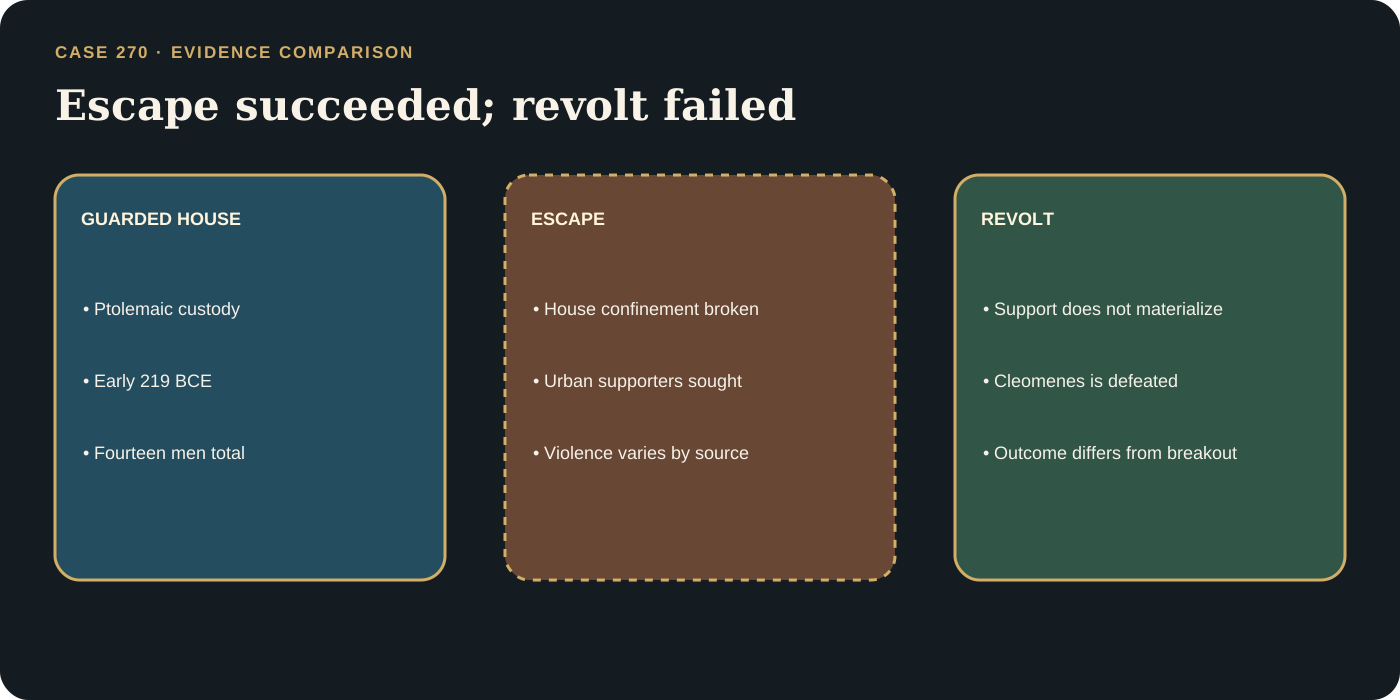
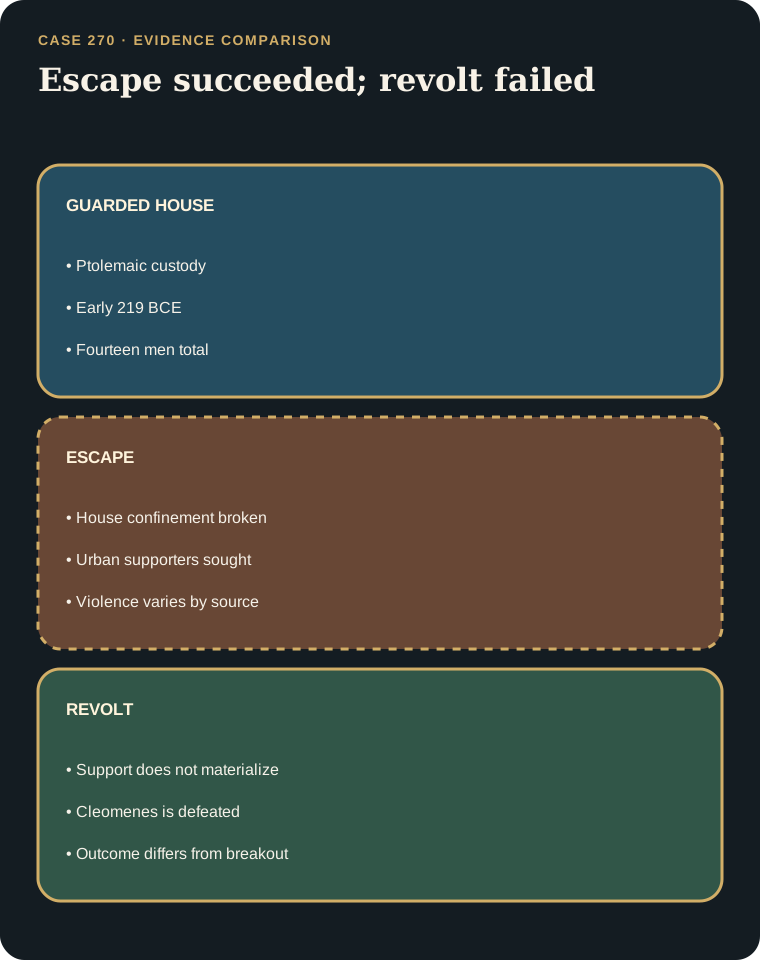
Cleomenes and thirteen companions escaped the guarded house; the urban rising that followed ended in defeat.