
Henry of Navarre’s departure from the French court in early February 1576 was an escape, but not from a conventional prison. Since the St. Bartholomew’s Day Massacre of August 1572, the young king of Navarre had lived under a changing mixture of coercion, surveillance, royal favor, political usefulness, and occasional formal detention. France’s Château de Pau describes the condition as semi-captivity, while modern scholarship has also described him as a closely supervised captive.
Henry nevertheless remained a king in his own right and a prince of the blood. He appeared at court, traveled with the royal household, joined royal ceremonies and military activity, maintained a household, and cultivated political relationships. Yet he had survived the massacre under intense pressure to abandon Protestantism, could not simply return to his own territories, and was watched closely enough that earlier plans to leave had failed. In February 1576, he finally used the freedom available to a royal courtier against the surveillance intended to keep him near the Valois court.
At a Glance
- Escape: early February 1576
- Best specific early date: Pierre de L’Estoile places Henry’s departure from Paris on 3 February
- Control: the Valois royal court under Charles IX, Catherine de’ Medici, and later Henry III
- Status: semi-captive royal prince rather than continuously imprisoned prisoner
- Immediate pretext: a hunting excursion toward Senlis
- Core method: cultivate trust, leave under an ordinary aristocratic pretext, then separate from royal supervision
- Destination: first toward Alençon and Malcontent-controlled territory, later toward western and southwestern networks
- Religious consequence: repudiated the Catholic conformity imposed after 1572; a formal public return to Calvinism followed later in 1576
- Political consequence: recovered personal and political independence
The massacre that changed his status
Henry had arrived in Paris in 1572 for a marriage intended to help reconcile France’s Catholic and Protestant elites. He was already king of Navarre after the death of his mother, Jeanne d’Albret, and on 18 August he married Margaret of Valois, sister of King Charles IX. Less than a week later, on 24 August, the St. Bartholomew’s Day Massacre began.
Prominent Huguenots gathered in Paris were killed, and the violence spread beyond the capital. Henry survived, as did his cousin Henry of Condé, but survival came with intense religious and political pressure. Modern source criticism places Henry’s formal public abjuration of Protestantism on 26 September 1572, after more than a month of pressure rather than in the first hours after the massacre.
The conversion story is therefore more complicated than a simple instant choice between conversion and death. Henry resisted for a period and then publicly conformed. Later, once beyond court control, he described the religious change as coerced. His new public Catholic identity also had political consequences, including pressure to restore Catholic worship in his Béarnese territories even though he could not freely return there to govern.
Was Henry really a captive?
Henry did not spend the years from 1572 to 1576 behind bars. He retained his title, moved with the court, participated in elite social life, and accompanied royal military activity, including the siege of La Rochelle in 1573. That mobility makes a literal description of him as a four-year prison inmate misleading, but it does not mean he was fully free.
The crown had powerful reasons to keep him close. Henry was a sovereign king through Navarre, a senior Bourbon prince, a potential leader of the Huguenot party, and a politically valuable hostage after much of the Protestant leadership had been killed or dispersed. His return to his own territories would have restored an independent center of power to the Reformed cause.
The degree of control also changed over time. During the Malcontents conspiracy crisis of 1574, Henry and François, duke of Alençon, were deprived of their swords, placed under arrest at Vincennes, and formally interrogated. Henry’s surviving deposition of 13 April shows that he had already contemplated leaving court because he feared for his safety and wanted to return to Béarn and Navarre.
Henry III later publicly restored the princes’ liberty, but Henry of Navarre’s political independence remained sharply constrained. The Château de Pau’s description of semi-captivity captures the situation more accurately than either “free courtier” or “ordinary prisoner.”
Learning how to look harmless
The 1576 escape became possible partly because supervision relaxed. François of Alençon had escaped in September 1575 and joined the broad Malcontent opposition, yet Henry of Navarre did not immediately follow him. Instead he cultivated the impression that he was estranged from Alençon and had no intention of returning to the Protestant camp.
Pierre de L’Estoile later emphasized how successfully Henry reassured even hard-line Catholics. He conspicuously associated with Henry of Guise and other men who had strong reasons to distrust a Bourbon prince with Huguenot connections.
A private letter written to Miossens shortly before the escape shows that the apparent normality of court life concealed a dangerous atmosphere. Henry described a court divided by faction and men carrying weapons beneath their clothes. By early 1576, however, he had gained enough room to move that an ordinary aristocratic activity could serve as the beginning of a flight.
The hunting pretext
The exact date attached to the escape varies because different histories count different stages. Pierre de L’Estoile places Henry’s departure from Paris on Friday, 3 February 1576, under the appearance of going hunting toward the forest of Senlis, and says that he hunted there the following day.
The decisive break came after the hunt. Henry sent Saint-Martin, a gentleman attached to him by Henry III, back toward the king carrying a message. Later reconstructions drawing on Agrippa d’Aubigné add a second royal watcher who was also sent away. Once the men expected to report on him were separated from the party, Henry continued away from court with trusted companions.
This helps explain why neighboring dates appear in later chronologies. One date can mark the departure from Paris, another the moment he ceased acting as a supervised courtier near Senlis, and another the point at which the flight was recognized as irreversible. The most defensible public formulation is therefore early February 1576, with L’Estoile’s 3 February departure preserved as the strongest specific anchor.
Leaving Margaret behind
Margaret of Valois’s memoir adds a personal detail without controlling the calendar. She remembered that Henry rose before she was awake and left without saying goodbye, despite apparently having promised her brother that he would speak to her before departing. Written later, the memoir is evidence of Margaret’s recollection rather than a contemporary timetable.
The decision left her in an awkward political position: she was both the French king’s sister and the wife of the king who had just fled royal supervision. The escape was not a clean transfer of an intact royal household from one court to another. Henry deliberately departed without his wife and without openly declaring his intention until he was beyond immediate control.
From Senlis toward Alençon
Later reconstructions drawing on L’Estoile and d’Aubigné describe a small escort including figures such as Lavardin, Fervaques, La Valette, and other trusted noblemen, but the precise membership expands in later retellings. The broad route is more secure than a definitive companion count.
Henry moved away from Senlis, crossed the Seine west of Paris, pushed through the Beauce, and reached the political sphere around Alençon. A surviving letter written by Henry on 13 February 1576 from Beaumont-le-Vicomte confirms that he was moving through the region and intended to pass Le Mans on his way toward La Flèche.
That letter is a valuable post-escape anchor because it comes from Henry himself. By then the French court could negotiate with him and threaten him, but it could no longer supervise his daily movements.
Religion after freedom
Popular summaries often compress the religious aftermath into a single moment in which Henry escapes and immediately “becomes Protestant again.” The evidence supports a more layered sequence.
L’Estoile presents Henry as rejecting the Catholic conformity forced on him and participating in Reformed worship soon after reaching areas outside direct court control. Henry also publicly characterized his earlier change of religion as the product of force and constraint.
Modern scholarship, particularly Ronald Love’s study of Henry’s religious conscience, distinguishes those early repudiations from a formal public return to Calvinism on 13 June 1576. The delay was politically useful: Henry needed Protestant support, but he also depended on Catholic Malcontents and had reason not to turn his flight immediately into a narrowly sectarian defection.
This distinction also clarifies the years at court. Henry’s public Catholic practice after 1572 does not by itself reveal his private convictions, just as his political caution after the escape does not mean that he intended to remain Catholic permanently.
Beaulieu and recovered autonomy
Henry’s flight occurred during the Fifth War of Religion, when Henry III already faced pressure from the duke of Alençon, the prince of Condé, Protestant armies, moderate Catholic Malcontents, and German forces entering France. Henry’s escape added another autonomous Bourbon prince to that opposition.
The conflict ended temporarily with the Peace or Edict of Beaulieu on 6 May 1576. The settlement made major concessions to Protestants and Malcontents, and Henry obtained the government of Guyenne. Freedom did not instantly make him undisputed leader of the Huguenot cause—Condé had exercised leadership while Henry was trapped at court, and Protestants had reason to be cautious toward a prince who had publicly lived as a Catholic for more than three years.
What the escape restored was Henry’s ability to build authority on his own terms. He could govern in the southwest, assemble followers from both confessions, and develop the independent Bourbon position that later became central to the French Wars of Religion.
Why “court captivity” still fits
“Court captivity” works only if the phrase is explained. Henry’s condition after 1572 was neither a four-year dungeon sentence nor simple voluntary residence with his royal in-laws. His prestige required visible freedom, while his political importance made the crown unwilling to let him act independently.
At moments, especially in 1574, restraint became formal imprisonment. At other times it operated through household supervision, royal orders, controlled movement, religious pressure, and the danger attached to an openly Protestant departure. The structure of the 1576 escape reflects exactly that kind of confinement: Henry did not need to break a lock or cross a prison wall; he needed ordinary movement to look harmless until the people assigned to watch him no longer controlled where he went next.
The secure sequence is stronger than the adventure stories later built around it: coercion after the massacre, semi-captivity at court, formal arrest in 1574, deliberately cultivated trust, a hunting excursion toward Senlis, separation from royal supervision, and movement into territory where Henry could again act as an independent king. His escape succeeded because court captivity depended on keeping a prince close without making him look like a prisoner.
Evidence discipline
What the record supports
Status labels distinguish secure conclusions from uncertainty and rejected claims. Color is never the only signal.
MYTH
Henry of Navarre was continuously imprisoned in a cell from 1572 to 1576.
He retained royal rank and substantial court mobility. His condition is better described as semi-captivity or closely supervised royal residence, punctuated by formal arrest in 1574.
Sources: SRC-001, SRC-002, SRC-004MYTH
Henry was fully free at the Valois court after his public Catholic conformity.
His political independence, religious profession, and ability to return to his own territories remained constrained.
Sources: SRC-001, SRC-002, SRC-005DISPUTED
The escape has one uncontested exact date.
L’Estoile dates the departure from Paris to 3 February, while later chronologies use neighboring dates depending on which stage they call the escape.
Sources: SRC-006DISPUTED
Henry openly reverted to Protestantism at one single moment immediately after leaving Paris.
He quickly repudiated coerced Catholic conformity and participated in Reformed worship, but modern scholarship distinguishes those acts from a formal public Calvinist declaration on 13 June 1576.
Sources: SRC-002, SRC-006MYTH
Henry’s 1572 conversion was a simple voluntary change of belief.
Contemporary and modern source-critical evidence documents intense pressure after the massacre, and Henry later characterized the change as forced.
Sources: SRC-002, SRC-003, SRC-006MYTH
The hunting story is a late romantic invention with no early basis.
L’Estoile’s account explicitly connects Henry’s departure with a hunting excursion near Senlis.
Sources: SRC-006Documentary reconstruction
Court mobility within coercive control
A case-local editorial visual clarifies the evidence structure without adding false precision or reusable operational detail.
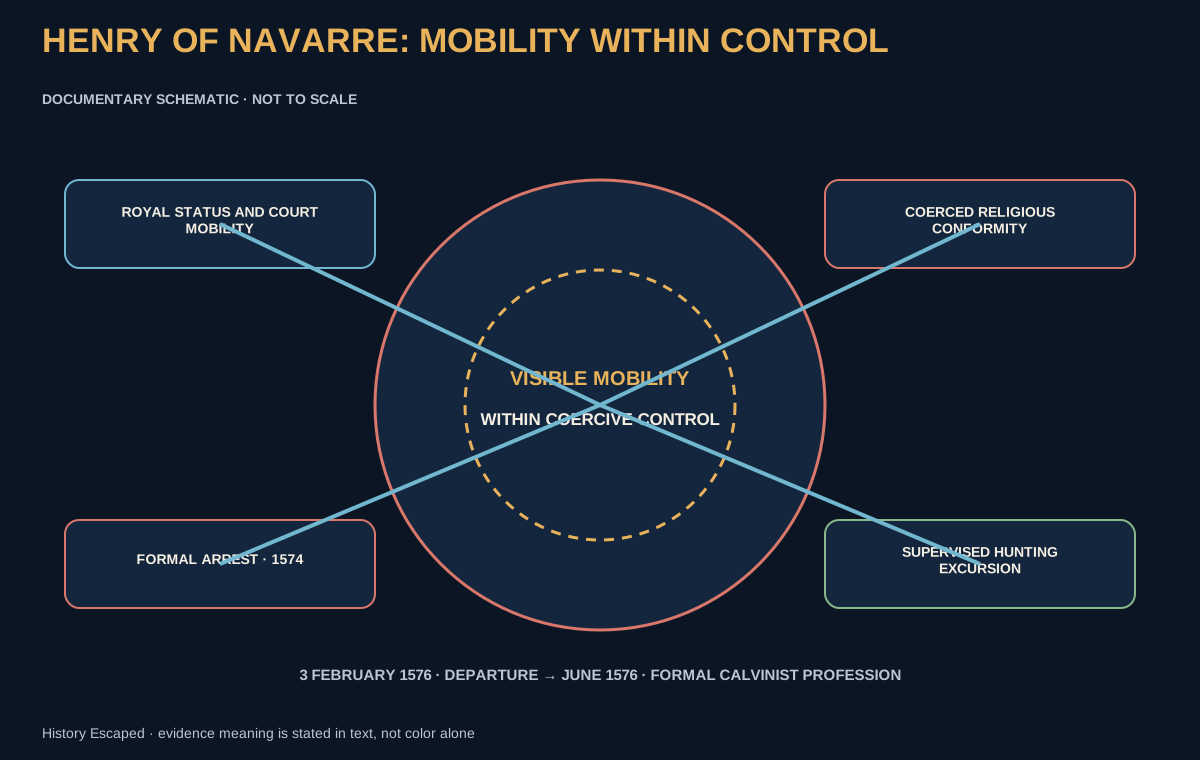
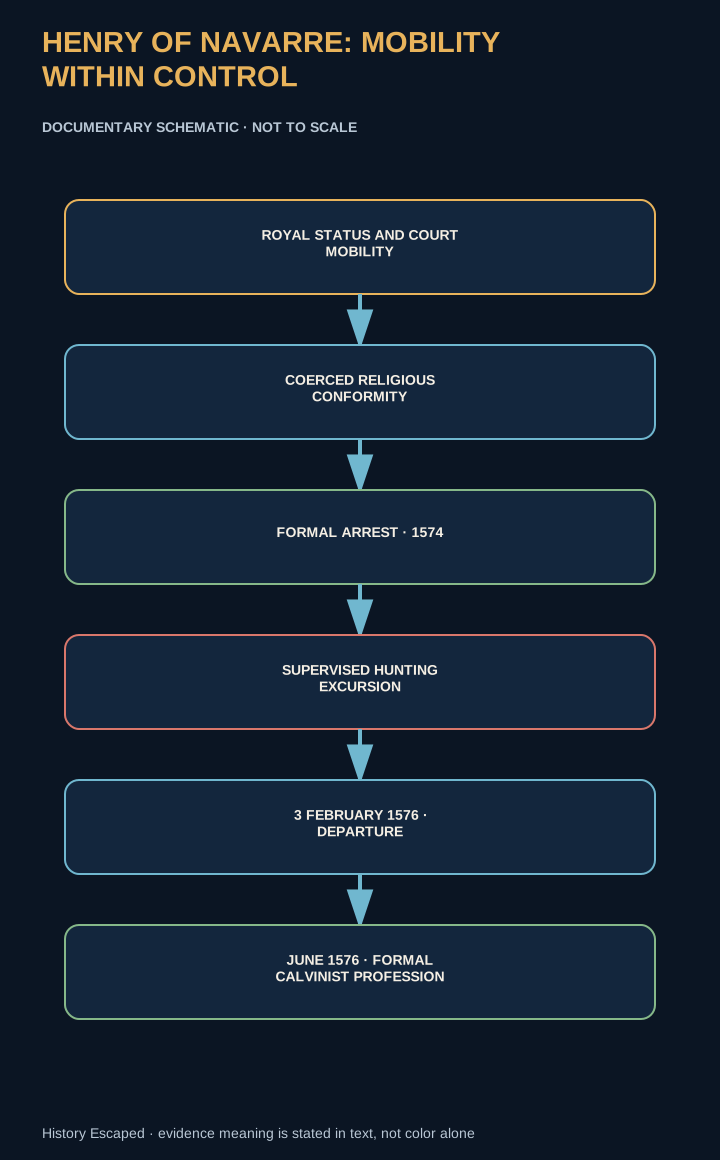
Simplified evidence-led editorial reconstruction based on the cited record; not to scale. Uncertainty is stated directly in the visual and adjacent text.
