
Josiah Henson’s escape began with a decision about jurisdiction.
He had already seen that moving north inside the United States did not necessarily mean safety. Free states existed, but Henson believed people acting for enslavers could still pursue him there. Canada, by contrast, lay outside the United States and offered the stronger protection he wanted for himself, his wife, and their children.
So in 1830 he chose a destination beyond the national border.
The journey that followed was not a lone dash by one man. Henson escaped with his wife Charlotte and four children. They crossed the Ohio River at night, moved through Indiana and Ohio, endured hunger and exhaustion, accepted help when it appeared, found passage across Lake Erie, and finally crossed from Black Rock to the Upper Canadian settlement of Waterloo, near present-day Fort Erie.
Henson later dated that last crossing to 28 October 1830.
The broad outline is well established. The fine detail requires more caution. Most of what we know about the route comes from Henson’s autobiography, dictated and published in 1849—nineteen years after the event. It is a powerful primary source, but it is also memory.
That distinction matters because this is a story in which later retellings have often become cleaner than the evidence.
Why Henson Finally Chose Escape
Henson had been born into slavery in Maryland in 1789. By the 1820s, he had become a trusted manager for the Riley family and a Methodist preacher. That trust did not make him free.
In 1825 he was ordered to move a group of enslaved people west from Maryland to Kentucky. Henson later emphasized a painful irony: during that journey he passed through free territory and could have fled, but he believed he had given his word to deliver the group and completed the assignment.
The next years changed his calculation.
Henson tried to purchase his freedom. His 1849 narrative describes raising money while preaching and negotiating what he believed was a price for manumission. He then discovered that Isaac Riley had changed the terms and demanded substantially more. Later, Henson was taken south toward New Orleans, where he expected to be sold. Illness in the Riley family disrupted that plan and returned him to Kentucky.
By then, Henson no longer believed loyalty or payment could secure his family. He decided to leave.
Six People, Not One
The logistics immediately made the escape harder than a typical story of individual flight.
Charlotte and Josiah had four children with them. Henson’s account says the two youngest were small enough that he expected to carry them. Charlotte would manage another child, while the oldest boy could walk and help with provisions.
He even remembered practicing with the youngest children in a large knapsack before the escape.
The point was not athletic preparation for its own sake. Every mile of the route had to work for a family.
Henson later wrote that Charlotte initially resisted the plan because of the danger. He argued that remaining in Kentucky left them exposed to something just as frightening: separation through sale.
Eventually she agreed. The family would go together.

Across the Ohio River
Henson placed the departure at about the middle of September 1830.
He arranged to bring his oldest son away from the main house under an ordinary pretext. After dark, the family assembled near the Ohio River. An unnamed enslaved man agreed to row them across in a small skiff.
That helper took an enormous risk. Assistance to freedom seekers could bring severe punishment.
Henson’s 1849 account preserves a conversation between the two men before the crossing, but the exact words belong to retrospective memory. The secure historical point is simpler: another enslaved man helped put the family on the Indiana side of the river.
Crossing into Indiana mattered, but it did not end the escape. The family was still in the United States.
Night Travel and Concealment
Henson remembered traveling mainly at night and resting or hiding during the day.
The reason was obvious. A Black family moving north through rural country could attract questions, and Henson believed capture remained possible even beyond Kentucky.
The pace was slow.
His account says it took nearly two weeks to reach Cincinnati. Their food dwindled before they arrived. At one point, Henson risked approaching houses in daylight to buy something for Charlotte and the children. He tried to disguise the direction of travel by appearing to move south before doubling back north out of sight.
At Cincinnati, the pattern changed briefly. Henson wrote that the family was received kindly, allowed to rest for several days, and then carried about thirty miles farther by wagon.
This is one reason the escape should not be reduced to either extreme: it was neither entirely unaided nor a perfectly organized relay from station to station. For long stretches, the family navigated alone. At critical moments, help changed what was possible.
Hull’s Old Military Road
Farther north, Henson aimed for a route associated with General William Hull’s War of 1812 campaign. He had been told that once they reached the Scioto area they could find the old military road and travel more openly during the day. The road did not solve the family’s basic problem of food.
Henson remembered entering a sparsely settled stretch expecting to find supplies and discovering instead a rough wilderness road. Charlotte became exhausted. The children were hungry. The family’s remaining food was nearly gone.
It was during this stretch that Henson recorded one of the most significant episodes of outside assistance in his entire escape.
Help from an Indigenous Community
Henson described encountering several Indigenous travelers on the road and then reaching their community.
His narrative is written in the racial language and assumptions of a nineteenth-century Black abolitionist narrator, and some of its observations should not simply be reproduced as neutral description. What matters for the escape is what happened after the encounter.
According to Henson, the community learned that the family was traveling north and needed help. They fed them, gave them a place to sleep, told them how far they were from Lake Erie, and sent people to show them where to turn.
The National Park Service highlights the episode as an example of Indigenous participation in the wider history of resistance to slavery and assistance to freedom seekers. The sources used here do not securely identify the nation Henson met. That uncertainty should remain visible. What is clear is the function of the assistance: at a point when the family was exhausted and short of food, they received shelter, nourishment, and directions that helped them continue toward Lake Erie.
Sandusky: A New Kind of Risk
After leaving the military road, the family approached the Sandusky area. Henson hid Charlotte and the children and went ahead alone to investigate.
Near the lakeshore he found men loading a vessel. Instead of immediately asking for escape assistance, he joined the work. He soon spoke with a Black laborer and then with the captain.
Henson told the captain what he was trying to do. The captain agreed to help. Henson remembered his name as Captain Burnham.
Burnham’s offer transformed the final American leg of the escape. Rather than continuing overland toward Buffalo, the family could travel east on Lake Erie.
Henson also remembered the captain warning that people were watching for freedom seekers around Sandusky. To reduce the risk of exposure, the family remained concealed until the vessel had moved off and a small boat returned for them after dark.
That scene comes almost entirely from Henson’s later narrative, so its exact timing and dialogue should not be overstated. But the transport itself is central to the route.
Lake Erie to Buffalo
The vessel carried the family to Buffalo. Henson wrote that they arrived in the evening, too late to make the final crossing into Upper Canada. After weeks of movement, the international border was now only a short distance away.
The next morning, the vessel proceeded to Black Rock, just north of Buffalo. Henson said Burnham placed the family aboard the ferry, paid their fare, and gave him a dollar.
The destination was Waterloo, a small Upper Canadian settlement opposite Black Rock. The historic community later became part of Fort Erie.
A modern visitor can easily imagine the final crossing as a journey across Lake Erie because so much of the preceding travel took place on the lake. Henson’s own account is more specific: the last border passage was the ferry from Black Rock across the Niagara River to Waterloo.
28 October 1830
Henson dated the arrival to the morning of 28 October 1830.
His memoir describes an explosive emotional reaction after stepping onto the Canadian side. He celebrated so intensely that a local man initially thought something was wrong with him. Henson then explained that he was free.
The exact exchange belongs to memoir. The meaning does not.
Upper Canada had not yet abolished every remaining form of slavery in 1830. The province’s 1793 law had limited slavery and prohibited the importation of enslaved people, and later legal precedent strengthened protection for people escaping slavery from the United States. Full abolition across most of the British Empire would take effect in 1834.
For Henson, however, the border represented the protection he had deliberately sought from the beginning.
He had chosen Canada because he believed a foreign jurisdiction gave the family security that a free U.S. state could not.
On 28 October, that calculation became reality.
Not a Simple “Underground Railroad Route”
Henson is rightly part of Underground Railroad history.
After settling in Canada, he himself returned to the United States repeatedly and assisted other people escaping slavery. Parks Canada recognizes him as a conductor, and the National Park Service places him within the same history.
But the phrase can distort his own 1830 escape if it makes readers imagine a mature, continuous organization moving the family from one known station to the next. Henson’s first autobiography describes something less orderly.
The family began by relying on secrecy and its own movement. Assistance came in episodes: the unnamed man who rowed them across the Ohio, people in Cincinnati, the Indigenous community in northern Ohio, a Black worker at Sandusky, Captain Burnham and his crew, and finally the established Black Rock ferry.
The escape was a network in the literal sense that people helped one another. It was not described by Henson as one coordinated chain.
The Problem with “The Real Uncle Tom”
Henson’s later fame created another distortion.
His 1849 autobiography became one of the real-world narratives associated with Harriet Beecher Stowe’s Uncle Tom’s Cabin. Henson later appeared publicly in connection with the novel, and some portraits were even captioned as showing the “original” Uncle Tom.
That language is too simple.
In A Key to Uncle Tom’s Cabin, Stowe presented Henson as a parallel instance whose life helped demonstrate that experiences resembling those in her novel were real. Modern scholarship likewise treats the novel as drawing on multiple people, narratives, legal cases, and abolitionist sources rather than one exact prototype.
Henson’s importance does not depend on being converted into a fictional character’s source. His own record is larger.
After reaching Upper Canada, he became a minister and abolitionist, helped other freedom seekers, and participated in creating the Dawn settlement and the British American Institute. He published his life story and traveled internationally to raise support.
The man who crossed the border in 1830 did not disappear into literary history. He built institutions.
Why the Escape Worked
The family succeeded because Henson adjusted the plan as circumstances changed. He chose a destination that addressed the real danger: not simply getting out of Kentucky, but getting beyond the jurisdiction in which he believed he could be reclaimed. He prepared for the physical demands of moving children. He used darkness and concealment when visibility was dangerous.
He accepted help without depending on one predetermined organization. He shifted from walking to wagon transport when it became available. He followed an old military route through the north. He approached strangers at Sandusky when continuing alone had become less practical.
He used the Great Lakes transport network to reach Buffalo. Then he took the shortest final step that mattered most: across the river and out of the United States. Henson’s later narrative turns that final landing into a moment of celebration. Historically, the more important fact is what had gone into reaching it.
Six people had moved for weeks through a country in which their family could legally be torn apart. On 28 October 1830, that journey ended on the other side of the border.
Escape reconstruction
How the escape unfolded
An evidence-aware sequence of the principal stages.
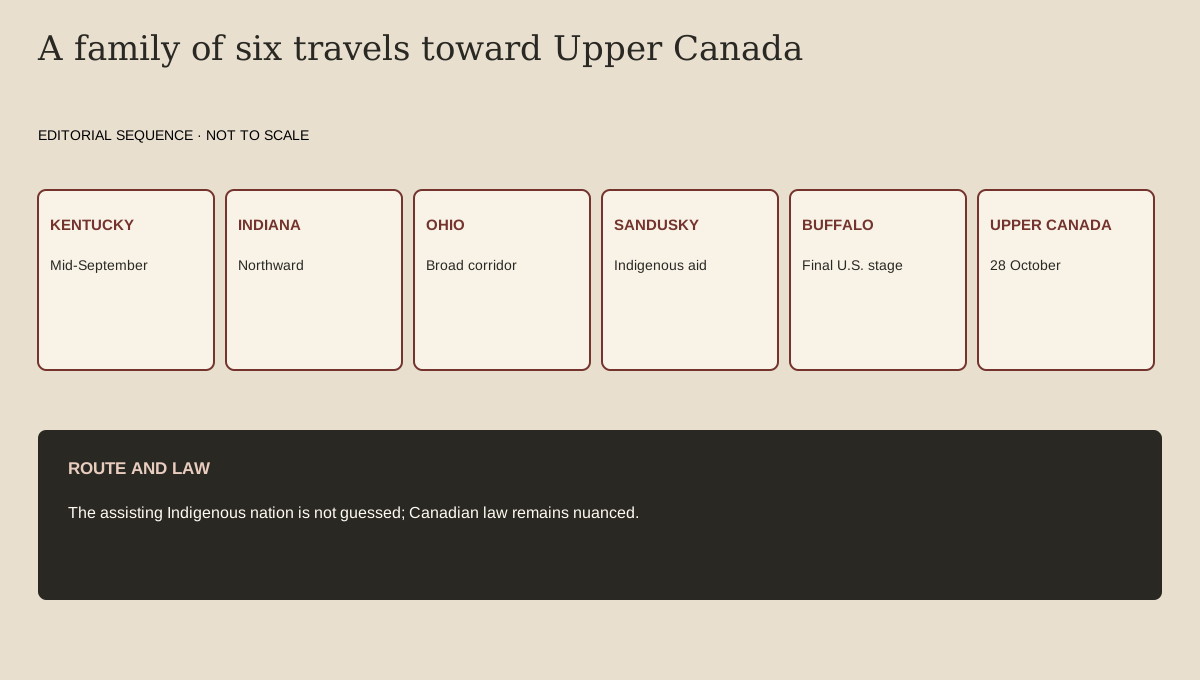
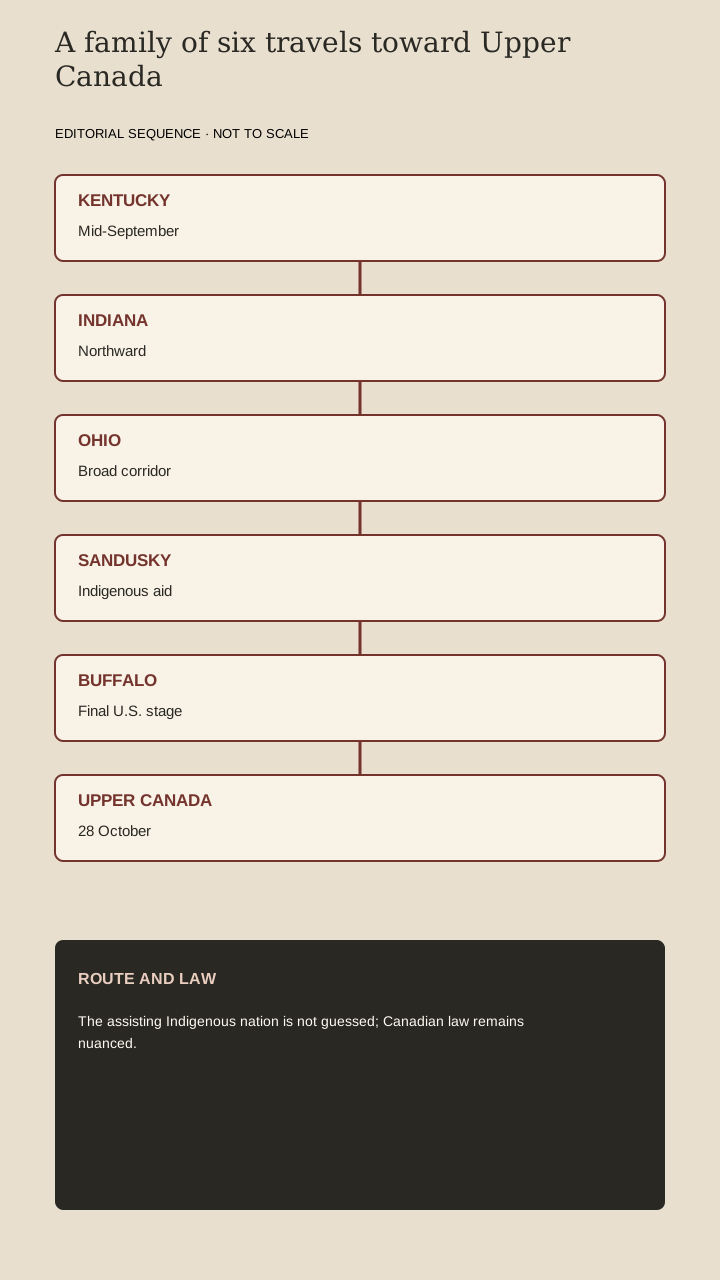
Simplified editorial reconstruction; not to scale. See adjacent text for evidence qualifications and unresolved details.
Material evidence
Tools of Escape
The objects used in an escape reveal how a plan worked under constraint.
- 01Family mobility
Large carrying knapsack
Henson recalled that Charlotte made a large knapsack in which he could carry the two youngest children during parts of the journey.
- 02Initial boundary crossing
Small skiff
An unnamed enslaved man used a small boat to carry the family across the Ohio River from Kentucky to Indiana at the start of the escape.
Problem → response
Escape was a sequence of problems
Each response solved a practical obstacle while often creating the next one.
- 01→
Obstacle
Risk of capture and forced return
Henson believed remaining inside the United States left the family vulnerable even in free states.
Response
The family aimed not merely for a northern U.S. state but for British jurisdiction in Upper Canada.
- 02→
Obstacle
Travel with four children
The escape had to move an entire family, including young children, rather than a single adult traveler.
Response
Henson prepared to carry the youngest children, Charlotte led another child, and the oldest boy could walk and help with provisions.
- 03→
Obstacle
Hunger and exhaustion
Food ran short during the journey and Charlotte and the children were repeatedly exhausted.
Response
The family bought food when possible, rested with helpers in Cincinnati, and later received food and shelter from an Indigenous community in northern Ohio.
- 04→
Obstacle
Exposure near Sandusky
Henson’s account says he feared slave catchers or agents watching the Sandusky area.
Response
Captain Burnham arranged for the family to come out of concealment after dark and board from shore rather than appearing openly at the landing by daylight.
The final accounting
Outcome
Family reached Upper Canada
Josiah Henson, Charlotte, and their four children arrived at Waterloo near Fort Erie on 28 October 1830.
Permanent self-emancipation
Henson remained in British North America and built a new life rather than returning to legal enslavement in the United States.
Later abolitionist leadership
Henson became a minister, abolitionist, Underground Railroad conductor, author, and an organizer of the Dawn settlement and British American Institute.
Evidence discipline
What the record supports
Status labels distinguish secure conclusions from uncertainty and rejected claims. Color is never the only signal.
WELL-SUPPORTED
The family reached Upper Canada on 28 October 1830.
Henson supplied the date in his 1849 narrative, and it is repeated by the Dictionary of Canadian Biography, the U.S. National Park Service, Parks Canada, and Niagara heritage interpretation.
Sources: SRC-001, SRC-002, SRC-003, SRC-006, SRC-009MYTH
The entire escape followed a prearranged, organized Underground Railroad chain from Kentucky to Canada.
Modern institutions reasonably place Henson within Underground Railroad history, especially because of his later work as a conductor. But his 1849 escape narrative describes long stretches of self-directed travel and says the family initially expected to rely on itself, followed by discrete episodes of assistance rather than a continuous station-to-station network.
Sources: SRC-001, SRC-003WELL-SUPPORTED
An Indigenous community in northern Ohio materially assisted Henson’s family.
The episode comes from Henson’s detailed 1849 account and is highlighted by the National Park Service as an example of Indigenous assistance to freedom seekers. The specific nation is not established by these sources.
Sources: SRC-001, SRC-004MYTH
Henson escaped alone.
He escaped with his wife Charlotte and four children. The logistics of moving a six-person family are central to the historical event.
Sources: SRC-001, SRC-002, SRC-003MYTH
Henson was the single real-life model for Harriet Beecher Stowe’s Uncle Tom.
Stowe’s 1853 Key called Henson a 'parallel' instance and drew on his memoir among multiple bodies of evidence. Modern scholarship cautions against reducing the fictional character to one historical prototype.
Sources: SRC-005, SRC-008MYTH
The detailed escape scenes are independently documented contemporaneously in 1830.
The principal detailed narrative was dictated in 1849, nineteen years after the escape. Institutional histories corroborate the broad route and outcome, but many fine-grained scenes, conversations, and measurements rest on Henson’s later recollection.
Sources: SRC-001, SRC-002, SRC-010Selected chronology
Selected chronology
Henson is taken to Kentucky
Henson was charged with moving a group of enslaved people from Maryland to the Kentucky plantation of Amos Riley. He later emphasized that he declined an opportunity to flee during that earlier journey.
Attempt to purchase freedom collapses
Henson’s narrative describes raising money toward his freedom and then discovering that Isaac Riley had altered the terms. A later effort to sell Henson farther south helped convince him that remaining was unsafe.
The family leaves Kentucky
Josiah, Charlotte, and their four children crossed the Ohio River into Indiana at night and began moving north.
Northern Ohio crossing
The family moved through Ohio, used Hull’s former military road, received aid from an Indigenous community, and reached the Sandusky area.
Arrival at Buffalo
A sailing vessel carried the family east along Lake Erie to Buffalo. Henson said it was too late to cross the international border that night.
Freedom in Upper Canada
The family crossed from Black Rock to Waterloo near Fort Erie. Henson identified this as the moment he knew he was free.
First autobiography published
Henson dictated The Life of Josiah Henson, Formerly a Slave, Now an Inhabitant of Canada to Samuel Atkins Eliot, creating the principal detailed source for the 1830 escape.