
Madison Washington and the Creole Revolt: How Captives Seized a Slave Ship in 1841
On the morning of 9 November 1841, the American brig Creole approached Nassau under the United States flag. It was still an American ship. It was no longer following the voyage its owners had planned. Two weeks earlier, the Creole had left Virginia carrying enslaved people toward New Orleans, one of the largest slave markets in the United States.
Now the ship was entering a British colony where slavery had been abolished. The change in course had been forced by people the ship was carrying for sale. Two nights earlier, a group led by Madison Washington had seized control.
One white slaving agent had been killed. The captain had been badly wounded. The rebels had forced the surviving officers to abandon the route to New Orleans and steer for the Bahamas.
Their problem was no longer how to control the vessel. It was whether freedom would exist when they reached land.
A Slave Ship Inside the United States
The transatlantic importation of enslaved people into the United States had been prohibited by federal law beginning in 1808. Slavery did not shrink because of that law. The domestic trade expanded. Slave traders moved people from older slave states in the Upper South toward plantation regions and markets farther south and west.
Richmond became an important center of that trade. New Orleans became its most famous market. Ships moved human beings down the Atlantic coast and around Florida into the Gulf. The Creole was part of that system.
It was not sailing illegally across the Atlantic to import people from Africa. It was operating within a legal American market that treated people born in the United States as saleable property. For the people aboard, the distinction offered no freedom. The destination was forced sale.
The Voyage Begins
The Creole left Richmond at midnight on 25 October 1841 under Captain Robert Ensor. People and cargo were added as the vessel moved toward open water. The best-supported total is 135 enslaved captives. That number is not perfectly uniform across every modern source.
Some later book and museum summaries use 137 or another nearby loading-stage figure. The National Archives coastwise manifests, however, contain 84 names on one list and 51 on another. Together:
135
Historian Anita Rupprecht likewise uses 135 as the voyage count. That is the controlling figure used here.

Who Was Madison Washington?
Washington's earlier life is only partly recoverable. What can be reconstructed is remarkable. He had already escaped slavery once. By late 1839, Washington had reached Canada.
He was outside the immediate reach of the American slave system. Then he went back. In early 1841 Washington travelled south through Philadelphia and into Virginia because he was searching for his wife. Black abolitionists warned him that returning was extraordinarily dangerous.
He returned anyway. He was captured. Washington was then sold to Thomas McCargo, a Virginia slave trader. Within months, he was aboard the Creole, being transported toward New Orleans.
The man who would lead one of the most successful acts of collective self-emancipation in American history was therefore an escaped man who had voluntarily risked his own freedom to search for someone he loved—and had been reenslaved because of it.

Was His Wife on the Creole?
Later writers made the story more dramatic. Some accounts placed Washington's wife aboard the Creole with him. That scene has been repeated often. The evidence does not support treating it as fact.
The Library of America notes that the story of Washington's wife being aboard is almost certainly apocryphal and appeared in later abolitionist storytelling. Frederick Douglass also fictionalized Washington's life in The Heroic Slave. The historical Washington returned to Virginia searching for his wife. The secure record does not show that he found her aboard the ship.
Nineteen Men
Washington did not act alone. Rupprecht's reconstruction identifies three other core figures: Elijah Morris Doc Ruffin Ben Blacksmith The four operated within a wider group of at least fifteen other participants.
Washington served as a cook among the enslaved passengers. That position gave him more opportunity than many captives to observe the ship, move among people, and understand routine. The surviving record does not preserve a transcript of how the revolt was planned. That absence matters.
It means historians can identify evidence of coordination without pretending to know every conversation. The most defensible conclusion is:
The Creole revolt involved an organized core that had observed the ship, built trust, and prepared for resistance.
Knowledge Was an Escape Tool
The rebels had something that mattered as much as control of the deck. They had information. Enslaved people in coastal slave pens and ports were not cut off from news. They spoke with:
- sailors;
- free Black workers;
- other enslaved people;
- people who had travelled the coast;
- people who knew about previous escapes.
They knew that British colonies were legally different from the United States. They also knew about earlier cases in which enslaved Americans had gained freedom after arriving in the Bahamas. A year before the Creole, the American slave ship Hermosa had wrecked in the Bahamas while carrying enslaved people from Virginia toward New Orleans. The captives gained freedom there.
Stories travelled. By November 1841, the difference between New Orleans and Nassau was not abstract geography. It was the difference between another slave market and a possible free jurisdiction.
November 7
The revolt began on the night of 7 November. The Creole was in Atlantic waters east of the Bahamas. The precise deck-by-deck sequence comes largely from testimony given by the white officers and crew afterward. It should be used carefully.
What is secure is that Washington and the other rebels moved against the people controlling the ship. The struggle was violent. John Hewell, a white slaving agent responsible for some of the captives, was killed. Captain Robert Ensor was severely wounded.
Other men aboard were injured. By the early hours, the rebels controlled the ship.
Control Did Not Become Mass Killing
Seizing the vessel and killing everyone aboard were not the same objective. Later testimony indicates that once the rebels had control, Washington helped stop further killing. The wounded captain was kept alive and treated. The crew members who could navigate remained necessary.
The revolt therefore moved into a second phase. The question was no longer:
Can the captives seize the ship?
It was:
Where should the ship go?
Not New Orleans
The original route was now impossible if the rebels hoped to remain free. New Orleans meant slave traders, imprisonment, punishment, and sale. Washington at one point discussed Liberia, according to the later testimony. The ship lacked the provisions for a transatlantic voyage.
Other men argued for the Bahamas. That choice was practical. It was also political. British emancipation had changed the legal geography of the Caribbean.
The rebels knew enough to use that geography.
Course for Nassau
The surviving sailors were compelled to navigate toward Nassau. Some of the enslaved men possessed maritime knowledge of their own. One had travelled the New Orleans route before. Others understood compass markings.
The point is not that the rebels suddenly became the ship's professional navigation crew. The point is that they were not passive cargo waiting for white officers to decide their future. They monitored the route. They enforced the new destination.
They knew why that destination mattered.
November 9: A Black Pilot Comes Aboard
As the Creole approached Nassau on the morning of 9 November, a pilot boat met the ship. One of the Black Bahamian mariners boarded. Rupprecht's reconstruction describes him telling the enslaved Americans that he himself had gained freedom through arrival in the Bahamas. The effect was immediate.
The people aboard had sailed toward a legal possibility. Now a Black man from the colony was telling them that the possibility was real. The harbor became the next stage of the revolt.
British Soldiers Board
The American consul, John Bacon, wanted colonial authorities to preserve American claims to the ship and captives. The Bahamian governor sent 24 soldiers of the Second West India Regiment aboard. Except for their captain, the soldiers were African. Their assignment was officially to keep order while authorities decided what to do.
Their presence had a larger meaning. American slave traders now faced armed Black imperial soldiers in a British colony that had abolished slavery. The legal and racial order of the voyage had been reversed.
The Nineteen Are Identified
British officials gathered depositions and attempted to identify those involved in the killing and seizure. Nineteen men were eventually treated as the principal mutineers. They were separated from the others and detained. This is the first reason the phrase:
“Britain immediately freed all 135”
does not work. The men who had led the revolt faced months of uncertainty. The rest of the enslaved passengers faced a different danger. The Americans wanted the ship back.
And they wanted to sail the remaining captives to New Orleans.
An American Plan to Retake the Ship
Consul Bacon and members of the Creole crew considered taking control back after the 19 accused leaders had been removed. They needed weapons. Nassau merchants refused to sell them what they wanted. News of the ship had spread through the island.
People were gathering at the harbor. Black Bahamians understood that if the Creole sailed before the status of the captives was resolved, the opportunity for freedom might disappear with it. They mobilized.
The Harbor Fills With Boats
Small boats surrounded the Creole. Rupprecht describes a harbor crowded with Black mariners, fishermen, stevedores, and other residents. At least 2,000 people were watching when a small armed American party attempted to approach the ship. British soldiers aboard warned them away.
The American plan failed. The scene is historically important because the captives did not simply arrive in Nassau and passively receive freedom from an imperial government. Black Bahamians helped make it politically and physically difficult to reenslave them.
British law mattered. Local action helped force that law to have consequences.
“No Restrictions on Your Movements”
British officials eventually informed the people not accused of the revolt that they were not legally confined. They could leave the vessel. Boats took people ashore. For most, the voyage to New Orleans had ended.
The domestic slave trade had tried to move them south. The revolt had carried them into a jurisdiction where that forced movement could be broken.
Five Stayed
Not everyone disembarked. Five enslaved people remained aboard and eventually reached New Orleans when the Creole arrived there on 2 December 1841. National Archives records preserve their presence. Four are identified on one manifest as:
- Rachel;
- her son Isah;
- Elizabeth;
- Mary.
A fifth appears on the second manifest. Why did they remain? We do not know. They may have had family already sold to New Orleans.
They may have feared being stranded without support in an unfamiliar place. Other relationships may have mattered. Those possibilities come from historical interpretation, not testimony that settles the question. The safe conclusion is:
Five remained aboard. Their individual reasons are unknown.
It is wrong to reduce that decision to:
“They chose slavery.”
So How Many Were Freed?
This is the number problem at the center of modern retellings. The strongest evidence gives:
135 enslaved captives aboard the voyage
and:
5 still aboard when the Creole reached New Orleans
That means 130 did not continue to the New Orleans market aboard this ship. But not all 130 walked free in Nassau at the same moment. The 19 accused mutineers were jailed. Most of the others left the ship.
The detained men were released months later. That is why sources produce different “freed” totals. Some count:
- immediate disembarkation;
- some exclude the detained leaders;
- some include everyone eventually released;
- some repeat older arithmetic.
A single “128 freed” headline would hide the different stages of the Nassau outcome. The stronger summary is:
135 aboard.
Five continued to New Orleans.
Most of the rest left the ship in Nassau.
Nineteen identified revolt participants were detained and later released.
Six Months for the Leaders
Washington and the other detained men remained in Nassau for nearly six months. The United States wanted punishment. British authorities considered whether piracy, mutiny, or murder charges could proceed. The case did not fit cleanly into the legal machinery available.
The piracy charge collapsed. The men were released. There is no secure later biography showing Madison Washington living out a neatly documented life in freedom. He largely disappears from the historical record.
That uncertainty should remain.
The United States Calls It Property
The Creole created a diplomatic crisis because American officials insisted that the people carried aboard the ship remained legally protected property. Secretary of State Daniel Webster argued the American case to Lord Ashburton. The Library of Congress preserves their 1842 correspondence. At its center was a question that slavery forced into the language of international law:
Could an American legal claim of ownership over a person travel into a British jurisdiction that rejected slavery? Abolitionists said no. Slaveholders demanded yes.
Joshua Giddings
The dispute also exploded inside Congress.
Ohio representative Joshua Giddings introduced resolutions arguing that once the Creole left U.S. territorial jurisdiction, the enslaved people were entitled to liberty.
The House censured him. Giddings resigned. His constituents reelected him almost immediately. The ship had made the legal contradictions of slavery impossible to keep offshore.
The Case Lasted Longer Than the Voyage
The diplomatic dispute was not finally settled in the immediate 1842 negotiations. Years later, Creole claims entered the international commission established by the 1853 U.S.-British convention. An arbitral decision followed in 1854. By then, the people carried aboard the Creole had long since disappeared into individual lives that the surviving American record only partially traces.
Governments continued arguing over money and property claims after the people themselves had acted to reject the premise that they were property.
Frederick Douglass Creates a Hero
Madison Washington became famous partly because the historical record was incomplete. Abolitionist writers turned him into a symbol. The most important literary treatment was Frederick Douglass's 1853 novella, The Heroic Slave. Douglass admired Washington.
He used the revolt to argue that an enslaved person who resisted violently for freedom could be understood in the same heroic political tradition Americans applied to revolutionaries of 1776. But The Heroic Slave is fiction. Douglass invented:
- scenes;
- conversations;
- a white abolitionist named Listwell;
- dramatic encounters;
- parts of Washington's prehistory.
The novella can show what Washington came to mean. It cannot be used as a transcript of what Washington actually did.
The Wife Story
William Wells Brown and other later abolitionist traditions also filled gaps. One especially persistent claim placed Washington's wife aboard the Creole. Modern source criticism does not support that scene. The Library of America calls it almost certainly apocryphal.
The historical core is already powerful without it: Washington had once escaped. He returned south searching for his wife. He was captured.
He was put aboard a slave ship. Then he helped turn that ship away from the slave market.
Evidence, Myth and What the Sources Support
Were there 135 enslaved captives aboard the Creole?
DOCUMENTED
The National Archives manifests list 84 people on one manifest and 51 on another, while major scholarly reconstruction uses 135 as the voyage total. Some modern book and museum summaries use slightly higher loading-stage totals.
Did exactly 128 people gain freedom?
DISPUTED
The number 128 appears frequently in popular history, but the strongest surviving reconciliation is more complex.
Five of the 135 reached New Orleans aboard the Creole. Most of the others left the ship in Nassau, while 19 identified revolt participants were detained and later released.
Were there exactly 19 revolt leaders?
WELL-SUPPORTED
Major scholarship and the Nassau detention record identify 19. A National Archives educational summary describes Washington and 17 others, producing 18. The broader record supports the 19-person figure more strongly, while the 18-person institutional summary remains part of the source disagreement.
Did Madison Washington plan the revolt alone?
MYTH
No. He was a central leader, but Elijah Morris, Doc Ruffin, Ben Blacksmith, and at least fifteen other participants formed a collective revolt network.
Had Washington escaped slavery before the Creole voyage?
WELL-SUPPORTED
Yes. He escaped Virginia and reached Canada in late 1839.
Why did Washington return to Virginia?
WELL-SUPPORTED
He returned searching for his wife and was recaptured.
Was Washington's wife aboard the Creole?
MYTH
Later abolitionist accounts placed her there, but modern source criticism regards the story as almost certainly apocryphal.
Did the rebels choose Nassau by accident?
MYTH
No. They possessed and shared knowledge that British Bahamian jurisdiction offered a realistic path to freedom, informed partly by earlier maritime emancipation cases.
Did British officials alone free the captives?
MYTH
British emancipation law was essential, but Black Bahamian pilots, sailors, workers, crowds, and African soldiers played a major role in preventing the captives from being quietly carried back into American slavery.
Did all 135 immediately walk free in Nassau?
MYTH
No. Nineteen identified mutineers were detained for nearly six months. Five people remained aboard and continued to New Orleans.
Why did five people remain aboard?
UNKNOWN
Surviving evidence does not establish their individual motives.
Is Frederick Douglass's The Heroic Slave a factual biography?
MYTH
It is a historical novella inspired by Washington and the Creole revolt. It deliberately mixes historical events with invented characters and scenes.
Why the Revolt Succeeded
The domestic slave trade placed 135 people on a vessel bound for sale. That confinement also brought people together. A core group formed trust. Shipboard routines created opportunities to observe.
Washington's role gave him mobility and contact. The rebels seized control. Control of the ship was not enough. They needed a destination where American slave law would lose power.
They chose the Bahamas. Reaching Nassau was not enough. American officials still tried to preserve their claims. British law provided an opening.
Black Bahamians mobilized around the ship. African soldiers stood between American plans and the captives. Most left the vessel. The 19 accused leaders remained imprisoned.
Their prosecution failed. They were released. The revolt succeeded because seizure of the ship, knowledge of Atlantic political geography, and collective action in Nassau became parts of the same escape.
Escape reconstruction
How the escape unfolded
An evidence-aware sequence of the principal stages.
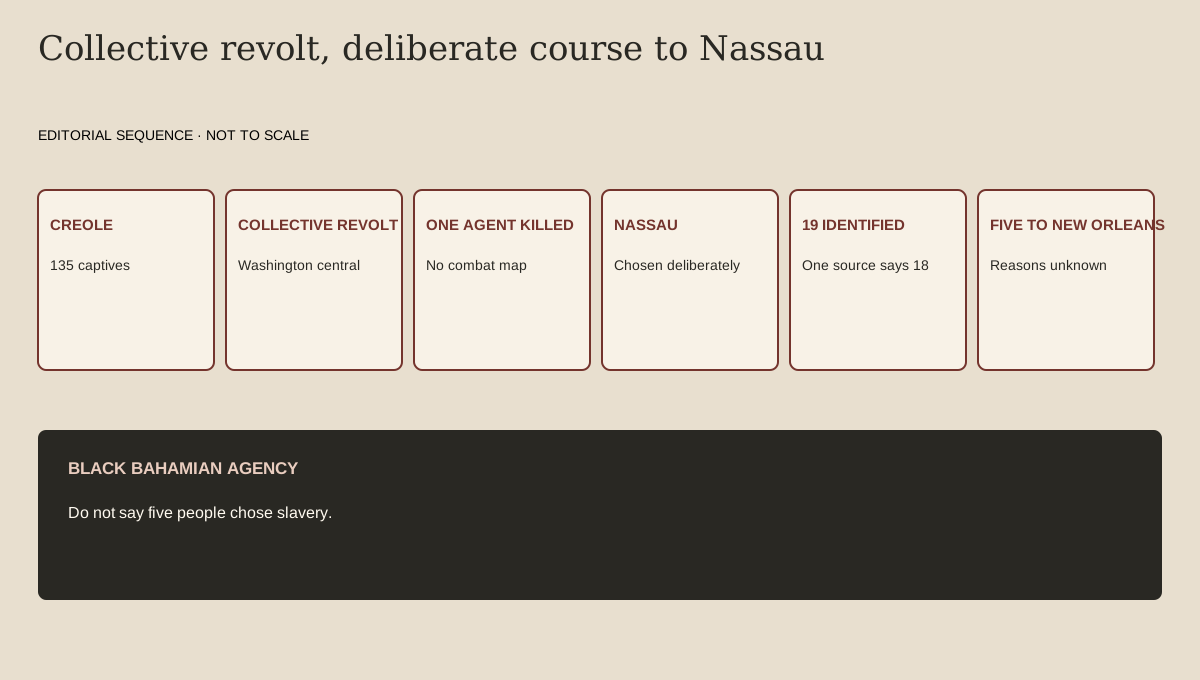
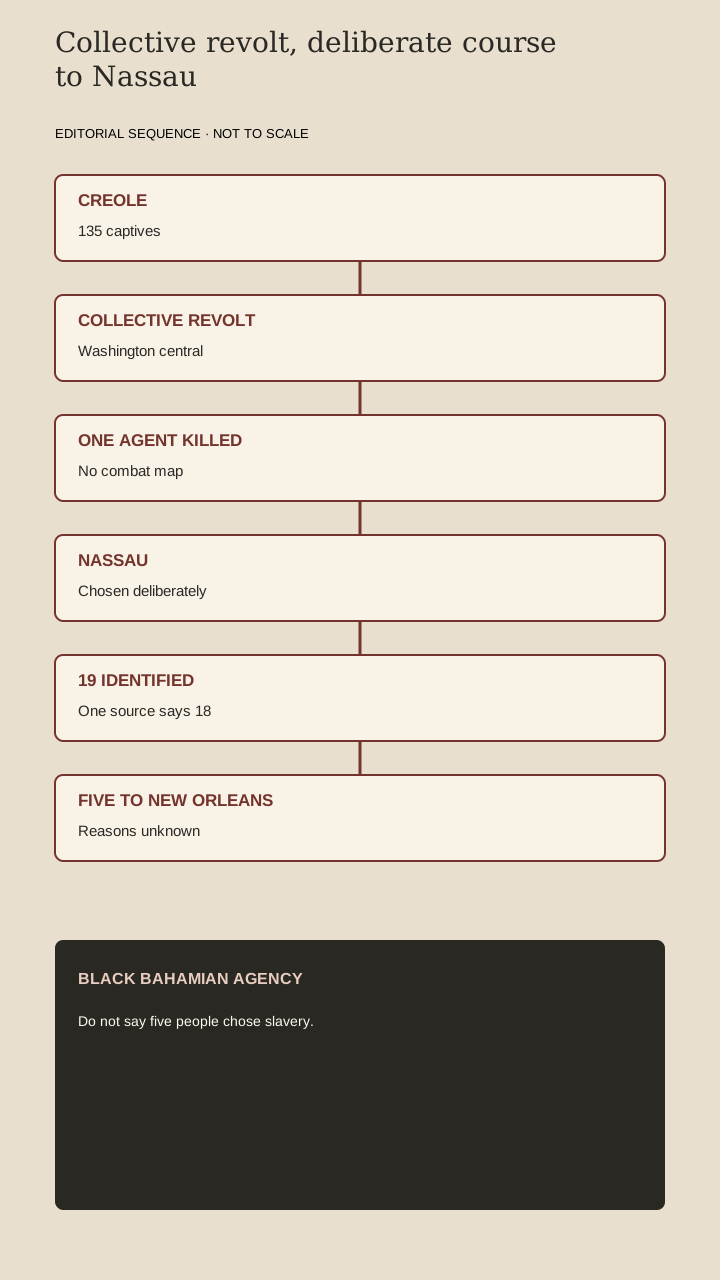
Simplified editorial reconstruction; not to scale. See adjacent text for evidence qualifications and unresolved details.
Material evidence
Tools of Escape
The objects used in an escape reveal how a plan worked under constraint.
- 01Essential
Collective planning
A trusted group of captives coordinated resistance and acted together rather than relying on one individual.
- 02Essential
Geopolitical knowledge
Knowledge that British Bahamian law offered a materially different legal environment made Nassau a strategic destination.
- 03High
Maritime knowledge
Shipboard and coastal knowledge among captives helped them monitor the forced change of course while retaining professional crew for navigation.
- 04Essential
Black Bahamian solidarity
Pilots, mariners, workers, crowds, and local Black political action helped prevent American officials from quietly carrying captives back into slavery.
- 05Essential
British antislavery jurisdiction
The legal abolition of slavery in the British Caribbean created the jurisdictional opening the revolt leaders sought.
Problem → response
Escape was a sequence of problems
Each response solved a practical obstacle while often creating the next one.
- 01→
Obstacle
Domestic slave-trade confinement
The captives were being forcibly transported toward sale in New Orleans aboard a vessel controlled by armed white officers and agents.
Response
A coordinated core seized physical control of the ship.
- 02→
Obstacle
Need for skilled navigation
Controlling the deck did not automatically give the rebels the ability to sail safely to a new international destination.
Response
The rebels retained and compelled surviving crew members to navigate while monitoring the route.
- 03→
Obstacle
Uncertain legal status in Nassau
Arrival in the Bahamas did not automatically resolve allegations of mutiny and murder or American property claims.
Response
The captives and local supporters relied on British antislavery law, public mobilization, and legal process.
- 04→
Obstacle
American attempt to preserve custody
The U.S. consul and ship interests sought to keep control over the captives and considered retaking the vessel.
Response
Black Bahamian mobilization, merchant refusal to supply arms, and British military presence blocked simple removal.
- 05→
Obstacle
Detention of revolt leaders
Nineteen identified participants faced prolonged confinement and potential prosecution even after the ship reached a free jurisdiction.
Response
The prosecution ultimately failed and the surviving detainees were released.
The final accounting
Outcome
Enslaved captives aboard Creole
Controlling voyage count supported by the two National Archives manifests and major scholarship.
Identified mutineers detained in Nassau
Nineteen men are identified in the controlling scholarly/detention reconstruction; one NARA educational summary implies eighteen.
Captives who reached New Orleans aboard Creole
Five enslaved people remained aboard the ship and were present when it arrived in New Orleans on December 2, 1841.
Evidence discipline
What the record supports
Status labels distinguish secure conclusions from uncertainty and rejected claims. Color is never the only signal.
DOCUMENTED
The strongest surviving voyage count is 135 enslaved captives aboard Creole.
The National Archives holds two coastwise manifests with 84 and 51 names, totaling 135, and major scholarship uses the same voyage count.
Sources: SRC-001, SRC-002, SRC-003DISPUTED
Exactly 128 people were freed in Nassau.
The widely repeated 128 figure depends on how immediate disembarkation, later release of detained mutineers, deaths in detention, and the five who remained aboard are counted. The cleaner documentary sequence is 135 aboard, five reaching New Orleans, most others leaving the vessel in Nassau, and detained leaders later released.
Sources: SRC-001, SRC-002, SRC-003, SRC-005WELL-SUPPORTED
Exactly nineteen men formed the revolt leadership group.
Major scholarship and the Nassau detention history use nineteen identified mutineers, although one National Archives educational summary describes Washington and seventeen others.
Sources: SRC-001, SRC-003, SRC-004MYTH
Madison Washington planned and executed the revolt alone.
Washington was a central leader, but the revolt involved Elijah Morris, Doc Ruffin, Ben Blacksmith, and a wider organized group.
Sources: SRC-003, SRC-009WELL-SUPPORTED
Washington had escaped slavery before the Creole voyage.
Scholarly and later literary-history sources place him in Canada after an earlier escape before he returned south and was recaptured.
Sources: SRC-003, SRC-005WELL-SUPPORTED
Washington returned south in search of his wife.
Modern scholarship reconstructs his return through Black abolitionist networks as a search for his wife, followed by recapture.
Sources: SRC-003, SRC-005MYTH
Madison Washington's wife was aboard Creole and reunited with him during the revolt.
Later abolitionist storytelling popularized this scene, but Library of America source criticism describes the wife's presence aboard as almost certainly apocryphal.
Sources: SRC-005MYTH
The rebels chose Nassau by accident.
Scholarship shows that the revolt depended on circulating knowledge of British emancipation and earlier maritime freedom cases in the Bahamas.
Sources: SRC-003MYTH
British officials alone caused the captives' freedom outcome.
British antislavery law was essential, but Black Bahamian pilots, mariners, crowds, and African soldiers materially shaped the harbor confrontation and prevented simple re-enslavement.
Sources: SRC-003MYTH
All 135 captives immediately walked free when the ship arrived in Nassau.
Nineteen identified revolt participants were detained, and five enslaved people remained aboard to New Orleans.
Sources: SRC-001, SRC-002, SRC-003UNKNOWN
The reasons five enslaved people remained aboard are known.
The records establish that five remained, but scholarship can only suggest possible family, dependency, or vulnerability explanations.
Sources: SRC-001, SRC-003MYTH
Frederick Douglass's The Heroic Slave is a factual biography of Washington.
Douglass's 1853 work is a historical novella that uses the Creole revolt but invents characters, dialogue, and scenes.
Sources: SRC-011Selected chronology
Selected chronology
Washington reaches Canada
Madison Washington escapes slavery in Virginia and reaches Canada.
Washington returns south
He travels back toward Virginia searching for his wife despite warnings from Black abolitionists.
Washington is recaptured
He is captured in Virginia and sold into the interstate slave trade.
Creole leaves Richmond
The brig begins its New Orleans-bound coastwise voyage and accumulates the documented human cargo reflected in the surviving manifests.
Revolt aboard Creole
Washington and other captives seize the ship after a violent struggle.
Creole reaches Nassau
The vessel enters British Bahamian jurisdiction and the captives' legal and political status becomes the center of a major harbor confrontation.
Creole reaches New Orleans with five captives
National Archives manifests record only five enslaved people remaining aboard when the ship reaches its original destination.
Joshua Giddings censured
The U.S. House censures Giddings for introducing antislavery resolutions concerning the Creole case.
Detained mutineers released
The British prosecution cannot proceed and the surviving men held in Nassau are released.
Webster–Ashburton correspondence
The Creole dispute becomes part of formal Anglo-American diplomatic correspondence over slavery, jurisdiction, and property claims.
Douglass publishes The Heroic Slave
Frederick Douglass transforms Madison Washington into the central figure of a historical novella that mixes documented events with fiction.