
On the evening of 16 July 1985, Oleg Gordievsky stood near a Moscow bread shop carrying a plastic bag from Safeway. In London or Copenhagen, the red supermarket logo would have meant almost nothing. In Moscow, it was the first half of an emergency signal. Gordievsky was a colonel in the KGB.
He was also one of Britain's most valuable secret intelligence sources inside the Soviet system. The KGB had begun closing in on him. If the British recognized the bag, Operation Pimlico would begin. An MI6 officer passed carrying a Harrods bag and eating a Mars bar.
The message had been received. Three days later, Gordievsky left Moscow. The British did not pick him up there. He would first have to travel north through the Soviet Union by himself.
A KGB Officer Working for Britain
Gordievsky had not become a British source overnight. He had entered the Soviet intelligence system and served abroad as a KGB officer. Over time, his view of the Soviet regime changed. The crushing of the Prague Spring in 1968 was especially important in his later account of his political disillusionment.
While stationed in Copenhagen, Gordievsky began cooperating with British intelligence in 1974. For the next eleven years, he occupied two identities. To the KGB, he was a rising Soviet intelligence officer. To MI6, he was a source with access to the thinking, personnel, methods, and priorities of the Soviet intelligence establishment.
By the early 1980s he was serving in London. In 1985 he had reached colonel rank and was operating at the top of the London residency while awaiting formal confirmation from Moscow as rezident. That promotion increased his value. It also increased the consequences if he was exposed.
The Plan That Was Supposed Never to Be Used
MI6 understood the basic problem long before 1985. A Soviet intelligence officer working for Britain could defect relatively easily if he happened to be in a western or neutral country when exposed. The more dangerous scenario was obvious: What if the KGB discovered Gordievsky while he was inside the Soviet Union?
Operation Pimlico was created for that possibility. Later British reporting identifies MI6 officer Valerie Pettit as the principal architect of the long-term escape system. The plan was maintained for years. Signal locations were watched.
British officers assigned to Moscow were briefed. The procedure was rehearsed. Gordievsky later gave another important name. Before his dangerous return to Moscow in 1985, he said he carried a compact backup version of the plan prepared by John Scarlett, then one of his MI6 handlers and later chief of the service.
The two accounts describe different layers of the same preparation. Pimlico was not a plan invented in a single afternoon. It was a contingency architecture that had been refined over time.

Aldrich Ames and the Closing Net
The threat came partly from a spy inside the American intelligence system. CIA officer Aldrich Ames began giving secrets to the Soviet Union in 1985. Later accounts consistently connect his betrayal with the information that led the KGB toward Gordievsky. The exact wording should remain careful.
Some histories say Ames exposed Gordievsky directly. Gordievsky later described the information as a clue pointing the KGB toward a high-level British source within its London residency, after which Soviet counterintelligence narrowed the field. Either way, Gordievsky's position became dangerous. He was recalled to Moscow.
The official reason concerned his senior London posting. Gordievsky suspected another possibility: the KGB wanted him where it could control him. He returned.
The Interrogation
His suspicion was justified. The KGB took Gordievsky to a safe-house setting outside Moscow. He was given alcohol and, according to his later account and subsequent reporting, drugged during interrogation. The questioning focused on betrayal.
He denied working for Britain. Whatever the interrogators believed, they did not immediately place him in a prison cell. Instead, Gordievsky was kept in the Soviet Union and watched. He understood the implication.
The KGB might not yet have the evidence for the arrest it wanted. That could change. For the first time, the emergency escape plan was no longer theoretical.
The Safeway Bag
Pimlico's activation method had been designed years earlier. On Tuesday evenings, British officers could monitor a specified Moscow location as part of an established routine. If Gordievsky needed extraction, he was to appear carrying a distinctive Safeway bag. On July 16, he did.
Later accounts describe a grey cap as part of the signal as well. The British response had to tell Gordievsky that he had been seen without requiring a conversation. An MI6 officer approached carrying a green Harrods bag and eating a chocolate bar. For the actual July 1985 activation, the chocolate was remembered as a Mars bar.
Gordievsky saw the acknowledgement. Pimlico was active. The remarkable part was what happened next. Nothing immediate happened.
There was no embassy car waiting around the corner. No British team rushed him out of Moscow. The plan required Gordievsky to make most of the journey to the Finnish frontier before MI6 could physically take control of the escape.
July 19: Leave Moscow
On Friday afternoon, July 19, Gordievsky left his apartment. He had to reach Moscow's railway system without being stopped. His own later account describes efforts to determine whether he was being followed and to separate himself from KGB surveillance, but the exact maneuvers are less important than the result.
The historically important result is simpler. Gordievsky reached Leningrad Station. He boarded a northbound train. For the first time since activating Pimlico, the physical distance between him and Moscow began to grow.
His wife and daughters were still behind him.
The Family He Could Not Take
Gordievsky had not told his family the full truth about his relationship with MI6. Operation Pimlico was designed to extract him. Not his household. His wife, Leila, and their two daughters remained in the Soviet Union.
That fact shaped every mile of the escape. Defection would protect Gordievsky from imminent KGB arrest if it succeeded. It could also make his family vulnerable to the anger and pressure of the state he had betrayed. The later public story often emphasizes the ingenious signals, the car boot, and the border guards.
For Gordievsky, the cost was already clear before he reached the train. He was leaving his family without knowing when—or whether—he would see them again.
Leningrad
The overnight train carried Gordievsky to Leningrad, today's St. Petersburg.
He was not yet near enough to the frontier for British officers to retrieve him. The next stage used ordinary Soviet transport. From the Leningrad area, he boarded a suburban electric train to Zelenogorsk. Then he transferred again.
A bus would carry him toward Vyborg, the city controlling the route toward Finland. The transport sequence mattered because Pimlico was not built around a British car penetrating deep into Moscow to collect him. It was built around convergence. Gordievsky had to move north.
The British team had to move north. They had to meet at the right place before the KGB stopped either side of the operation.
A Rendezvous Described, Not Addressed
Gordievsky did not simply ask the bus driver for the name of his pickup point. His later interview says he was working from a physical description of the rendezvous area. He watched for a large bend and the landscape described in the plan. At some point, he believed the bus had gone too far.
He pretended to be sick so that he could get off. Then he walked back along the road. Eventually he found the wooded meeting place. The escape was now reduced to a question that had haunted the entire journey:
Would the British cars arrive?
The Other Half of Pimlico
While Gordievsky travelled independently, MI6 personnel from the British Embassy had begun their own journey. Later public accounts identify the convoy leaders as Raymond Asquith, the MI6 station chief in Moscow, and deputy Andrew Gibbs. Their wives travelled with them. A small child was also in the party.
The presence of families helped make the drive resemble an ordinary diplomatic trip into Finland rather than a clandestine extraction. That did not mean the British officers were invisible to Soviet surveillance. Embassy personnel were themselves watched. The plan had to work inside that reality.
Two diplomatic cars headed toward the same stretch of road where Gordievsky was waiting.
The Cars Arrive
Eventually the vehicles appeared. Gordievsky recognized them. The British team brought him into the convoy and concealed him in the luggage compartment of one of the diplomatic cars. From this point forward, his escape depended on the people driving.
The route still lay inside the Soviet Union. The border remained ahead. Pimlico's most dangerous assumption was about to be tested.
Diplomatic Plates Were an Advantage, Not Magic
Popular accounts sometimes make the border-crossing idea sound almost automatic. Put Gordievsky into a diplomatic car. Show diplomatic plates. Drive through.
The participants did not regard it that way. Diplomatic vehicles were less likely to be subjected to the kind of intrusive search that would expose a person hidden inside. That reduced the risk. It did not eliminate it.
Gordievsky later recalled that British personnel knew Soviet authorities had searched diplomatic vehicles before. Border guards could stop the cars. Dogs could approach them. A suspicious official could cause the operation to collapse within meters of Finland.
The plan therefore exploited diplomatic status. It did not treat it as an invulnerability shield.
The Border Dogs
The most famous border detail entered later retellings through participant testimony. Dogs approached the British vehicle. A child's soiled nappy was used or discarded near the relevant area, creating a strong smell that later accounts say distracted the animals. The story is repeated in several serious modern histories.
It should not become the explanation for the entire escape. The nappy did not arrange the signal. It did not get Gordievsky out of Moscow. It did not bring the British cars to the rendezvous.
It did not create diplomatic cover. At most, it helped during one dangerous moment inside a much larger operation. It is a well-supported episode, not the gimmick that “saved the spy.”
Across the Soviet Border
The vehicles moved forward. The frontier was crossed. Gordievsky was inside Finland. He still could not simply open the boot at the first possible moment and announce himself.
The extraction remained controlled. Then, in Gordievsky's later recollection, music began to play. It was Sibelius's Finlandia. The choice told him what the windows could not.
He was out.
Finland Was Not the Final Destination
Finland occupied a delicate position during the Cold War. It was democratic and independent, but its long border and political relationship with the Soviet Union made intelligence confrontations especially sensitive. The British therefore continued moving Gordievsky. Finnish public broadcaster Yle records the onward chain.
He was transferred through Finland toward the Norwegian border. From northern Norway, he was moved onward to Oslo. Then he travelled to Britain. Operation Pimlico had carried a KGB colonel from a Moscow apartment to British protection without a public arrest, prison break, or exchange.
The extraction route had worked.
What the KGB Had Lost
Gordievsky's value did not end when he stopped providing live access from within the KGB. Britain could now debrief him openly and at length. He possessed knowledge of:
- KGB personnel;
- Soviet intelligence organization;
- operations in Britain;
- political influence efforts;
- Soviet assessments of western governments;
- and the leadership psychology behind Cold War crises.
His defection soon had visible diplomatic consequences. Britain expelled 25 Soviet intelligence officers. After Soviet retaliation, another six Soviet officials identified as intelligence personnel were expelled. The Soviet Union responded against British personnel.
The exchange became one of the largest intelligence-related diplomatic expulsions of the period. Gordievsky's information was central to Britain's ability to identify Soviet intelligence officers, although the public record should not be simplified into the claim that every expulsion came from one list he personally produced.
The Death Sentence
For Moscow, Gordievsky was now a traitor who had escaped. Soviet authorities sentenced him to death in absentia in 1985. The sentence was not merely a later biographical flourish. More than a decade afterward, the British Parliament was still discussing it.
In March 1996, a House of Lords question explicitly referred to the Soviet death sentence and asked what representations the British government had made about it. The answer was that Gordievsky had not requested such intervention. The man who had crossed the frontier concealed in a diplomatic car could not safely return.
Six Years Without His Family
The Soviet authorities did not allow Leila and the daughters to join Gordievsky immediately. Britain tried to negotiate. The family remained behind. Only in 1991, as the Soviet system was collapsing, were they allowed to reunite with him in Britain.
Six years separated the escape from the family reunion. That timeline changes the emotional shape of Operation Pimlico. At the Finnish border, the operation was a complete intelligence success. For Gordievsky as a husband and father, it remained incomplete.
Who Designed Operation Pimlico?
The public record produces two names.
Valerie Pettit
Later British reporting identifies Pettit as the MI6 officer who designed the long-running Pimlico framework and repeatedly updated it.
John Scarlett
Gordievsky himself said Scarlett prepared the concise backup plan he carried on his return to Moscow in 1985. The cleanest interpretation is not to choose one. Pimlico evolved. Pettit appears to have been the principal architect of the standing extraction system.
Scarlett prepared or refined the operational version Gordievsky had available during the crisis. The sources genuinely differ on this point.
Did Aldrich Ames Name Him?
The same caution applies to the betrayal. Aldrich Ames undeniably caused catastrophic damage by supplying Soviet intelligence with CIA secrets. Modern biographies and obituaries frequently say his disclosures exposed Gordievsky. The narrower question—whether Ames directly gave the KGB Gordievsky's name at the decisive first moment—is less clear.
Gordievsky later described Ames's information as identifying the existence and location of a highly placed source, allowing Soviet counterintelligence to narrow its search. The responsible formulation is:
Ames's betrayal materially helped the KGB focus on Gordievsky. Public accounts differ on whether he directly named him at the outset.
Evidence, Myth and What the Sources Support
Was Operation Pimlico invented after the KGB interrogation?
MYTH
No. MI6 had maintained an emergency extraction plan for years before it was activated in July 1985.
Did John Scarlett single-handedly invent Operation Pimlico?
MYTH
No. Gordievsky credited Scarlett with a compact backup plan used in 1985, while later reporting identifies Valerie Pettit as the principal architect of the longer-running Pimlico system.
Did Gordievsky leave Moscow in a British embassy car?
MYTH
No. He travelled independently by train and other Soviet public transport toward the Finnish frontier before meeting the British extraction team.
Did the British acknowledge the emergency signal with a Mars bar?
DOCUMENTED
Later participant-based accounts consistently identify a Harrods bag and Mars bar as the acknowledgement used when Pimlico was activated in July 1985. Descriptions of the standing plan sometimes allow either Mars or KitKat.
Did Gordievsky cross the Soviet-Finnish border hidden in a diplomatic car?
DOCUMENTED
Yes. His own later testimony and multiple independent accounts agree on this essential feature of the extraction.
Did diplomatic immunity guarantee that Soviet officials could not search the car?
MYTH
No. Diplomatic status reduced the expected search risk, but the participants understood that vehicles could still be stopped or challenged.
Did a dirty nappy single-handedly save Gordievsky?
MYTH
Later sources support the nappy-and-dog episode, but it was one element in a much larger extraction and should not be treated as the sole reason for success.
Did Aldrich Ames directly hand Gordievsky's name to the KGB?
DISPUTED
Ames clearly supplied information that materially contributed to the investigation. Public sources differ on whether he initially named Gordievsky outright or provided clues that allowed Soviet counterintelligence to identify him.
Did Gordievsky's wife and daughters escape with him?
MYTH
No. They remained in the Soviet Union and were not reunited with him in Britain until 1991.
Was Gordievsky already formally arrested when he escaped?
MYTH
No. He had been interrogated, was under grave suspicion, and expected eventual arrest, but he retained enough physical freedom to activate and execute the escape plan.
Why Operation Pimlico Worked
The KGB suspected Gordievsky. It did not immediately imprison him. MI6 had prepared for that narrow possibility years earlier. Gordievsky needed to tell Britain he was in danger.
The standing signal system worked. The British could not simply collect him in central Moscow. He moved north independently. The rendezvous was distant and hard to locate.
He reached it. The British vehicles had to travel under surveillance without exposing their purpose. They reached him. The frontier could still expose the hidden passenger.
Diplomatic cover reduced the risk. The vehicles crossed. Finland was safer, but politically sensitive. The team moved him onward through Norway.
Each stage solved only the next problem. That is what made Pimlico effective. It was not one brilliant trick. It was a contingency plan built from a chain of imperfect advantages—and activated before the KGB converted suspicion into custody.
Escape reconstruction
How the escape unfolded
An evidence-aware sequence of the principal stages.
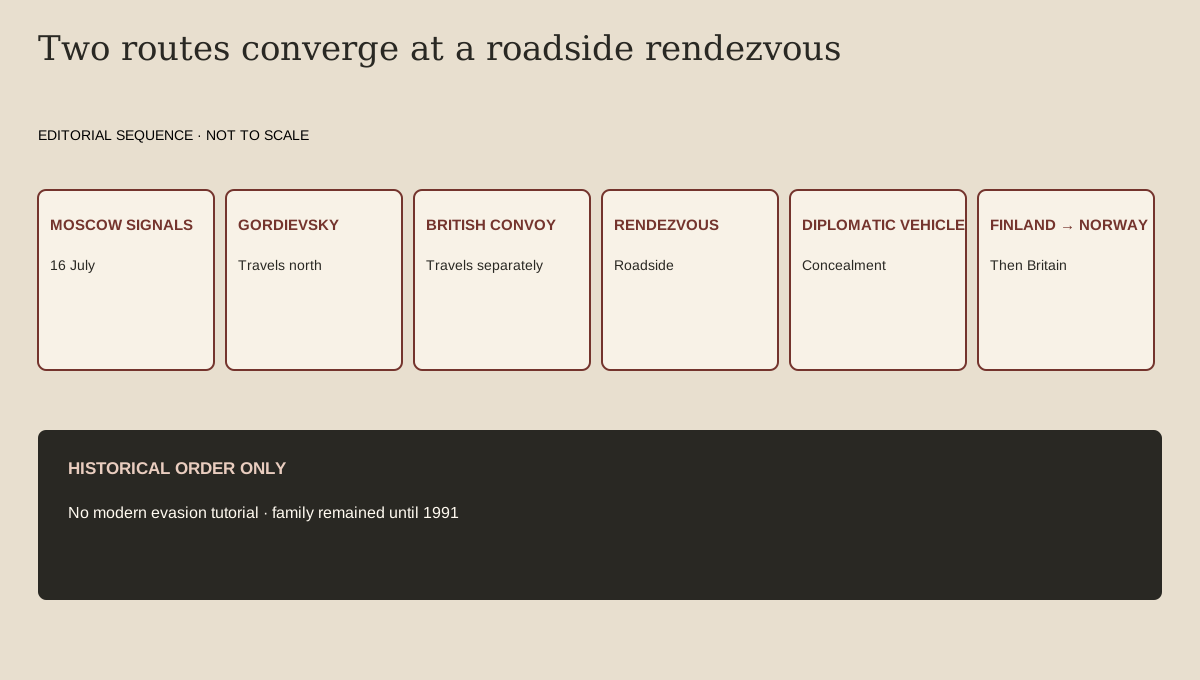
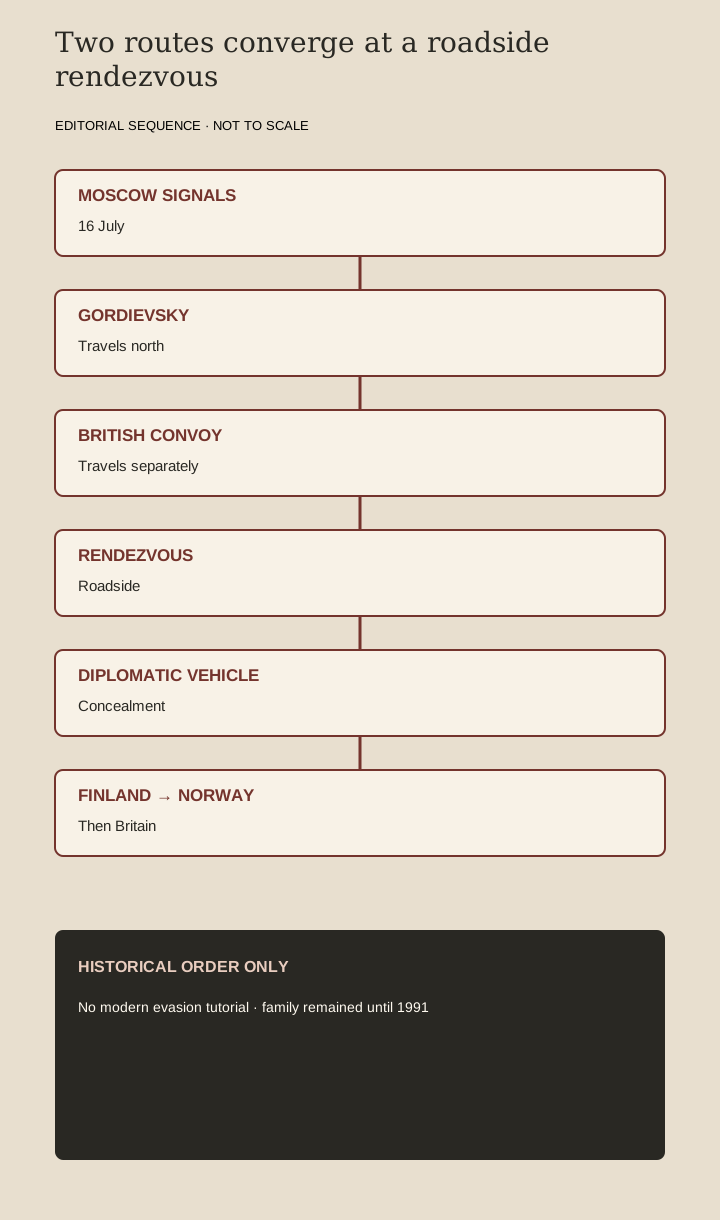
Simplified editorial reconstruction; not to scale. See adjacent text for evidence qualifications and unresolved details.
Material evidence
Tools of Escape
The objects used in an escape reveal how a plan worked under constraint.
- 01Essential
Prearranged signal system
The Safeway-bag activation and British acknowledgement allowed Gordievsky to trigger a long-standing extraction contingency without a direct meeting.
- 02Essential
Railway and public transport
Ordinary Soviet transport carried Gordievsky most of the distance from Moscow toward the Finnish frontier before physical British pickup.
- 03Essential
Remote rendezvous
A prearranged roadside meeting point allowed Gordievsky's independent route and the British diplomatic convoy to converge near the frontier.
- 04Essential
Diplomatic vehicles
British embassy cars provided transport and concealment for the Soviet frontier crossing while reducing, but not eliminating, the likelihood of an intrusive search.
- 05High
Family-trip cover
The British convoy included family members, supporting the appearance of an ordinary diplomatic journey into Finland.
Problem → response
Escape was a sequence of problems
Each response solved a practical obstacle while often creating the next one.
- 01→
Obstacle
KGB suspicion and interrogation
Gordievsky had already been recalled, drugged during interrogation, and kept under suspicion.
Response
He activated a preplanned emergency extraction before suspicion became formal custody.
- 02→
Obstacle
Surveillance in Moscow
Gordievsky's movements were monitored and reaching the railway without detention was essential.
Response
He reached the northbound rail system and began the independent travel phase of Pimlico.
- 03→
Obstacle
Long independent journey
MI6 could not safely collect Gordievsky in central Moscow, so he had to travel toward the frontier before pickup.
Response
He used ordinary trains and road transport through Leningrad and Zelenogorsk toward the Vyborg region.
- 04→
Obstacle
Rendezvous uncertainty
The pickup was described geographically rather than functioning as an ordinary named destination.
Response
Gordievsky left road transport near the described area and located the wooded meeting point.
- 05→
Obstacle
Soviet border inspection
The extraction could still fail if guards discovered Gordievsky inside the vehicle.
Response
MI6 used diplomatic cars and concealment, exploiting a lower expected search risk without assuming inspection was impossible.
- 06→
Obstacle
Family left in the Soviet Union
Pimlico was designed to extract Gordievsky alone, leaving his wife and daughters under Soviet control.
Response
British diplomatic efforts continued after the escape; the family was permitted to reunite with him in 1991.
The final accounting
Outcome
Oleg Gordievsky
Successfully extracted from the Soviet Union and brought to Britain.
Evidence discipline
What the record supports
Status labels distinguish secure conclusions from uncertainty and rejected claims. Color is never the only signal.
DOCUMENTED
Operation Pimlico existed before Gordievsky's 1985 interrogation.
Gordievsky and later British accounts describe a standing emergency extraction plan developed and rehearsed years before July 1985.
Sources: SRC-001, SRC-005, SRC-004MYTH
John Scarlett alone invented Operation Pimlico.
Gordievsky credited Scarlett with a concise backup plan used in 1985, while later British reporting identifies Valerie Pettit as the principal architect of the long-running Pimlico framework.
Sources: SRC-001, SRC-005WELL-SUPPORTED
Valerie Pettit was the principal long-term architect of Operation Pimlico.
Later British reporting based on intelligence-community sources publicly identified Pettit's central role after decades in which her identity was concealed.
Sources: SRC-005, SRC-004WELL-SUPPORTED
Aldrich Ames materially contributed to the KGB investigation that focused on Gordievsky.
Modern biographies and obituaries consistently connect Ames's betrayal with the Soviet counterintelligence pressure that endangered Gordievsky.
Sources: SRC-004, SRC-007, SRC-008, SRC-009DISPUTED
Aldrich Ames unquestionably handed the KGB Gordievsky's name at the decisive first moment.
Some later accounts describe direct exposure, while Gordievsky's own recollection describes Ames providing information that pointed toward a highly placed source in the London residency and helped Soviet investigators identify him.
Sources: SRC-001, SRC-002, SRC-004, SRC-008MYTH
Gordievsky left Moscow in a British diplomatic car.
He travelled independently by Soviet rail and road transport and joined the British extraction convoy only near the Finnish frontier.
Sources: SRC-001, SRC-002WELL-SUPPORTED
The Safeway bag and Harrods-bag/Mars-bar exchange activated the 1985 extraction.
Participant testimony and multiple later high-quality accounts consistently describe this signal exchange on July 16, 1985.
Sources: SRC-005, SRC-008, SRC-009DOCUMENTED
Gordievsky crossed the Soviet-Finnish border concealed in a British diplomatic vehicle.
Gordievsky's own interviews, Finnish public broadcasting, and multiple independent accounts agree on the essential border-crossing method.
Sources: SRC-001, SRC-002, SRC-006, SRC-007MYTH
Diplomatic immunity guaranteed that Soviet border authorities could not search the extraction vehicle.
Diplomatic status reduced expected search risk, but participants understood that Soviet officials could still stop, challenge, or potentially inspect the vehicles.
Sources: SRC-001, SRC-010WELL-SUPPORTED
A child's soiled nappy was used during the border episode involving dogs.
The episode appears in multiple later participant-based reconstructions, though it is not necessary to explain the operation's success and does not appear in every version of Gordievsky's own account.
Sources: SRC-008, SRC-004MYTH
A dirty nappy by itself saved Operation Pimlico.
The border anecdote was only one moment in a multi-stage extraction involving preplanning, independent travel, a remote rendezvous, diplomatic cover, vehicle concealment, timing, and chance.
Sources: SRC-008, SRC-004MYTH
Gordievsky's wife and daughters escaped with him in July 1985.
They remained in the Soviet Union and were not allowed to join him in Britain until 1991.
Sources: SRC-006, SRC-007MYTH
Gordievsky was already under formal arrest when he activated Pimlico.
He had been interrogated and remained under grave suspicion and surveillance, but retained enough freedom of movement to activate the plan and leave Moscow.
Sources: SRC-001, SRC-007, SRC-009Selected chronology
Selected chronology
Gordievsky begins cooperating with MI6
While serving the KGB in Copenhagen, Gordievsky begins the long-running secret relationship with British intelligence.
Emergency extraction planning develops
MI6 establishes and rehearses a standing contingency for extracting Gordievsky if he is compromised while inside the Soviet Union.
Gordievsky is recalled to Moscow
The KGB summons him from London while suspicion generated by intelligence leaks is converging on him.
KGB interrogation
Gordievsky is taken to a safe-house setting, drugged during questioning, and pressed about betrayal but is not immediately arrested.
Pimlico is activated
The Safeway-bag emergency signal is recognized and acknowledged by an MI6 officer carrying a Harrods bag and eating a Mars bar.
Gordievsky leaves Moscow
He reaches the railway system and begins travelling north toward Leningrad.
Rendezvous and frontier crossing
After travelling through Leningrad and Zelenogorsk toward the Vyborg region, Gordievsky meets the British convoy and crosses into Finland concealed in a diplomatic vehicle.
Major intelligence expulsions
Britain expels Soviet intelligence officers identified through its security investigations and Gordievsky's debriefing; reciprocal expulsions follow.
Soviet death sentence
Gordievsky is sentenced to death in absentia for treason.
Family reunited
Leila Gordievsky and the couple's daughters are finally permitted to leave the Soviet Union and join Gordievsky in Britain.
Oleg Gordievsky dies
Gordievsky dies in England at age eighty-six, nearly forty years after Operation Pimlico.