
At a Glance
- Escape: Night of 28–29 September 1943
- Place: Babyn Yar, Kyiv, German-occupied Ukraine
- Prison origin: Syrets labor education camp
- Captivity type: Holocaust forced labor under Sonderaktion 1005
- Initial group sent on 18 August: 100 prisoners in contemporary testimony
- Expanded labor detail: Roughly 320–330 by late September
- Breakout group: Commonly given as several dozen, often 25–30
- Survivor-count range: 12–18 in major source traditions
- Preferred current institutional figure: 18 escaped, hid and later testified
- Outcome: A small group survived the breakout and preserved evidence of the Nazi attempt to erase the crimes of Babyn Yar
The prisoners who escaped Babyn Yar in September 1943 were being forced to destroy evidence of one of the Holocaust’s largest mass-shooting sites. They had been taken from the nearby Syrets camp, shackled, and compelled to exhume and burn the remains of people murdered in the ravine. By late September the work was nearing completion. The prisoners understood what that meant: the German authorities who were eliminating the physical evidence also intended to eliminate the witnesses.
During the night of 28–29 September, several dozen prisoners broke from their confinement and fled under fire. Most did not get away. A small number reached hiding places and survived long enough to describe what the Germans had tried to conceal.
The exact number of survivors is one of the hardest parts of the case. Depending on the source, the figure is 12, 14, 15 or 18. Even the size of the forced-labor detail changes according to which stage of the operation a source is counting.
Those differences are not a reason to choose the most dramatic number. They are part of the historical record.
Syrets was the camp; Babyn Yar was the killing site
The names are often merged in retellings, but they describe different places and functions. Babyn Yar, historically rendered Babi Yar in much English-language literature, was a ravine on the outskirts of Kyiv. On 29–30 September 1941, German SS and police forces and their auxiliaries murdered 33,771 Jews there according to the Einsatzgruppen report. Germans continued killing Jews, Roma, Soviet prisoners of war, Ukrainian civilians and others at the site during the occupation.
Syrets was a detention and forced-labor camp established nearby in 1942. The United States Holocaust Memorial Museum classifies it specifically as an Arbeitserziehungslager, or labor education camp. It was not formally part of the SS concentration-camp system, though prisoners endured conditions, abuse, forced labor and killing comparable to those in concentration camps.
Wartime Soviet witnesses routinely called Syrets a concentration camp. Modern writing can preserve that historical terminology when discussing the testimony while still explaining the administrative distinction.
The prisoners who carried out the 1943 evidence-destruction work came from Syrets. Their place of forced labor—and later escape—was Babyn Yar.
Sonderaktion 1005
By summer 1943, the military situation around Kyiv had changed. The Red Army was moving westward, and German authorities knew they might lose the city. Across occupied eastern Europe, the Nazis were conducting Sonderaktion 1005, a secret program intended to destroy evidence of mass murder.
At Babyn Yar, Syrets prisoners were forced to reopen mass graves and burn the remains of victims. USHMM describes the prisoners as working in shackles for long hours while German authorities accelerated the task as the front approached.
The phrase “Sonderkommando 1005” sometimes appears in later writing for the prisoner work force. It can be misleading. Sonderaktion 1005 was the German evidence-destruction program; the prisoners were coerced laborers within it. They were not volunteers and they were not the perpetrators who had designed the operation.
The purpose of the labor made their danger obvious. Once the burial sites had been emptied and the remains destroyed, the prisoners themselves were among the last witnesses to what had happened there.
The first number is 100
The clearest early count comes from testimony later introduced at Nuremberg. Vladimir Davydov, Leonid Ostrovsky, Semen Berland, Yakov Steiuk and Isaak Brodsky described being prisoners at Syrets. Their statement says that on 18 August 1943, 100 men were sent to Babyn Yar, placed in chains and ordered to exhume and burn corpses.
That does not mean the entire evidence-destruction detail always numbered one hundred. More prisoners were added as the operation expanded. Current USHMM material uses the broad formulation approximately 300. Other USHMM-language versions give 321. Ukrainian institutional histories and the Yad Vashem tradition commonly give 327, while recent scholarship places the late-September work force somewhere around 321 to 330.
The apparent contradiction is largely chronological. One hundred describes an initial selection on 18 August. A number around 320–330 describes the expanded labor force closer to the end of September.
Why 327 became the famous number
The figure 327 appears repeatedly in Holocaust timelines, Ukrainian public history and later narratives. It is useful because it gives the scale of the final operation. It should not be treated as though every surviving document independently produced the same figure.
The USHMM’s current English treatment deliberately avoids that precision and says approximately 300. Other institutional versions use 321. A recent Babyn Yar historical synthesis describes the work force as increasing as the Germans tried to finish the destruction more quickly.
For that reason, the most defensible formulation is roughly 320–330 prisoners, with 327 identified as the best-known specific total. The prisoners included Jews and non-Jews. Modern scholarship identifies Jews, Russians, Ukrainians and Armenians among them and notes that women were also present. The escape should therefore not be described as an all-Jewish prisoner revolt even though Jewish prisoners formed a central part of the group and the underlying crime being concealed was overwhelmingly the Holocaust murder of Kyiv’s Jews.
Planning to leave witnesses alive
The prisoners understood that completion of the work would probably be followed by their execution. A former-prisoner statement prepared after the war described the objective directly: even if most were killed, several had to get away and tell others what the Germans had attempted to hide.
Planning developed inside conditions meant to prevent escape. Prisoners were shackled and confined under guard near the ravine.
Survivor accounts describe a collective effort to create a moment when at least part of the group could get free of the confinement area and scatter. Later narratives provide very detailed stories about individual tools, locks and improvised weapons. Those details vary enough that they should not define the reconstruction. The secure historical point is that the prisoners prepared in advance rather than launching an entirely spontaneous rush.
Night of 28–29 September
The evidence-destruction work ended around 28 September 1943. The prisoners recognized that their own killing was imminent.
During the night that followed, prisoners freed themselves and broke out of the area where they were being held. The flight continued into the early hours of 29 September.
Many sources simply call this “the escape of 29 September.” That is accurate at the day level. Describing it as the night of 28–29 September better reconciles the accounts that place preparation and departure before midnight with those that date the main flight to the morning of the 29th.
The date fell almost exactly two years after the beginning of the great massacre of Kyiv’s Jews at Babyn Yar. That coincidence later became symbolically important. The surviving evidence used here does not require the additional claim that the prisoners deliberately selected the anniversary for commemorative reasons.
Twenty-five, thirty—or more?
The next count is less stable than the date. One influential Yad Vashem-derived chronology says 25 prisoners broke out, of whom 15 escaped. A modern German scholarly account instead describes about 30 fleeing. A later memorandum by former Syrets prisoners recalled about 20 getting away from the roughly 300 people condemned at Babyn Yar.
The difference probably reflects more than faulty arithmetic. Sources can be counting different thresholds: prisoners who had freed themselves, prisoners who got through the first confinement barrier, prisoners who cleared immediate gunfire, or prisoners who ultimately found a hiding place.
There is no reliable basis for saying that all 327 prisoners formed one organized column and attempted the same escape at the same instant. “Several dozen joined the active breakout” is the most stable formulation.
The survivor count is a range
Even after the prisoners were outside the immediate confinement area, survival was not guaranteed. German guards opened fire and a search followed. Most of the forced-labor prisoners were killed either during the breakout or once the Germans regained control of the site.
The best modern scholarly summary explicitly says that sources place the number of successful survivors between 12 and 18. That range can be traced to different survivor traditions. The Black Book gives 12. David Budnik later gave 14. Yakov Kaper wrote that 18 survived, while also acknowledging that the fugitives dispersed and that he could not know every person’s fate immediately.
An older Yad Vashem tradition settled on 15. Current USHMM multilingual material gives 18 prisoners who escaped, hid and later testified to Soviet authorities in November 1943.
Eighteen is the preferred current institutional figure, but the 12–18 range remains visible wherever the count matters.
Hiding was part of the escape
Getting beyond Babyn Yar was only the first stage of survival.
The fugitives scattered around Kyiv and needed places where German searches would not find them. Modern scholarship based on archival accounts names several local residents who hid escapees.
Natalia Petrenko sheltered Vladimir Davydov and Leonid Kharash. Feofan Vlasiuk hid David Budnik, Efim Vilkis, Vladimir Kotlyar, Leonid Ostrovsky, Yakov Kaper and Semen Berland in a pipe at a brick works. Another resident, N. Kozlovskaia, hid Doliner.
These civilians belong in the escape story because the Red Army did not retake Kyiv until 6 November 1943, more than a month after the breakout.
The prisoners who survived did so not only because they crossed the killing site under fire, but because people outside the prisoner group were willing to conceal them afterward.
Vladimir Davydov and the immediate evidence
Vladimir Davydov became one of the most important surviving witnesses.
Soviet authorities interrogated him in Kyiv on 9 November 1943, only days after the Red Army retook the city. His testimony described Syrets, the selection of prisoners on 18 August and the work at Babyn Yar.
Other escapees also gave statements. The post-liberation record includes names such as Isaak Brodsky, Semen Berland, Yakov Steiuk, David Budnik, Efim Vilkis, Yakov Kaper, Leonid Ostrovsky and Zakhar Trubakov.
Names and transliterations differ considerably among Russian, Ukrainian, German, Hebrew and English sources. An apparently complete survivor roster would overstate certainty unless every identity can be reconciled across those records.
What matters most is that multiple witnesses existed.
From escape testimony to Nuremberg
The breakout directly frustrated one purpose of Sonderaktion 1005.
The German authorities had tried to destroy graves, bodies and witnesses. The survivors carried information out of the killing site and into the post-liberation investigation.
Soviet prosecutors later presented testimony from former Syrets prisoners at the International Military Tribunal in Nuremberg. The trial record names Ostrovsky, Berland, Davydov, Steiuk and Brodsky as men who had escaped the shootings at Babyn Yar on 29 September 1943.
Their testimony described how prisoners were taken from Syrets, shackled and forced to destroy the remains of murder victims.
The prisoners therefore became witnesses to two crimes at once: the mass murder at Babyn Yar and the subsequent attempt to erase it.
A breakout, not a conventional prison escape
The physical event resembles a prison breakout, but its historical setting was different.
These prisoners were not trying to evade an ordinary sentence. They were coerced witnesses inside a Nazi operation designed to conceal mass murder and then eliminate the people performing the concealment work.
Nor was the site itself a conventional prison. Syrets was the detention camp. Babyn Yar was the killing site where the special forced-labor detail had been confined near the graves they were ordered to destroy.
That distinction changes the meaning of success.
The important endpoint is not simply that a small number crossed a barrier. It is that they remained alive through the manhunt, reached liberation and spoke.
What the numbers actually mean
The escape is easiest to understand when each number is attached to a stage.
100 were documented as being sent from Syrets on 18 August. Roughly 320–330 were in the expanded evidence-destruction work force by late September; 327 is the most familiar specific total.
About 25–30 is the common range for the prisoners described as breaking out in the first successful wave, although one former-prisoner memorandum used roughly 20.
12–18 is the documented range for survivors across major postwar and modern source traditions. 18 is the preferred current institutional number for men who escaped, hid and survived to give evidence after Kyiv was retaken.
Those figures are not mutually exclusive. They answer different historical questions.
The clearest result is also the most important: almost the entire forced-labor detail was murdered, but enough prisoners survived to ensure that the Nazi attempt to destroy the evidence of Babyn Yar did not destroy the witnesses with it.
Evidence discipline
What the record supports
Status labels distinguish secure conclusions from uncertainty and rejected claims. Color is never the only signal.
DISPUTED
Exactly 327 prisoners were present throughout the entire Babyn Yar evidence-destruction operation.
Contemporary testimony begins with 100 prisoners on 18 August. Later totals vary from approximately 300 or 321 to 327 and about 330 as the detail expanded.
Sources: SRC-001, SRC-003, SRC-007, SRC-009MYTH
All approximately 327 prisoners escaped together on 29 September.
The forced-labor detail was much larger than the several-dozen group usually described as entering the active breakout. Most prisoners were killed.
Sources: SRC-005, SRC-007, SRC-008, SRC-010DISPUTED
Exactly 18 survivors is an uncontested count.
Eighteen is the preferred current institutional figure, but scholarly source criticism records survivor counts from 12 to 18 depending on memoir, roster and endpoint.
Sources: SRC-002, SRC-007, SRC-011MYTH
Syrets was formally one of the SS concentration camps.
USHMM classifies Syrets as an Arbeitserziehungslager administered by the Security Police and SD, though its conditions resembled concentration camps and contemporary Soviet sources often used that terminology.
Sources: SRC-001MYTH
The prisoners were members of a German Sonderkommando who voluntarily helped destroy evidence.
They were prisoners coerced into forced labor under Sonderaktion 1005. The German authorities organized the cover-up and intended to eliminate the laborers as witnesses.
Sources: SRC-001, SRC-003, SRC-007MYTH
The evidence-destruction labor detail was entirely Jewish.
Jews were central to the group, but scholarly sources identify Jewish and non-Jewish prisoners, including Russians, Ukrainians and Armenians.
Sources: SRC-001, SRC-007Documentary reconstruction
Reconciled counts and evidence layers
A case-local editorial visual separates the documented sequence from uncertainty without implying exact modern geography or operational detail.
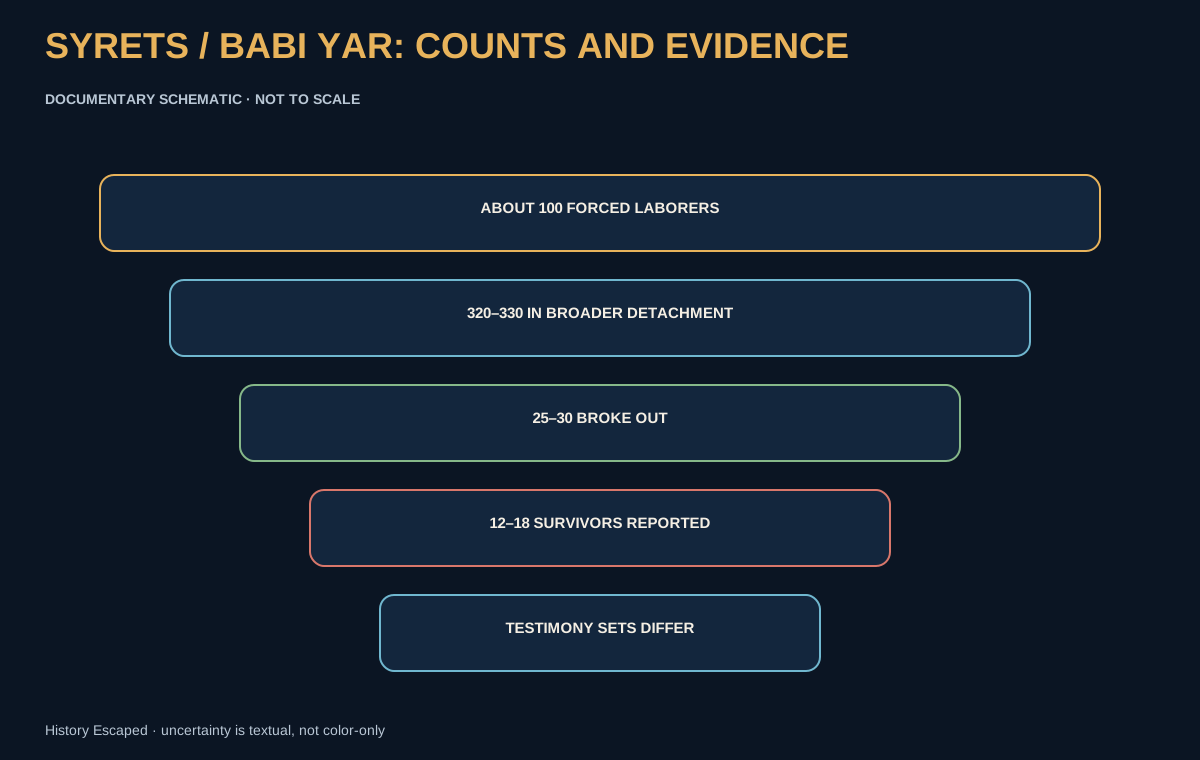
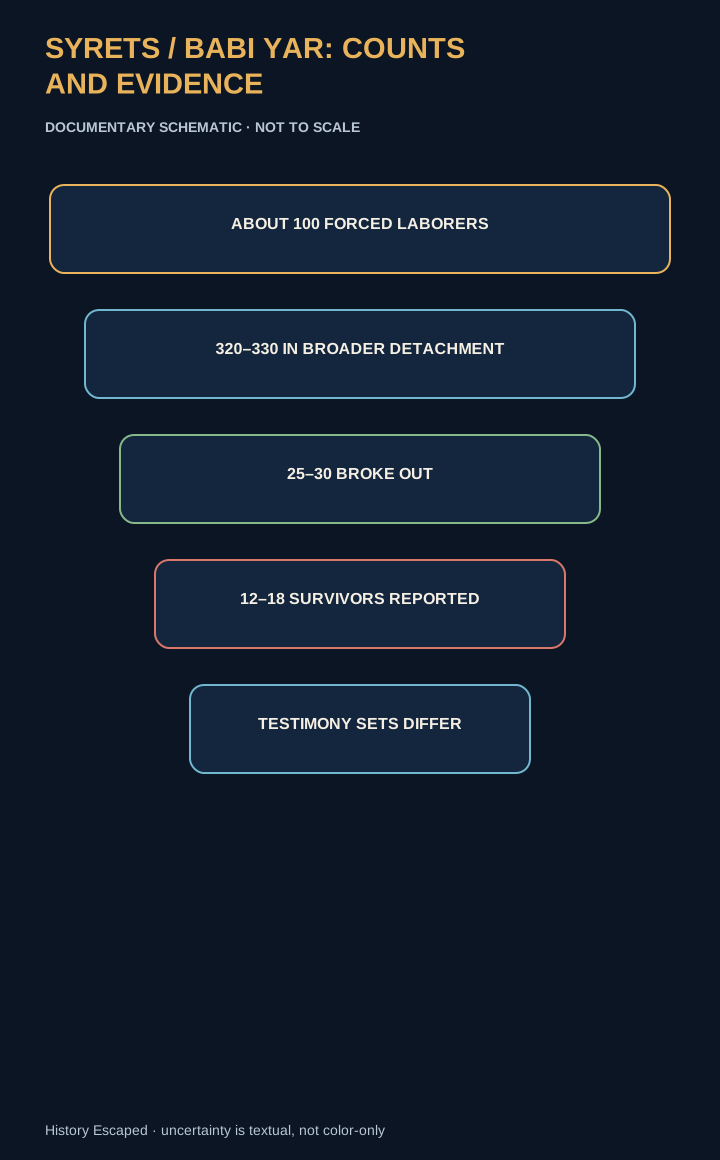
Simplified editorial reconstruction based on the cited historical record; not to scale. Uncertainty is stated directly in the visual and adjacent text.